What Are You Afraid Of?
A dog can stop barking because the thing that frightened her has become less frightening, but she can also stop barking while remaining afraid... Those outcomes can look remarkably similar when the principal question being asked is whether the dog reacted.

The Most Terrible Time of the Year
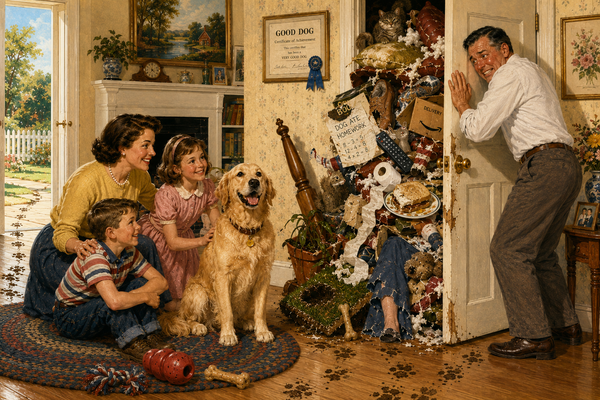
October is an odd month for fear. For most of the year, fear is something we try to avoid. We install locks and alarms, turn on lights when we hear something outside, and cross the street when something ahead of us doesn't look quite right. Then October arrives and we begin manufacturing the stuff. We hang corpses from trees, put gravestones on the lawn, fill the porch with enormous spiders and invite strangers to approach after dark. By Halloween night, the same front door we spend the rest of the year securing against unexpected visitors may be opened fifty times to people wearing masks.
Some of us take the arrangement considerably further. We pay to walk through buildings specifically designed to frighten us, which, when you think about the transaction, is peculiar. A haunted house promises that once we enter, strangers will hide from us in the dark and attempt to make us believe, however briefly, that something terrible is happening. We hand them money for this. The better they are at making us scream, the more likely we are to recommend them to our friends.
I've always liked the strange double consciousness involved in being scared for fun. You can know perfectly well that the man chasing you with a chainsaw is an employee of a seasonal entertainment business and still discover that your body has opinions of its own. The rational case for remaining calm is excellent. Murdering customers would be disastrous for repeat business. The chainsaw probably doesn't have a chain. The blood is fake. Somewhere nearby there are emergency exits, workplace safety rules and a bored twenty-year-old waiting for his turn to jump out of a coffin. Yet when the engine starts behind you, you run.
Scientists have actually gone into haunted attractions to study this peculiar appetite for recreational fear. The results make intuitive sense. In one study, there appeared to be a sweet spot: too little fear and the experience wasn't particularly exciting; too much and it stopped being fun. Somewhere in between, people could scream, recover, laugh and willingly continue into the next room. Other haunted-house research has found that unexpected scares produce more frequent and more intense physiological responses than predictable ones, even when everyone involved knows exactly why they are there. Knowing that we're safe doesn't necessarily prevent the machinery that responds to possible danger from doing its job.
There is, however, a reassuring infrastructure surrounding all this terror that nobody puts on the poster. The haunted house has an exit sign. The actor with the axe has a supervisor. There are fire codes and liability insurance and employees who presumably know what to do if someone stops having fun. We don't know what's around the next corner, because knowing would ruin the experience, but we know why there is a next corner. Even our uncertainty exists inside something we understand.
Imagine taking that away. Nobody tells you it's a haunted house. You don't know where you are, why the lights have gone out, who these strangely dressed people are or what they want from you. You don't know whether the noises are harmless, whether the person approaching intends to touch you, or whether the door behind you will open if you try to leave. The fake chainsaw doesn't have to become a real one for the experience to change completely. The explanation has disappeared.
Dogs don't get many of our explanations, which makes Halloween an especially funny collision between two species that already experience the same world quite differently. In fact, much of what we've gone to considerable trouble to make horrifying probably isn't horrifying to a dog for any of the reasons we intended. Walk through a Spirit Halloween and almost everything in the store depends upon knowing what humans think is scary. A rubber severed hand is a symbol of gruesome dismemberment to us; to the right dog it might be a surprisingly good chew toy. The plastic gravestone on the lawn comes loaded with human ideas about death, burial and whatever may happen afterward. A dog may find it primarily interesting as a novel object to sniff and, after careful consideration, pee on. The costume racks contain ghosts, demons and the walking dead to us, while a dog's nose may be discovering that several hundred living people have tried them on.
Some of the store's tricks need less translation. A sudden noise is still sudden. A thing that wasn't moving a moment ago can abruptly move. A familiar human body can become an unfamiliar shape when the face disappears behind a mask or the outline changes beneath a costume. Motion-activated decorations sit perfectly still until an approaching animal comes close enough to make them scream, lunge or light up. We may know that the corpse pitching forward from the porch is a forty-dollar seasonal decoration with three AA batteries in its back. The dog has considerably less reason to be impressed by our knowledge of retail pricing.
If dogs opened their own Spirit Halloween, perhaps we'd understand the problem a little better. The twelve-foot inflatable vacuum cleaner could roar to life as we passed underneath it. A motion-activated delivery driver might emerge from behind a hedge and head directly for the front door carrying an enormous box. Somewhere in the home-haunting department, the deluxe smoke detector could wait until 3:17 in the morning to announce that its battery is dying. We'd wander through the store wondering what any of this had to do with horror. It's a vacuum cleaner. That's a delivery driver. Everybody knows what a smoke detector is for.
Except knowing what something is, what it predicts and whether it deserves our concern is something experience helps teach us. Dogs learn those things too, but their experience isn't ours, and sometimes the important difference is that experience is missing altogether. A dog encountering something unfamiliar isn't necessarily remembering what happened the last time it saw one. Sometimes there was no last time. In my own work with fearful dogs, a history of frightening experiences can certainly matter, but so can the absence of sufficient early experience with the ordinary features of the world the dog will eventually be expected to navigate. There needn't be a hidden traumatic event waiting to explain every fear.
Halloween makes these differences unusually visible because for one evening we deliberately make an already human-designed world stranger. A dog walking through an ordinary neighborhood in the afternoon may find it populated that evening by children with enormous heads, people without recognizable faces, bodies hanging from trees and decorations that suddenly move when approached. Some dogs seem delighted by the commotion. Some are indifferent. Some discover that costumed children are unusually unreliable custodians of food. Others make it unmistakably clear that they would prefer the neighborhood returned to whatever passed for normal yesterday.
Those dogs seem, at first, like the easy ones. We have a familiar picture of what fear looks like: a dog crouches or retreats, the tail disappears beneath the body, the ears pull back, perhaps the animal trembles or tries to hide. Most of us would recognize that picture without knowing very much about canine behavior at all. The more interesting question begins with the dogs who don't give us that picture.
Showing No Fear
The trouble with our familiar picture of fear is not that it is wrong. A tucked tail, lowered posture, retreat, trembling and attempts to hide can all be perfectly useful evidence that a dog is frightened. The trouble begins when a recognizable picture quietly becomes a definition, and everything that doesn't resemble it starts being interpreted as something else.
This is especially easy with dogs because behavior is what we can actually see. Fear is not. We observe a dog becoming still, moving away, barking, lunging, lowering her body, refusing food or scanning the environment, and from those observations we make an inference about what she may be experiencing. Often the inference is very good. Sometimes it isn't. The distinction sounds almost pedantic until the interpretation determines what we do next.
A 2012 study by Molly Wan and colleagues provides a useful demonstration. The researchers showed people short video clips of dogs displaying behavior that an expert panel had previously categorized as associated with happiness, sadness, anger or fear, then asked participants to identify the emotional state being portrayed. Some participants had little experience with dogs, others were dog owners, and others had substantial professional experience.
Happiness was comparatively easy. Across experience levels, people were generally good at recognizing dogs the researchers had categorized as happy. Fear produced a very different picture. Among participants with little dog experience, the modeled probability of identifying the fearful examples as fearful was only around 30%. Dog owners did better, and performance continued to improve with experience. Among professionals with more than ten years of experience, the probability climbed above 70%. Experience clearly mattered, and it mattered a lot. However, even experience didn't turn experts into mind readers, and when you consider the improvement from 30% to 70% it sounds pretty good. When you consider that a 70% success rate is also a 30% failure rate, suddenly it sounds less like a victory lap for professionals and more like an echoing illustration of how much we're missing.
There is an important caution in those numbers. It would be tempting to turn the result into a catchy claim that “even professionals miss fear thirty percent of the time,” but that isn't what the study measured. These were particular video clips categorized beforehand by an expert panel, and the numbers describe modeled probabilities of participants selecting the corresponding emotional category under those experimental conditions. They aren't a diagnostic error rate that can simply be carried into a veterinary clinic, shelter kennel or training session. The real result is both less sensational and, to me, more interesting: people with substantial experience became much better at interpreting the fearful presentations, but expertise did not produce perfect agreement about what was right there on the screen.
Part of the difficulty is that fear doesn't come with a mandatory behavioral script. A frightened animal may retreat, but increasing distance is only one possible response to threat. Another dog may become very still. Another may bark or lunge. Another may move toward the thing that frightens her, particularly when controlling or increasing distance through approach has worked before. Conflicting motivations can appear together, producing an animal who approaches and retreats, investigates and withdraws, seeks information while simultaneously trying to make the source of uncertainty go away.
Context complicates the picture further. A dog who freezes during veterinary handling and a dog who lies motionless on the couch after lunch may superficially share the behavior of not moving, but treating stillness itself as the emotional diagnosis would be absurd. The surrounding conditions, what happened immediately beforehand, what happens next, the rest of the dog's body, the dog's history and the behavioral options available all help determine what that stillness might mean. The observation can be simple. The interpretation rarely is.
This is why body-language education is useful but cannot be reduced to flash cards. Learning that lip licking, yawning, gaze aversion, lowered posture, changes in muscle tension or shifts in weight can occur in uncomfortable dogs gives us more things to notice. It does not turn any of them into a one-signal fear detector. A dog may lick her lips because food is present, yawn because she is tired or turn her head because something interesting happened behind her. The point of learning more signals is not to become certain more quickly. It is to become better at assembling evidence.
That distinction matters because humans are extraordinarily good at turning observations into character judgments. A dog who plants all four feet and refuses to move may be called stubborn. A dog who growls when approached may be called aggressive. A dog who barks and lunges at the end of the leash may be described as dominant, protective or badly behaved. Those labels can become explanations remarkably quickly, even though they may tell us more about the effect of the behavior on the human than about the conditions producing it in the dog.
Fear is particularly vulnerable to disappearing inside those explanations. Once the lunging dog becomes “aggressive,” the growling dog “mean,” or the motionless dog “fine,” the interpretation begins determining what happens next. We may correct the behavior, expose the dog again, move closer, insist on handling or conclude that the dog has adjusted. If the interpretation was wrong, the dog's subsequent behavior may then look like evidence that we need to do more of exactly the thing that was already making the situation difficult.
This is one reason the familiar phrase fight or flight has had such an enormous cultural life. It gives us two beautifully intuitive responses to danger: confront the threat or escape it. Both are real, and both matter. But once a memorable shorthand becomes the mental model through which we recognize fear, animals who do something quieter, stranger or more conflicted can begin slipping through the gaps.
The phrase itself has an origin story, and it is considerably darker than the tidy three-word explanation that survived it.
The Terrified Cat, the Barking Dog and the Doctor Who Wanted Blood
Long before fight or flight became something people said about difficult meetings, roller coasters and dogs barking at the mail carrier, physiologists were trying to understand a more basic problem: how does an animal's body reorganize itself when circumstances suddenly demand action?
Walter Bradford Cannon entered that story through digestion. Working at Harvard around the turn of the twentieth century, he used the relatively new technology of X-rays to watch food moving through the digestive tract of living animals. To make the process visible, animals were fed material containing bismuth salts, which blocked the X-rays and allowed Cannon to observe the contractions moving food through the stomach and intestines.
The experiments produced an observation that would become enormously important to his later work. Digestion was sensitive to emotional disturbance. Cannon described how cats that became frightened, angry or otherwise distressed could show abrupt inhibition of stomach and intestinal movement. The body, in other words, did not continue conducting business as usual while the animal dealt with a threat. Something was coordinating a broader physiological change.
Cannon became increasingly interested in the sympathetic nervous system and the adrenal glands, particularly in the substance we now commonly call adrenaline or epinephrine. He and his collaborators explored how sympathetic activation and adrenal secretion could alter circulation, mobilize energy and prepare an animal for intense muscular activity. Fear and rage became experimental tools for provoking those responses.
This is where the history becomes difficult to describe without allowing the clean language of physiology to sanitize what was actually done.
Cannon's laboratory frightened animals deliberately. Cats were restrained or confronted with barking dogs. Animals were subjected to invasive procedures, surgery and blood sampling while researchers measured the physiological consequences of distress. In some experiments, nerves were cut or organs altered so that Cannon and his colleagues could determine which parts of the response remained and which disappeared. These were sentient animals being intentionally frightened, injured and killed so that human beings could observe what happened inside their bodies.
I don't think the historical distance makes that morally neutral. Some of the work was considered legitimate science by the standards of its time and became enormously influential, but describing the mentality required to design these experiments is difficult for me without reaching for language considerably less polite than early physiology. Read outside the antiseptic vocabulary of the journal article, some of the scenes resemble the work of a serial killer who happened to be taking very careful notes. The fact that useful knowledge emerged from them does not retroactively justify the suffering, and it certainly doesn't require us to admire the methods because they occupy an important place in scientific history.
Halloween, at least, gives us an appropriately grotesque setting in which to look at them. Imagine a frightened cat strapped into experimental apparatus while a dog is brought close enough to bark and threaten. The animal struggles, its pupils dilate, the heart accelerates, digestion stops, blood chemistry changes, and the researchers record the results. Elsewhere, another animal is operated on so that a particular physiological pathway can be interrupted and the experiment repeated. The horror isn't metaphorical. The fear is the experimental condition.
Cannon was trying to understand a genuine biological phenomenon. Under threat, an organism has immediate priorities that differ from those it has while resting after a meal. Sympathetic activation can increase cardiac output, redirect blood flow, mobilize glucose and support the intense muscular activity that may suddenly be necessary. Cannon increasingly described these coordinated changes as preparation for action, particularly the actions of fighting or fleeing.
But historians John Adams and Edmund Ramsden point to a much more disturbing continuity in their book Rat City. Cannon's laboratory work did not remain confined to frightened animals at Harvard. World War I provided another population in which extreme physiological disturbance could be observed: human beings arriving from industrialized battlefields with catastrophic wounds, shock and terror.
Cannon went to Europe during the war and worked with Allied medical services, studying traumatic shock in wounded soldiers. The conditions were almost unimaginably brutal. Artillery and machine guns were producing bodies damaged on a scale that civilian medicine rarely encountered, while the men arriving for treatment had often endured bombardment, injury, blood loss, exhaustion and the terror of modern combat before Cannon or another physician ever saw them. These were not merely severely wounded human beings. Many were severely wounded and terrified human beings whose bodies were responding simultaneously to injury, pain, blood loss and circumstances designed to kill them.
Adams and Ramsden's account makes the continuity with Cannon's earlier research hard to ignore. In the laboratory, fear and injury had been deliberately produced in animals so their physiological consequences could be studied. War now produced those conditions in human beings on a staggering scale. Cannon did not create the war, of course, and his medical work had the immediate purpose of understanding and treating shock in wounded soldiers. But the battlefield also supplied something no ethical laboratory could have manufactured in humans: an enormous natural experiment in catastrophic injury and extreme fear.
That fact sits uneasily beside the later heroic story of scientific discovery. There is something deeply disturbing in the possibility that one of humanity's most grinding, mechanized episodes of carnage also became scientifically useful precisely because it generated so many damaged and terrified bodies. The same questions Cannon had pursued through frightened cats and injured experimental animals could now be followed in soldiers carried from battlefields.
After the war, Cannon continued developing his account of the body's emergency response. In his 1915 book Bodily Changes in Pain, Hunger, Fear and Rage, and in later work, he described the sympathetic-adrenal response as preparing an organism for vigorous action. By 1929, in Bodily Changes in Pain, Hunger, Fear and Rage, he used the formulation that would eventually be compressed into the phrase nearly everyone now knows: animals under threat were prepared for “fighting or flight.”
The phrase survived spectacularly. The source mostly didn't.
More than a century later, people who have never heard of Cannon can explain that an animal confronted by danger will fight or flee. The formulation has migrated far beyond physiology into psychology, medicine, popular culture and dog training, where it often appears as though it were simply an obvious fact humans have always known. Its experimental origin has largely disappeared beneath the familiarity of the words.
What survived scientifically was important. Cannon was right that threat can produce coordinated physiological changes and that defensive behavior may include confrontation or escape. What did not survive nearly as well was the idea that those two outcomes provide anything close to a complete description of what frightened animals do.
Later research across species greatly expanded the defensive repertoire. Animals may freeze, become immobile, hide, avoid, monitor, submit, seek proximity to familiar individuals or shift among defensive strategies depending on distance, context, previous learning and available escape routes. Contemporary models describe defensive behavior as flexible and context-dependent rather than as a binary switch between attacking and running away. Even freezing itself is not merely a failure to choose between the famous two options; it can be an organized defensive response with its own physiological and behavioral characteristics.
That incompleteness matters enormously when the animal in front of us is a dog. Fight is easy to notice. Flight is easy to understand. A dog barking and lunging at the end of a leash makes the problem visible, while a dog desperately trying to leave tells a story humans tend to recognize. The quieter strategies are easier to misread, particularly when they happen to produce behavior we find convenient.
I learned that distinction years before I had language precise enough to describe what I had gotten wrong. The dog who taught it to me weighed well over a hundred pounds, belonged to a breed people tend to notice immediately, and was so frightened that one of the things I initially mistook for progress was his decision to stop trying to get away from me.
Quiet Riot
Early in my career, I worked with a large Irish Wolfhound whose reactivity was impossible to miss. This was not a dog whose discomfort required a particularly sophisticated eye to detect. When the things that concerned her appeared, she responded in ways that made the problem obvious, and with a dog of her size, obvious could be impressive. I began working through what was, and remains, a standard approach to fear-related behavior: desensitization and counterconditioning, carefully exposing her to versions of the things she found difficult at an intensity she could tolerate while working to change the emotional association those things predicted.
The basic idea sounds almost deceptively simple. Desensitization begins with the frightening stimulus at an intensity low enough that it produces little or no observable fear response, then gradually increases that intensity as the animal becomes more comfortable. Counterconditioning pairs the presence of the frightening thing with something the animal already values, often food or play, so that the appearance of one begins to predict the arrival of the other. Done thoughtfully, the two procedures work together. We aren't simply trying to stop a dog from barking at something; we're trying to change what the appearance of that thing means to the dog. I understood that distinction in principle at the time, but I understand it much more deeply now.
As we worked, the behavior I had originally been called to change began to diminish. Exposures that once produced conspicuous reactive behavior produced less of it, I could work closer, and the dog was quieter. From the outside, the direction of travel looked encouraging, and I interpreted what I was seeing in the most obvious way: the treatment was working. What I wasn't yet as good at asking was what had replaced the behavior that was disappearing. A dog can stop barking because the thing that frightened her has become less frightening, but she can also stop barking while remaining afraid. She may become still, inhibit other behavior, or simply remain present while the exposure happens. Those outcomes can look remarkably similar when the principal question being asked is whether the dog reacted.
One evening we were working outside as daylight began to disappear. Dusk is a mundane environmental change to a human being who knows what dusk is, but visually it changes an enormous amount. Detail recedes, contrast changes and familiar shapes become less informative. At sufficient distance, a person who had been recognizable a little earlier can become mostly outline. During this particular session, that person was me.
I can't reconstruct the dog's subjective experience from an event that occurred years ago, and I don't want to retrofit a neat causal story onto it now. What I can say is that the visual conditions changed during an already difficult behavioral exercise, and my interpretation is that the accumulated challenge exceeded what this dog could tolerate. The quiet presentation I had been reading as improvement gave way to an unmistakable defensive response when she bit me, leaving a scar on my hand that I still have today.
The scar is considerably less important than what the bite did to my interpretation of everything that had preceded it. It didn't prove that every quieter exposure had been shutdown, and I can't travel backward and measure the emotional state of the dog I was working with then. What it forced me to confront was the possibility that I had been treating reduced outward response as evidence that the internal problem was resolving. Those are not the same measurement, and confusing them is particularly consequential when the purpose of the treatment is not merely to make a dog's fear less troublesome to the people around her, but to make the frightening thing genuinely less frightening.
That distinction goes to the heart of desensitization and counterconditioning. If I expose a dog to something frightening and the dog eventually stops barking, I have observed a change in behavior. If my goal were simply to produce less barking, that might sound like success. If my goal is to reduce fear, however, the disappearance of barking becomes one piece of a much larger picture. I want to know what is happening throughout the dog's body and behavior, whether normal exploration and voluntary engagement are returning, how readily the dog can disengage and recover, and what happens when the dog is genuinely free to increase distance. Even something as apparently reassuring as taking food needs context. A dog accepting a treat tells me that a dog accepted a treat; it doesn't, by itself, certify comfort.
The same caution applies to the familiar training idea of threshold. The term is useful shorthand, but it can encourage an image of a clean boundary separating a dog who is fine from a dog who is not. Real emotional responding is less tidy. Stimulus intensity changes along multiple dimensions, including distance, duration, movement, sound and context, while the animal's response can change with learning history, accumulated stress and what behavioral options are available in the moment. A dog may still eat, respond to a familiar cue or remain physically in place while showing other evidence of significant discomfort. The useful question is therefore not simply whether we succeeded in preventing the spectacular behavior from appearing, but whether the evidence taken together suggests that the animal's relationship with the situation is actually changing.
The Irish Wolfhound taught me that distinction before I had language precise enough to describe it. At the time, I thought I had watched reactivity decrease until an unusually difficult exposure caused it to return. Looking back with considerably more experience, I have to entertain another possibility: some of what I interpreted as decreasing fear may instead have been fear becoming less visible.
The Trouble with Better
There is another complication hiding inside our relief when difficult behavior disappears. Behavior change and emotional change are not the same measurement, but the vocabulary of learning theory can make that distinction unusually easy to forget because learning theory is concerned first with what behavior does over time.
Take punishment. In ordinary language, the word carries moral and emotional baggage. It suggests correction, unpleasantness, perhaps cruelty. In its strict behavioral sense, however, punishment is defined functionally: a consequence follows a behavior, and the future probability of that behavior decreases under the relevant conditions. Positive punishment means something is added following the behavior and the behavior subsequently decreases. Negative punishment means something is removed and the behavior subsequently decreases. Positive and negative describe addition and subtraction, not good and bad, and the definition tells us what happened to behavior rather than how the animal felt about the event.
That distinction is routinely muddled, including in professional conversations, because aversive, punishment and behavior reduction begin sliding around as though they were synonyms. They aren't. A leash jerk, shock or other unpleasant event may be described colloquially as punishment because it is aversive, but in functional terms we cannot call it punishment simply because we dislike or object to it. We need to know what happened to the future probability of the behavior it followed. The same aversive stimulus can also participate in negative reinforcement if behavior increases because that behavior removes or avoids the stimulus. Conversely, taking away access to something a dog wants can function as punishment without looking remotely like what most people mean when they say a dog was “punished.”
The clinically interesting part for our purposes is what that functional definition leaves out. If a consequence reduces barking, learning theory allows us to say something about the future probability of barking. It does not, by itself, tell us whether the dog became less frightened. A dog can become less likely to growl because growling reliably produces an unpleasant consequence while the person, dog or situation that originally concerned her remains every bit as concerning. We may have changed the signal without changing the problem the signal was telling us about.
That possibility is one reason arguments about aversive training methods become much more interesting when we stop asking only whether they “work.” Aversive methods can certainly change behavior; otherwise there would be very little to argue about. The welfare question is what else changes along with it.
One of the stronger studies of companion dogs looked directly at that question. Ana Catarina Vieira de Castro and colleagues recruited 92 dogs attending seven training schools that differed in their reliance on aversive methods. The dogs were not randomly assigned to training approaches, which is an important limitation, but researchers observed actual training sessions, collected salivary cortisol samples and later tested cognitive bias. Dogs from the schools using the highest proportion of aversive methods displayed more stress-related behavior, spent more time in tense and low behavioral states, and showed larger post-training increases in cortisol than dogs from reward-based schools. They also showed more pessimistic responses in the cognitive-bias task. Dogs from mixed-method schools showed more stress-related behavior during training than dogs from reward-based schools as well.
That does not turn one study into a complete verdict on every training interaction, and the real-world design makes some questions difficult to disentangle. But it gives us very good reason not to assume that compliance and welfare are interchangeable outcomes. A dog doing less of a behavior we dislike may be learning exactly what the contingency teaches while experiencing something quite different from the emotional change we hoped to produce.
There is an almost irresistible temptation to turn this into the familiar argument about whether somebody should shock a dog, jerk a leash or call themselves a “balanced trainer,” but that would make the problem smaller than it is. You don't need an electronic collar to confuse quiet with comfortable. I had managed to do it during an intervention intended to reduce fear using desensitization and counterconditioning. A shelter worker can do it while sitting quietly beside a kennel. An adopter can do it when a newly arrived dog spends three days motionless on a bed and causes no trouble. A veterinarian can do it when a dog stops struggling during restraint. The methods and circumstances may be completely different, but the interpretive error is the same: something we can see has stopped happening, and we allow its absence to tell us more than it actually can.
Humans are especially prone to this because we don't merely observe behavior; we turn it into stories. Few examples are more familiar than the guilty dog. The garbage has been overturned, somebody's dinner has disappeared from the counter, or the dog has done whatever particular thing the household has established dogs are not supposed to do. The owner arrives, and there it is: lowered posture, ears pulled back, gaze turned away, perhaps a slow retreat from the scene. The verdict practically writes itself. He knows what he did.
Alexandra Horowitz tested that interpretation in an experiment that became famous for good reason. Fourteen dogs were placed into conditions in which what they actually did and what their owners believed they had done could be separated. Owners had instructed their dogs not to eat a desirable treat before leaving the room. The dog might obey or disobey, and the owner could subsequently be given accurate or inaccurate information about what had happened. The familiar “guilty look” was not reliably tied to whether the dog had actually committed the supposed offense. It appeared much more strongly in response to owner scolding, including in dogs that had actually obeyed but whose owners had been told otherwise.
That experiment doesn't prove that dogs are incapable of anything resembling guilt, nor was Horowitz claiming that it did. It demonstrates something more useful here: the behavior was real, while the human interpretation of its cause could be wrong. The lowered posture really happened. The gaze aversion really happened. The dog really moved differently in response to what was unfolding between dog and owner. “Guilty” was the story humans placed on top of those observations, and once the story was there, the dog's behavior seemed to confirm it.
Fear is vulnerable to the same narrative machinery, perhaps even more so because some of its possible expressions have meanings in human culture that point us elsewhere. A dog who backs away may look frightened, but a dog who becomes still can look calm. A dog who refuses to move can look stubborn. A dog who growls can look angry. A dog who remains silent while being handled can look cooperative. None of those interpretations is impossible, but the behavior alone hasn't earned them.
This is why I have become increasingly interested in what happens when several people with considerable experience look at the same dog and still tell different stories. It's easy to explain a misunderstanding by saying that an owner didn't know what to look for. It's considerably harder when the observers include experienced behavior professionals, veterinary staff, foster caregivers and people who spend their working lives making decisions about animals.
The Dog Everyone Looked At and No One Saw
While managing a behavior and training program at a large animal shelter in Northern California, I worked with a dog whose case became the subject of considerable discussion among experienced professionals. Difficult cases in that environment were rarely interpreted by one person alone. Behavior staff worked alongside medical teams, foster caregivers, adoption staff and others whose observations followed an animal through different environments. By then I had spent many more years working with dogs than I had when I met the Irish Wolfhound, and now I had the benefit of colleagues bringing different disciplines and perspectives to the same case. If experience makes us better at recognizing fear, this was the sort of setting where experience ought to help.
The dog was a large mastiff-type mix, with physical characteristics that suggested there might also be some pit-bull-type ancestry, although his paperwork simply identified him as mixed breed and recorded his weight. That distinction is worth a brief detour because breed labels are not neutral pieces of information. Visual identification of ancestry in mixed-breed dogs is unreliable, and a speculative pit-bull label can follow a dog into housing restrictions, insurance problems and breed-specific regulations. I don't want to discriminate by breed either, and I don't believe behavioral risk should ever be inferred from breed. Some of my own cases involving significant bite risk have involved much smaller dogs belonging to breeds popularly regarded as friendly, harmless or “safe.” Conversely, many of the most gregarious and social dogs I’ve ever met have belonged to large, physically powerful breeds branded as fearsome. What mattered here was not what breed we imagined this dog might be. It was the individual dog in front of us, the behavior we had actually observed, and the simple physical reality that a large, powerful animal can cause substantial injury if defensive behavior escalates.
At intake, however, escalation was not what made him difficult to interpret. He was profoundly inhibited. Leaving his enclosure frightened him, and much of what we saw initially was a dog who seemed to be trying to reduce his participation in the world rather than confront it. The behavior team began transitional medications, including trazodone and gabapentin, as part of an effort to reduce stress while he adjusted to the shelter environment. Progress came slowly enough that getting him out for ordinary walks was itself an accomplishment.
Eventually he began taking short walks, and outside the enclosure we started seeing behavior that looked strikingly different. Around other dogs, he could become reactive. The animal who had appeared almost stoic when confined could bark and respond defensively when enough of the world became available to him. It would have been possible to describe this as a new behavior problem emerging as the dog settled in. My concern was almost the reverse. I wondered whether we were seeing more behavior because the dog was becoming capable of doing more about fear that had been present all along.
That distinction matters in sheltering because “coming out of his shell” is usually an encouraging story. Sometimes it is exactly the right one. Animals entering shelters experience an enormous environmental disruption, and a dog who initially eats poorly, explores little or interacts cautiously may begin to recover as the environment becomes familiar. Seeing more movement, more social behavior and more engagement can be wonderful. The phrase becomes dangerous only when it turns into an explanation rather than a description. A dog can become more behaviorally active without becoming less afraid, just as the Irish Wolfhound had taught me that a dog could become less behaviorally active without necessarily becoming less afraid.
Placement in a foster home gave us another view. He was no longer spending his days inside a shelter enclosure, but the larger world remained difficult. He was afraid to go outside on leash and particularly frightened by cars. Transporting him back to the shelter for ordinary adoption meetings was sufficiently difficult that prospective-adopter meetings had to be conducted remotely over Zoom. Indoors, however, he could appear quiet and composed. There were moments in which calm or even stoic didn't seem like unreasonable words for what was visible on the surface.
Nobody involved needed convincing that this dog experienced significant fear. The disagreement was harder than that. What did the quieter periods mean when placed alongside everything else we knew? How much of what looked like acclimation represented genuine improvement in his experience, and how much represented inhibition within an environment he had learned to endure? What did the differences between kennel, foster home and outside behavior tell us about prognosis? How heavily should persistent fear weigh in a quality-of-life assessment when the dog could also appear settled for substantial periods? And when defensive behavior did break through, what did that uncertainty mean for placing a large, physically powerful dog into the community?
I increasingly interpreted the overall pattern as evidence of a dog whose experience remained substantially organized around fear. The quieter moments didn't reassure me because they existed alongside fear of leaving the house, fear of traffic, reactive behavior outside and the broader pattern we had been watching since intake. My concern wasn't simply that he had behavioral challenges. I questioned whether the evidence we had was sufficient to conclude that his quality of life was improving enough, or that his prognosis justified the uncertainty and risk involved in placement. Other experienced people weighted that evidence differently, and I want to be careful about how I tell that part of the story because hindsight can make disagreement look much cleaner than it was. I was not standing on one side of a conference table understanding the dog correctly while everyone else failed to recognize the obvious. These were experienced professionals working in an organization with substantial behavioral and medical resources, and the case was discussed repeatedly in multidisciplinary meetings precisely because people were taking the dog's welfare and placement seriously. We had observations from the shelter, walks, foster care, medical staff and behavior staff. Thoughtful people looking at much of the same information did not always reach the same conclusion about what it meant.
Nor was there a simple test that could resolve the disagreement for us. Shelter behavior research has repeatedly demonstrated how difficult it is to turn behavior observed under one set of conditions into confident predictions about an individual dog's behavior somewhere else. That doesn't make shelter observations useless. Quite the opposite. It makes observations from multiple contexts more valuable while making certainty harder to justify. The kennel mattered, the walks mattered and the foster home mattered, but none of them had exclusive access to the “real dog.”
The disagreement carried real stakes. If my interpretation was substantially correct, and periods of apparent calm included significant fear-based inhibition rather than meaningful emotional recovery, then the quality-of-life question was serious. The dog's breakthrough defensive behavior raised a separate but related concern about safety. A large, powerful dog who responds defensively under conditions that may not always be obvious presents a different placement problem from a dog whose fear is conspicuous and whose triggers and responses are readily identifiable. The difficulty was not that inhibition somehow made him inherently dangerous. It was that inhibition could obscure information we needed when estimating both his welfare and the circumstances under which defensive behavior might emerge.
The Silent Kennel
There is a practical reason shelter workers learn to be cautious about first impressions. The first few days after intake are strange ones. A dog may have lost a home, a familiar person, other animals, routines, smells and every reliable prediction about what happens next, sometimes in the space of an afternoon. Now there are unfamiliar people, unfamiliar dogs, unfamiliar sounds, doors opening and closing, cleaning equipment, feeding schedules and a kennel the dog did not choose to enter. Behavior observed under those conditions is real behavior, but it is behavior occurring under extraordinary conditions.
Physiology gives us another way to look at that transition, although not a magical window into the dog's emotional state. Cortisol is often described casually as “the stress hormone,” which makes it sound far more specific than it is. Cortisol has normal metabolic and regulatory functions, varies for reasons unrelated to psychological distress, and a single measurement cannot tell us that a particular dog is afraid. What it can do, when carefully measured across groups and time, is give researchers another source of information about activation of the hypothalamic-pituitary-adrenal system while dogs adapt to a shelter environment.
Some of the classic shelter work comes from Michael Hennessy and his colleagues. In one study, dogs in their first three days at a county animal shelter had higher plasma cortisol concentrations than dogs that had been there for more than nine days. Dogs in an intermediate period fell between those groups, and dogs measured on their first day showed lower cortisol concentrations when sampled again on days four or five. The first-day measurements were also higher than those obtained from pet dogs sampled in their own homes. Taken together, the results provided physiological evidence for something shelter professionals hardly need a blood test to suspect: entering a shelter can be a substantial stressor, and at least one major physiological response to that transition changes over time.
The interesting part is that behavior and physiology don't necessarily provide interchangeable accounts of how well a dog is coping. In later work, Hennessy and colleagues examined both behavior and plasma cortisol in dogs entering a public shelter. Among dogs who remained through day nine, cortisol declined between days two and nine, but relationships between cortisol concentrations and the behavioral factors the researchers measured were weak. The dog visible from outside the kennel and the endocrine response measurable in the blood were providing different kinds of information about the same animal.
Even the decline in cortisol needs to be interpreted carefully. It is tempting to see a high value at intake followed by a lower value days later and tell a reassuring story about acclimation. That may indeed be part of what is happening. But later reviews of HPA research in shelter dogs have cautioned that a reduction in glucocorticoids after prolonged exposure does not, by itself, establish that the dog has successfully adjusted. Changes in HPA regulation under continued stress can complicate that interpretation. The initial cortisol increase followed by decline is among the more consistent physiological findings in kennelled dogs, but the decline does not come with a simple translation telling us exactly what the animal is experiencing.
That caveat matters because it prevents physiology from becoming merely a more scientific-looking version of the mistake we've already been discussing. We cannot replace the dog stopped barking, therefore the dog is fine with the cortisol came down, therefore the dog is fine. Neither behavior nor a hormone concentration grants direct access to subjective experience. Each becomes useful as one piece of evidence interpreted alongside other pieces.
The environment also matters enormously to those measurements. Research on shelter dogs has found that human interaction can reduce physiological responses associated with shelter stress, and repeated petting sessions have been associated with reductions in both cortisol and behavioral signs of stress. In some work, those physiological changes reversed when dogs returned to their kennels. The implication is useful well beyond the hormone itself: “shelter stress” isn't simply a property lodged inside a dog. Change the dog's social and physical circumstances and the dog's response can change with them.
That is especially important after a case like the dog in the previous section. His enclosure behavior, behavior outside, behavior in foster care and responses to different parts of the world were not competing auditions for which setting revealed the “real dog.” They were observations of the same animal under different conditions. A quiet kennel tells us something, as do a walk, a foster home and physiology, but none deserves to become the whole story. Nor should learning that stillness can coexist with fear make us suspicious of stillness itself. A dog who begins sleeping in a shelter may genuinely be becoming more comfortable, and a dog who stops pacing may really be adjusting. Rest is important to welfare, and successful acclimation happens every day. The lesson from the physiology isn't that apparent improvement is an illusion, but that improvement is an inference we build from converging evidence rather than something any single behavior or biomarker can certify.
That makes the work less tidy, but considerably more interesting. We are watching an animal respond to an environment while trying to infer an experience we cannot observe directly, and the environment itself includes another animal whose presence, behavior and emotional state may be contributing to what happens next: us.
The Other Animal in the Room
If a dog's behavior changes when the environment changes, it is worth remembering that humans are part of that environment. We tend to think of ourselves as the observers in these situations, standing outside the system and trying to interpret what the dog is doing. From the dog's perspective, however, we are also large, mobile, noisy animals whose movements, expressions, attention and emotional states may be useful information about what is happening next.
Dogs are unusually attentive to human beings. Thousands of years of shared history have produced animals remarkably skilled at using human social information, although individual dogs vary enormously in how they do it. They follow gestures, monitor faces and bodies, learn routines with almost embarrassing efficiency and notice patterns in our behavior that we may not realize we have created. Anyone who has tried to take medication from the same cabinet that also contains dog treats has conducted a small experiment in how quickly apparently meaningless human movement can acquire predictive value.
The exchange runs in both directions. Humans read dogs, sometimes accurately and sometimes not, while dogs are simultaneously reading us. Research has found that dogs can discriminate human emotional expressions and integrate information from faces and voices, suggesting that our emotional displays are not merely background scenery to them. Other studies have found behavioral and physiological relationships between dogs and familiar humans that have encouraged researchers to investigate emotional contagion and cross-species synchronization. The details are still being worked out, and terms such as empathy can outrun the evidence quickly, but the broader point requires much less speculation: what humans do and how humans behave can become part of the information available to a dog.
Dogs don't have to look at our faces to gather some of that information. In a 2022 study, Clara Wilson and colleagues collected breath and sweat samples from people experiencing either a neutral condition or experimentally induced psychological stress, and dogs were able to discriminate the stress samples from baseline samples at rates well above chance. A 2024 study pushed the question further by exposing dogs to odor samples collected from unfamiliar humans during stressful or relaxed conditions and then testing the dogs in a cognitive-bias task. Dogs exposed to human stress odor were slower to approach an ambiguous location associated with a lower probability of food, a pattern the researchers interpreted as a more pessimistic response. Human emotional state, or at least chemical information associated with it, had become part of the dog's environment without a familiar person needing to say or do anything at all.
That does not mean your dog smells anxiety and immediately knows why you are anxious. It certainly doesn't mean that frightened owners manufacture frightened dogs through some mystical transmission of “energy,” an idea that has been used far too often to blame people for their animals' behavior. Odor is information, not telepathy. A dog still has to interpret that information through learning, context and whatever else is happening around her.
But consider what this does to a situation we might otherwise describe as a dog reacting to a stranger. The stranger approaches. The dog's person sees the approach and anticipates trouble because similar encounters have gone badly before. The leash shortens slightly. Walking speed changes. Perhaps the person's breathing changes, or the body becomes more rigid. The dog has her own history with approaching strangers, her own sensory information about this particular person and, layered into the same event, information coming from the familiar human at the other end of the leash. Asking whether the dog is responding to “the stranger” begins to sound much simpler than the event actually is.
None of this requires the human to have caused the original fear. A dog may have learned that strangers are concerning long before meeting the person currently holding the leash, or may have entered adulthood without enough benign experience with unfamiliar people for them ever to become comfortably ordinary. Once a pattern exists, however, dog and human can begin influencing one another in ways that make cause and effect difficult to untangle. The dog reacts, the person becomes more vigilant, the next encounter begins under slightly different conditions, and both participants acquire new information from what happens.
This is where the absence of history becomes especially important. When a dog is frightened by men in hats, children, traffic, unfamiliar dogs or people entering the home, humans naturally search backward for the event that explains it. Sometimes there is one. A frightening encounter can produce durable learning, and traumatic experiences matter. But fear does not require a dramatic origin story.
Development gives experience a particular importance early in life. Puppies pass through sensitive periods during which social and environmental exposure can have lasting effects on later behavior. The exact boundaries are not a stopwatch, and development continues well beyond them, but the broad finding is remarkably consistent: early experience helps determine which features of the world become familiar and which remain novel or difficult. A puppy who encounters a varied but manageable range of people, animals, surfaces, sounds, movement and environments has opportunities to learn that variation itself can be ordinary.
The inverse is easy to overlook because nothing has to happen. There may be no attack, no abusive owner, no terrifying encounter to discover in the history. The missing event is experience. A puppy raised in an unusually restricted environment can arrive later in a city where buses exhale at curbs, skateboards appear from behind parked cars, elevators move beneath the feet, children run unpredictably and unfamiliar people approach from every direction. To the humans, this is simply the neighborhood. To the dog, ordinary life may contain an exhausting amount of novelty.
That doesn't make every poorly socialized dog fearful, any more than good early socialization guarantees a fearless adult. Genetics matter, prenatal and early-life conditions matter, health matters, learning continues throughout life, and individual temperament shapes how experience is processed. Developmental history is one contributor among many. Its importance here is that it changes the question we ask. Instead of assuming fear must be a memory of something terrible, we can also ask whether the dog ever had enough safe experience to build the expectation that this part of the world was ordinary.
Once we start thinking that way, fear looks less like a defect located entirely inside an animal and more like a relationship between an animal and the world she is trying to predict. The same dog can look dramatically different as that world changes, because familiarity, distance, available choices, human behavior and previous learning all change what the situation means. That is useful for understanding fear, but it raises a larger question as well. If a dog's days require her to navigate a world she repeatedly experiences as threatening, eventually the issue is no longer just whether we have correctly identified an emotional state in a particular moment. It is what living that way does to the quality of a life.
Suffering Life Balance
Once fear becomes a welfare question, the standard changes. It is no longer enough to ask whether a dog is eating, medically stable, physically safe and capable of getting through the day without a crisis. Those things matter enormously, but animal welfare science has moved well beyond defining a good life as the absence of obvious suffering.
One influential framework is the Five Domains Model, originally developed to assess animal welfare through nutrition, physical environment, health, behavioral interactions and the animal's resulting mental state. Over time, the model has been revised to place greater emphasis not only on reducing negative experiences such as pain, thirst, fear and frustration, but on creating opportunities for positive ones. Welfare is not simply what remains after suffering has been subtracted. Pleasure, interest, comfort, exploration, social connection and other positive experiences belong in the accounting too.
That distinction becomes important very quickly with fearful dogs because a life can be remarkably successful at avoiding catastrophe while offering relatively little that looks like flourishing. Imagine a dog who is frightened by unfamiliar people. The household responds responsibly: visitors are rare, walks happen when the neighborhood is quiet, blinds stay closed, deliveries are managed carefully and the dog has a protected area of the home where nobody bothers her. Incidents decline. Nobody gets bitten, the dog no longer spends every afternoon barking at the window, and the humans quite reasonably feel that life has improved.
It may have. Good management can be profoundly humane, particularly when it removes repeated exposures an animal was never prepared to handle. There is no welfare prize for making a frightened dog encounter more frightening things simply because those things happen to be common in human life. But once management has made the crisis less visible, another question becomes possible: what has the dog gained in the space that fear no longer occupies?
This is where agency becomes especially important. Agency, in welfare terms, is not the fantasy that an animal should control every feature of life. My dog does not get a vote on whether we stop at red lights, and veterinary care occasionally requires things no reasonable dog would place on the day's itinerary. The meaningful question is whether an animal has opportunities to make choices and exert some control over experiences that matter to her.
Fear has an intimate relationship with control. The haunted house from the beginning of this article works partly because we choose to enter it and retain the option to leave. We may willingly tolerate darkness, screaming strangers and a maniac with a chainsaw because somewhere in our understanding of the experience is an exit sign. Remove that control and the same sensory events acquire an entirely different meaning.
For dogs, meaningful control can be much smaller and much more ordinary. Can the dog increase distance from an unfamiliar person rather than being required to greet? Can she approach something novel at her own pace? Can she leave an interaction when she has had enough? Does she have places where she can rest without being disturbed? During training, are we creating situations in which curiosity and voluntary engagement can emerge, or simply arranging exposures the dog has learned she cannot escape?
None of these questions requires us to conclude that every moment of fear represents poor welfare. Fear is a normal, adaptive emotion, and a good life is not a life from which every unpleasant experience has been removed. Dogs startle, become frustrated, dislike things, recover and move on. The welfare concern grows when fear becomes persistent, difficult to escape or broad enough that it begins organizing substantial portions of daily life.
That broader view changes what improvement can look like. Fewer lunges, bites, escape attempts or episodes of barking may be important, but so are changes that would never appear in an incident log. A dog begins sleeping deeply in a room where she once monitored every sound. She starts sniffing on walks instead of scanning constantly for threats. Recovery after a difficult encounter takes minutes instead of the rest of the afternoon. She approaches a visitor voluntarily, investigates and then chooses to leave. Play returns. Curiosity returns. The world contains more things worth moving toward.
This is why I increasingly think about behavior treatment not only in terms of reducing problems but in terms of expanding behavioral repertoires. A frightened dog often has a remarkably narrow set of workable responses because so much effort is devoted to monitoring, avoiding or controlling possible threats. Successful treatment should create alternatives. The dog who once had only bark until the person leaves may learn that she can retreat, orient to her handler, search for food, move behind a barrier or simply watch from a distance where she remains comfortable. More importantly, as the underlying fear changes, she may eventually need fewer defensive strategies at all.
The distinction is subtle but important. We are not trying to make a frightened dog perform happiness while the frightening world continues unchanged. We are trying to create conditions in which more of the behaviors associated with a good life become genuinely available.
That is a much harder thing to measure than whether a dog barked today. It is also, I think, much closer to what we mean when we say the goal is for the dog to feel better rather than merely behave better.
When the World Gets Bigger
The quality-of-life question becomes easier to understand when improvement is visible in more than the disappearance of a problem behavior. One of my current clients has given me an unusually clear example. I have known this family for more than a decade, going back to work I did with their now-older Old English Sheepdog. When they adopted a Shepadoodle earlier this year, they contacted me after I had resumed private practice and begun accepting complex behavior cases again.
What they were seeing was difficult to fit into one tidy category. The dog could retreat, become still, growl, bark and lunge. Under other circumstances she might pursue someone who was moving away, snap or bite. There had already been an inhibited bite involving a family member, and a later incident involving their adult daughter made it clear that this wasn't simply a timid dog who needed a little time to settle in.
What interested me from the beginning was the variety. If we were still working from the old fight-or-flight shorthand, we might have been tempted to sort individual episodes into separate boxes: this was avoidance, that was aggression, this was reactivity, that was shutdown. Taken together, however, they looked less like unrelated behavior problems than different responses emerging from an animal who seemed to find a remarkable number of ordinary situations difficult. She was vigilant much of the time. Visitors were complicated. Other dogs could be complicated. Changes in the environment mattered. Even within a single interaction, her behavior could contain competing tendencies to investigate, retreat, monitor and control distance.
My initial behavioral consultations for complex cases look beyond the incident that finally prompted someone to call me. I'm interested in the spectacular events, certainly, particularly when biting is involved, but also in the less spectacular architecture surrounding them. How easily does the dog settle? What does recovery look like after something difficult happens? How broad is the trigger landscape? Does the problem appear tightly attached to one context, or does uncertainty seem to travel with the dog from one situation to another?
In this case, the pattern led me to recommend veterinary review for possible generalized anxiety and fear-based behavior alongside the treatment and training plan. That distinction matters. A trainer cannot diagnose an anxiety disorder, and behavior modification is not a substitute for appropriate medical evaluation when the presentation suggests that one may be warranted. At the same time, referral to a veterinarian doesn't mean training stops while everyone waits to see whether medicine fixes the dog. We pursued both tracks concurrently: veterinary assessment on one side and a treatment plan built around mitigation, management and behavior modification on the other.
The veterinary behaviorist's assessment was consistent with generalized anxiety, and a low-dose SSRI was started. Meanwhile, our work initially concentrated less on confronting difficult triggers than on making daily life easier to navigate. We managed situations that were likely to overwhelm her, reduced opportunities to rehearse behavior that could become dangerous, gave her reliable places to retreat, and built communication and behavioral skills that could help her move through difficult situations with more information and more options.
Over time, however, the cumulative picture began to change. The behaviors that had worried the family became less prominent, but by then I was much less interested in counting their disappearance alone. Other behaviors were appearing. She was investigating more readily. Her body looked looser in situations that had previously produced conflict. Recovery improved. The family began describing a dog who seemed more comfortable rather than simply more controlled. These are still behavioral observations from which we infer an internal state, subject to all the cautions we've spent this article establishing, but the direction of the evidence was broader than the simple absence of barking, lunging or biting.
One particular comparison brought that home. Earlier in the case, a visit from the clients' adult daughter had resulted in a bite. The daughter's presence had therefore become part of a history nobody involved was inclined to treat casually. On a more recent visit, the dog received her very differently. Instead of the conflicted sequence that had previously concerned us, she approached with interest and investigated. Her body remained loose, her ears and tail looked relaxed, and the interaction did not carry the same sense of a dog struggling to decide what to do about the person in front of her.
The client described the difference to me with a phrase that has stayed with me: she said the dog had “clear eyes.” I knew what she meant. Eyes are among the features we watch when assessing canine body language, including the difference between the tension of a hard stare and the softer expression we may see in a more relaxed dog. But her phrase was doing more than describing one body part. She had lived with the vigilance and conflict that once seemed to travel with this dog from situation to situation, and now she was describing what their absence looked like to her. The dog looked interested in what was happening rather than consumed by the need to monitor it. Her eyes were part of a larger picture that included a loose body, relaxed ears and tail, voluntary investigation and the freedom to move toward and away from the interaction.
I don't want to turn one good visit into a cure story. The dog is still in treatment, medication effects and behavioral change require continued evaluation, and progress in complex fear cases is rarely linear. Nor can we neatly separate which improvements belong to medication, environmental management, behavior modification, increasing familiarity with the home, or interactions among all of them. That uncertainty isn't a defect in the case. Real animals don't live under experimental conditions where we can change one variable at a time.
What matters to me is what we are choosing to call improvement. If the only outcome were that this dog had stopped growling at the daughter, I would want to know what replaced the growling. If she had simply learned to remain motionless while the daughter visited, the household might have become easier while leaving the central welfare question unanswered. Instead, we were seeing a broader expansion of behavior: investigation where there had been avoidance or conflict, loose movement where there had been tension, voluntary engagement where management had once needed to do much more of the work.
For this dog, at least so far, that is a much more meaningful change than obedience. Her world is getting bigger. That doesn't mean every frightening thing has disappeared from it. It means fear appears to be occupying less of the available space.
Between the Incidents, Life
There is a practical reason behavior cases tend to organize themselves around incidents. Incidents are memorable. A dog bites a visitor, lunges at another dog, panics during a thunderstorm or spends three hours trying to escape after being left alone, and that event becomes the reason someone calls a trainer, veterinarian or behaviorist. We need to know about those moments. Their severity, frequency, context and consequences matter enormously, particularly when safety is involved. But an incident has a beginning and an end, while the conditions that produced it may occupy much more of the dog's life.
A dog who bites a visitor once in six months has, mathematically speaking, spent almost all of those six months not biting anyone. That tells us very little about whether fear has been a small part of those months. Perhaps visitors are rare and the dog otherwise moves comfortably through the world. Perhaps the household has quietly reorganized itself around avoiding them. Perhaps the dog spends twenty minutes monitoring every sound in the hallway, wakes whenever a car door closes outside, follows a particular family member from room to room, avoids the front half of the house when unfamiliar people are present, and requires hours to settle after an event that produced no bite at all. If we count only incidents, all of that disappears.
This is where quality-of-life assessment becomes both more useful and more difficult. Pain offers a familiar comparison. If someone told a physician that a patient screamed from pain twice last month, nobody would conclude from the other twenty-eight scream-free days that pain was therefore absent. We would want to know what happened between the screams. Did the person move normally? Sleep? Eat? Seek out things they enjoyed? Did they avoid stairs, brace before standing, stop participating in activities or arrange their movements around preventing the next painful event? The dramatic expression is important, but it isn't the unit from which an entire life can be reconstructed.
Fear deserves the same curiosity. Hypervigilance may never become a bite. Avoidance may be so successful that the feared interaction rarely occurs. A dog may discover that remaining on the other side of the room prevents visitors from approaching, or that staying upstairs keeps the frightening sounds of a gathering at a manageable distance. Those strategies may be effective and, where they allow the animal meaningful control, they can be useful parts of management. But successful avoidance can also make the underlying problem less visible to us. The household reports fewer incidents because the dog has become very good at arranging its behavior around not encountering the things it fears.
Management therefore occupies an interesting place in welfare. I use it constantly, particularly early in complex cases, because preventing overwhelming exposures and dangerous rehearsals can immediately make life safer and less stressful. A baby gate that keeps a frightened dog separated from arriving visitors may be an excellent intervention. Closing the blinds can prevent dozens of unnecessary reactions at a front window. Walking at a quieter time of day may transform an impossible outing into one the dog can actually enjoy. There is no virtue in repeatedly placing an animal into distress merely so that we can call the resulting exposure “training.”
At the same time, good management should make the dog's life easier rather than simply make the dog easier to contain. Those goals often overlap, but not automatically. If the only way a dog can cope with ordinary household life is permanent isolation from it, the absence of incidents doesn't settle the quality-of-life question. If walks have become so frightening that the dog no longer leaves the property, we should ask what enjoyable activity has replaced them rather than congratulating ourselves because leash reactivity has reached zero. A management plan can successfully prevent the behavior we're counting while quietly removing large portions of the animal's world.
This is one reason I think the idea of an animal's behavioral repertoire is so useful outside the laboratory. When welfare improves, I often hope to see more possibilities become available to the dog, not merely fewer unwanted responses. A dog who once had only distance-increasing behavior available around a visitor may eventually be able to retreat, observe, investigate, disengage, rest or voluntarily approach. A dog who spent walks scanning for other dogs may begin sniffing again. A dog who hid when guests arrived may remain behind a gate but settle with something enjoyable instead of monitoring every movement in the next room. None of these examples requires the dog to become social, exuberant or interested in everyone. The important change is that fear no longer dictates quite so much of what is possible.
That matters because humans have a tendency to define a good canine life according to a surprisingly narrow set of visible virtues. The good dog is quiet in the house, polite with visitors, easy at the veterinarian, tolerant of handling, friendly enough with strangers, manageable around other dogs and willing to accompany us into whatever environments our own lives require. There is nothing inherently wrong with wanting many of those things. Some are necessary for safety, and others make it much easier for dogs to remain successfully integrated into human families. But an animal can perform an impressive number of the behaviors we associate with being “good” while spending much of the time frightened.
The reverse is worth remembering too. A dog can have behavioral problems and still have substantial positive welfare. A dog who loses its mind when the mail carrier arrives may spend the other twenty-three hours and fifty-eight minutes of the day sleeping comfortably, playing, exploring, eating with enthusiasm and enjoying secure relationships. The existence of a behavior problem does not automatically mean the existence of a bad life. What concerns me more is breadth: fear that migrates across contexts, consumes ordinary activities, interferes with rest or exploration, limits social relationships, or requires so much avoidance that the animal's available world becomes progressively smaller.
This is also where simple counts can mislead us. If a dog barked at ten people last week and only three this week, something changed, and the number is worth recording. But perhaps the dog saw fewer people. Perhaps the family stopped walking during busy hours. Perhaps the dog learned that barking was ineffective and now freezes instead. Perhaps treatment really is working and people are becoming less frightening. The number doesn't know which story produced it. Measurement is enormously useful; it becomes dangerous only when we confuse what we measured with everything we wanted to know.
Structured quality-of-life assessment can help because human memory and intuition are unreliable. Asking systematically about sleep, appetite, social engagement, play, exploration, recovery, fear and other domains can reveal patterns and changes that are difficult to see from day to day. But the value lies in the observations the tool helps us collect and revisit, not in pretending that the number at the bottom of the page somehow contains the animal's experience. A dog cannot experience a score of seventy-three; the dog experiences Tuesday, which may contain a relaxed morning asleep in a patch of sunlight, an enjoyable search for breakfast scattered through the yard, forty minutes of vigilance while construction happens next door, a comfortable afternoon beside a familiar person, a frightening encounter with another dog on the evening walk and twenty minutes needed to settle afterward. Wednesday will contain a different mixture. Over weeks and months, those experiences accumulate into something we are trying, imperfectly, to describe when we use the phrase quality of life.
That phrase can sound grand when the actual evidence is remarkably ordinary. Does the dog rest deeply? Does she play? Does she investigate things? Can she recover after something startles her? Are there places where her body softens and the work of monitoring the world seems to stop? Does she seek out interaction she appears to enjoy? Can she decline interaction without having to escalate? Is the list of things available to her expanding or contracting? None of these questions alone answers what a life feels like from inside it, but together they can keep us from making the mistake that has followed us throughout this story: assuming that the absence of visible crisis means the absence of suffering.
Once we recognize that fear can be quiet, chronic and extraordinarily good at disappearing into the routines built around it, however, the quality-of-life question becomes harder than whether treatment is reducing behavior. There are circumstances in which keeping an animal physically safe and alive is not the same thing as giving that animal a life worth wanting, a distinction that becomes especially uncomfortable in animal welfare, where preserving life can become an end in itself.
Staying Alive
In sheltering and rescue, keeping an animal alive is not an abstract good. It is the work. An animal arrives because something has already gone wrong, and an enormous amount of human effort may then go into creating another possibility: medical treatment, foster placement, behavior support, transport, networking, adoption. Against the history of animals being discarded because they were inconvenient, old, sick, frightened or simply unwanted, the determination to preserve life represents real moral progress.
But every moral principle becomes dangerous when it is allowed to answer questions it was never designed to answer. Keeping an animal alive tells us that the animal is alive. It does not, by itself, tell us what that life contains.
This is where I part company with a certain version of rescue culture, particularly when sanctuary becomes a word capable of ending the conversation. The word itself is beautiful. It suggests refuge, safety and protection from harm, and there are sanctuaries doing extraordinary work for animals who cannot be conventionally placed but can nevertheless live rich, comfortable lives under appropriate care. The problem is not sanctuary. The problem is treating continued biological existence as proof that sanctuary has succeeded.
A dog can be fed, housed, medically treated and protected from euthanasia while living in a state of profound behavioral restriction. Perhaps unfamiliar people remain terrifying, handling requires extraordinary precautions, movement through ordinary environments is impossible, and most novelty has been removed because novelty reliably produces distress. The solution may become an increasingly controlled world: fewer people, fewer places, fewer transitions, fewer choices and fewer opportunities for anything unexpected to happen. Sometimes reducing those demands is exactly what good welfare requires. There are animals who flourish once humans stop insisting that they participate in a conventional pet life. But there is a meaningful difference between creating a quiet life an animal enjoys and creating a tiny life because almost everything outside it is intolerable.
From the outside, those two arrangements can look remarkably similar. Both may involve a rural property, limited visitors, carefully controlled handling and predictable routines. The difference is in what the restrictions accomplish for the animal. Does the protected environment allow normal rest, exploration, social connection, play and voluntary engagement to emerge, or has management merely reduced the number of situations in which suffering becomes visible? A sanctuary should be a place where an animal can live, not simply a place where an animal can avoid dying.
I find the distinction morally important because there can be a powerful human reward attached to keeping an animal alive. The rescue succeeds. The euthanasia doesn't happen. The difficult dog remains one of the saved ones, and the people involved can point to years of continued existence as evidence that the original decision was compassionate. None of that means the people involved are insincere or uncaring. Quite the opposite is often true. Love, commitment and an unwillingness to give up can motivate extraordinary care. They can also make it painfully difficult to ask whether the life being preserved is one the animal appears able to enjoy.
This is where our own needs can quietly enter the welfare equation. Sometimes we need the animal to remain alive because the alternative feels like a failure of compassion on our part. Sometimes an organization's identity, a rescuer's sense of purpose or a community's idea of what it means to “never give up” becomes attached to the animal's continued survival. At the extreme, I think this can become a kind of human vanity: suffering is permitted to continue because it is less emotionally difficult for us than acknowledging that keeping a body alive is not always the same thing as protecting the individual living inside it.
That is a strong statement, and I mean it as one. I have a moral objection to preserving an animal indefinitely in a state of suffering simply because the suffering can be managed out of public view. A dog who spends years frightened behind barriers has not necessarily been rescued from the thing that matters most to the dog. If fear has consumed the animal's capacity to rest comfortably, explore, form relationships, experience pleasure or exercise meaningful choice, the fact that food arrives every morning does not settle the ethical question.
At the same time, I don't want to turn this article into an argument about behavioral euthanasia, because that question deserves considerably more care than a few paragraphs can give it. Nor do I think there is some objective point on a quality-of-life scale at which a stranger can announce that an individual dog's life is no longer worth living. Prognosis matters. Treatment options matter. Medical causes matter. Environment matters. Resources matter. The animal's positive experiences matter enormously, and so does the possibility that an intervention we have not yet tried could substantially change the picture. The Shepadoodle I described earlier is a useful warning against assuming that the dog we see today is necessarily the dog treatment will leave us with tomorrow.
What I do reject is the idea that refusing to consider the question is somehow the more compassionate position. If fear is capable of becoming chronic, if it can remain hidden behind behavioral inhibition, if humans routinely misinterpret it, and if an animal's world can contract until nearly everything that provokes distress has simply been removed, then continued survival cannot be our only welfare metric. We have to remain willing to ask what the animal is surviving for.
That question also changes how we think about treatment. Success cannot mean merely keeping the dog alive long enough for management to become elaborate enough that nothing terrible happens. Nor does it require transforming every fearful dog into a dog who loves breweries, birthday parties, daycare and having strangers touch its head. Between those absurd extremes lies an enormous amount of room for an individualized good life. A dog may need a small social circle and still have a wonderful one. Another may never enjoy crowded streets but may spend hours joyfully exploring quiet trails. A dog who dislikes visitors may be perfectly content sleeping behind a gate with a stuffed food toy while dinner happens elsewhere. Restriction is not inherently deprivation when it protects the animal from experiences the animal would rather avoid and leaves plenty of worthwhile life on the other side of it.
The question is what remains. If management removes the frightening walk, is there somewhere the dog can explore comfortably? If visitors are separated from the dog, does the dog relax and enjoy something else, or spend the entire visit rigidly monitoring sounds from behind a door? If unfamiliar dogs are avoided, does that simply remove an unwanted social demand, or has fear made the neighborhood itself inaccessible? When we reduce the dog's world to make it safer, what fills the space we have created?
Those questions are much less dramatic than the ones that tend to dominate difficult behavior cases. They don't produce viral rescue stories, and there is no photograph of the moment a dog enjoys an uneventful Tuesday. Yet an accumulation of uneventful Tuesdays containing deep sleep, interesting smells, comfortable companionship, choices, play, appetitive anticipation and the ordinary expectation that most things are going to be okay may be a much better measure of success than any heroic story about what humans managed to save a dog from.
Perhaps that is the most important consequence of recognizing fear when it hides in plain sight. Once we can see suffering that doesn't announce itself with teeth, trembling or an attempt to escape, we acquire an obligation to do something with that information. Sometimes that means changing how we train. Sometimes it means medication, environmental modification or giving the dog more choice. Sometimes it means abandoning a human ambition for the dog and building a different life around what that individual can actually enjoy. The objective isn't to manufacture a life with no fear in it. No such life exists. The harder and more useful task is to keep asking what the life we have helped create looks like from the dog's side of the equation.
Now You See It
By now we have accumulated a fairly inconvenient collection of problems. Fear is an internal state we infer from behavior. Humans are better at recognizing some emotional presentations than others, and experience improves our odds without making us infallible. The defensive repertoire is broader than the fight-or-flight shorthand most of us inherited. Behavior can become quieter without the underlying fear necessarily improving, and even physiological measures require context before they tell us much about what an individual animal is experiencing. If all of that leaves us suspicious of everything, however, we've learned the wrong lesson. Uncertainty is not the same thing as ignorance. Behavior still tells us an enormous amount about emotional state; we simply have to read it as a picture rather than a password.
That means becoming less interested in the one signal that proves a dog is afraid and more interested in patterns unfolding over time. A tucked tail, panting, food refusal, lip licking, yawning, gaze aversion, trembling, lowered posture, muscle tension, scanning, freezing and attempts to increase distance can all contribute useful information without any one of them functioning as a diagnostic light that switches on when fear is present. Context gives those observations meaning. A dog yawning once while waking from a nap is not much of a mystery. A dog repeatedly yawning, turning her head away and shifting her weight backward as an unfamiliar person leans over her deserves more attention. If the person withdraws and the dog's body loosens, normal exploration resumes and the dog chooses to approach, we have learned something else. Instead of collecting isolated body parts like evidence from a crime scene, we can watch the picture change.
I find that temporal dimension particularly useful. What happened before the change? What happened during it? What happens when the presumed pressure is removed? Recovery can sometimes tell us as much as the initial response. A startle that resolves quickly into investigation presents a very different picture from an event that leaves a dog scanning the environment long after the apparent trigger has disappeared. Two dogs may both bark at a delivery person for thirty seconds. One returns immediately to a nap. The other spends the next forty minutes moving between windows. Counting thirty seconds of barking makes them look identical.
Choice can provide information too. If a dog is free to move away from an interaction and repeatedly does so, I am interested in that choice. If greater distance is followed by softer posture, sniffing, exploration or rest, I become even more interested. Conversely, voluntary approach can be encouraging without being treated as a declaration that fear has vanished. Conflict produces messy behavior. Dogs can approach something they are uncertain about because curiosity, food, social motivation or the need to gather information is pulling them forward while fear is pulling them back. Anyone who has watched a dog stretch her body toward a stranger while keeping her hind feet planted has seen competing motivations negotiate in real time.
This is one reason I dislike forcing frightened dogs into demonstrations of what they supposedly tolerate. A dog held in place cannot show us whether she would leave. A dog cornered by furniture cannot choose greater distance. A leash held short enough to prevent retreat removes information at the same time it removes movement. When safety permits, giving an animal options isn't merely kind. It can be diagnostically useful. What the dog does with an available choice tells us something that restraint has made impossible to observe.
We can also become more attentive to what fear displaces. Dogs do dog things when they have enough bandwidth to do them. They sniff. They forage. They investigate. They play. They sleep deeply enough to look ridiculous. They solicit contact, disengage from it, wander off to inspect something that seems entirely unworthy of inspection, and develop strong opinions about where everybody should sit on the couch. The return of ordinary behavior can be meaningful precisely because fear has a way of monopolizing attention.
None of this requires turning every dog owner into a behavioral pathologist. In fact, excessive surveillance can become its own problem. Living with a fearful dog is exhausting if every yawn becomes a symptom and every ear movement requires entry into a spreadsheet. The purpose of becoming better observers is not to spend the dog's life anxiously searching for evidence that something is wrong. It is to become good enough at seeing the larger pattern that we can arrange more of the dog's life around the things that appear to be going right.
That includes respecting individual dogs who simply don't want some of the experiences humans have decided dogs ought to enjoy. A dog who doesn't want strangers touching her is not necessarily a project awaiting completion. A dog who prefers a few familiar canine companions to a crowded daycare isn't socially defective. A dog who would rather sniff along a quiet trail than sit beneath a table at a brewery has not failed some final examination in dog ownership. Social media has given us an unusually public version of the ideal dog, portable and cheerful and apparently delighted to participate in every human activity. Real dogs have always been more particular.
Perhaps that brings us back to October. The haunted house works because we understand the architecture around our fear. We know why we're there, we chose to enter, and somewhere beyond the fog machine and the man with the chainsaw is an exit. Dogs spend their lives inside an architecture largely designed by another species, without access to much of the information that makes it intelligible to us. They don't know that the masked child approaching the door is participating in a holiday, that the veterinary procedure will end in ten minutes, that the delivery driver has no intention of entering the house, or that the strange dog across the street is attached to a leash. What looks ordinary from inside the human explanation may look very different without it.
Cannon gave us an enormously influential part of the map. Threat can reorganize the body for action, and fighting and fleeing are real pieces of the defensive repertoire. A century of subsequent work has made the map larger. Animals can freeze, inhibit behavior, monitor, avoid, seek information and shift among strategies as circumstances change. Development matters. Learning matters. Control matters. Social information matters. Physiology matters. So do the ordinary behaviors that return when fear loosens its grip.
None of that gives us direct access to another animal's mind. It gives us something more useful than certainty: more evidence, more ways to test our interpretations, and more reasons to remain willing to revise them. The Irish Wolfhound taught me that a quieter dog was not necessarily a less frightened dog. Years later, a room full of experienced professionals could look at another frightened dog and disagree about what his quieter moments meant. A family living every day with an anxious Shepadoodle could notice “clear eyes” and, because those eyes arrived alongside changes in posture, investigation, recovery and voluntary engagement, give me one more piece of evidence that something larger was changing.
The obligation that follows is not to eliminate fear. Fear belongs in a functioning nervous system, and a life without it would not necessarily be a safer or better one. What we owe frightened dogs is a more careful question than whether they have stopped doing the thing that frightened us, inconvenienced us or brought them to our attention in the first place. We can ask what has replaced it, what choices remain available, how quickly they recover, what parts of ordinary dog life are still present, and whether the world around them appears to be expanding or contracting.
Halloween will end. The plastic graves will disappear from the lawns, the rubber hands will go back into boxes, the masks will come off and the neighborhood will return to the version of normal that humans recognize. For some dogs, that will be a relief. For others, it will barely register. The harder cases are the ones in which fear was never wearing a costume in the first place.
It was there in the dog who stopped barking, the dog who stopped trying to leave, the dog who learned to remain very still, the dog whose world became smaller until almost nothing happened inside it. It may also be there beside play, affection, appetite, curiosity and all the other evidence that prevents a life from being reduced to its worst moments. Fear does not always announce itself in the form we expect, and recognizing it does not require us to become certain about everything happening inside another animal.
The frightening thing is how easily we can look straight at it and see something else.