What 4,700 Dogs Taught Me About Communication
Dogs spend an extraordinary amount of time trying to understand us. What I've come to appreciate over the years is that the process works best when we're willing to spend some time understanding them, too.

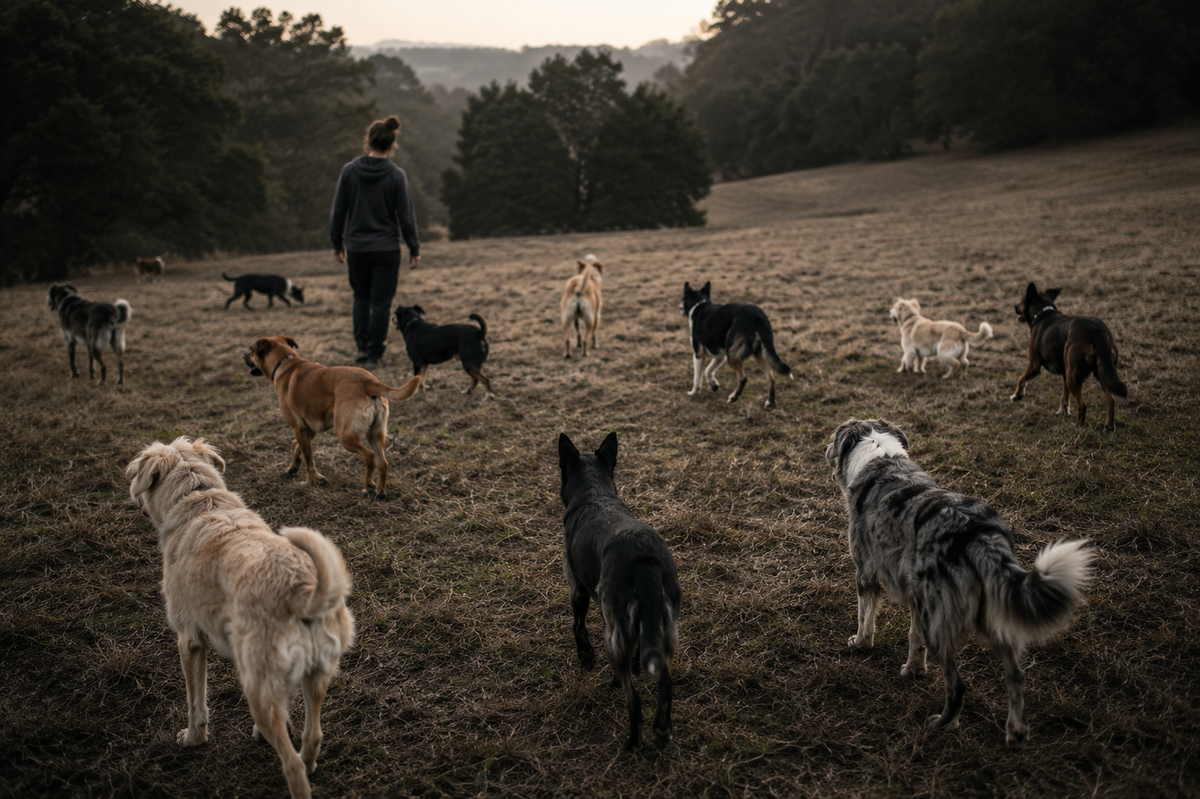
After working with more than 4,700 dogs over the course of my career, I've come to think of training less as teaching commands and more as developing a shared language. Over the years, the dogs I’ve worked with have come from all kinds of backgrounds. Some were training clients. Others came through boarding, grooming, daycare, and enrichment programs. Still more came through animal shelters, adoption programs, and post-adoption support work. Some were “easy” dogs whose families simply wanted a little guidance. Others were struggling with challenges that had become a major source of stress in daily life.
Despite all the variation in context, I’ve observed a constant thread that weaves through every case, every situation: dogs spend an extraordinary amount of time trying to understand us. Long before dogs learn a verbal cue, they're studying our routines, our movements, our habits, and our patterns. They learn what time dinner usually arrives. They learn which shoes mean a walk is coming. They learn the difference between a workday morning and a weekend morning. They pay attention to things many of us barely notice.
Humans do this too, but we often forget how much of our communication depends on language. We explain things. We describe our intentions. We negotiate. We ask questions. Words carry an enormous amount of information for us. For dogs, words are different. Dogs hear differently than humans in dramatic ways. Humans can hear up to 20,000 hertz, while dogs are able to hear up to 65,000 hertz. there’s an entire world of sonic experience dogs perceive that humans are utterly unaware of. However, canine brains process sounds differently. Dogs’ brains do not organize sounds the same way primate brains do (that includes us!) . For dogs, a verbal cue begins as a completely meaningless sound. Over time, though, through repetition and consistency, dogs CAN learn that a particular sound predicts a particular action or outcome. Eventually a cue like "sit" can become highly reliable, but getting there requires a tremendous amount of learning. In the meantime, dogs are gathering information from everywhere else.
One of my favorite examples is recall. When someone calls their dog and the dog hesitates, the assumption is often that the dog doesn't understand the cue or simply doesn't want to comply. What makes recall interesting is that humans and dogs often communicate direction differently. Humans tend to move toward one another when we want attention, cooperation, or interaction. Dogs frequently do the opposite. If you've ever watched dogs moving together, you'll notice that the dog initiating movement often simply starts going where they want to go. The invitation is in the movement itself.
That's why one of the first things I'll ask a guardian to try when we’re building recall fundamentals feels so strange. Rather than repeating "come" while moving toward the dog, I'll ask them to say it once and then turn and move away. People are often surprised by how quickly the dog's response changes. Almost every time, our dogs follow us. As primates, this is counter-intuitive and feels weird at first. But for our dogs, we’re finally making sense. The dog hasn't suddenly become more obedient, we've simply made the message easier to understand.
I see something similar when people tell me their dog already knows "sit." One of my favorite things to do in those situations is propose a simple experiment: ask your dog to sit without saying the word "sit." People laugh at first, but most of my clients are good sports, so they’ll give it a try. In nearly every case, they’re surprised to find that their dog sits every time they want them to, even without a hand signal or intentional outward signaling of any kind.
What makes the exercise so interesting is not that the dog sits. It's what the exercise reveals. Humans naturally assume that words are carrying most of the message because that's how communication works for us. The dog, however, has often been paying attention to every slightest signal we give off: posture, eye contact, movement, timing, anticipation, and context. While the human believes they've been teaching a word, the word may not matter at all. The dog may have been learning an entire conversation the human didn't know they were having: one carried out through the slightest physical "tells" the dog reads like a book.
The longer I work with dogs, the more I find myself thinking about communication outside of formal training sessions. One of the lessons shelter work taught me is that behavior can be surprisingly difficult to interpret. A dog lying quietly in the back of a kennel may be resting peacefully, but they may also be overwhelmed. The outward behavior can look remarkably similar while the underlying experience is completely different.
I think family dogs sometimes run into a version of the same problem. We naturally feel good when we've given our dogs a busy day. They've gone to daycare, met visitors, played with other dogs, attended training classes, accompanied us on errands, and by evening they're asleep before their head hits the bed. It's easy to look at that picture and conclude that we've done exactly what the dog needed. Sometimes that's true. Other times the dog is simply exhausted.
Over the years I've met many owners who were trying very hard to help their dogs by providing more activity, more stimulation, more social interaction, and more experiences. Their intentions were good. The problem was that they were measuring success by how tired the dog seemed at the end of the day.
A dog can become tired because they've spent the day navigating constant social pressure, noise, novelty, movement, and stimulation. A dog can also become tired because they've spent fifteen minutes working through a scent puzzle, following an odor trail, searching for hidden food, or investigating the world through their nose. From the outside, both dogs may end up asleep on the couch, but the experience that got them there may be completely different. One dog may be depleted. The other may be fulfilled.
That distinction has become increasingly important to me over the years because fulfillment tends to create the kind of outcomes most families are actually looking for. Dogs who have appropriate outlets for exploration, problem-solving, sniffing, chewing, foraging, and making choices often become easier to live with not because they're exhausted, but because important behavioral needs are being met.
Exhaustion can sometimes mask something else entirely. Overstimulation, anxiety, uncertainty, and stress don't always announce themselves in obvious ways. Dogs often continue trying to cope long before they begin showing behaviors that concern us. When those underlying needs go unrecognized, the eventual result can feel sudden: Reactivity. Destructive behavior. Conflict with other dogs. When I hear about these behaviors the stories are often accompanied by a familiar statement I’ve heard countless times throughout my career: "This came out of nowhere." When we start learning how to see the world from the perspective of our dogs, we find that behavior always comes from somewhere.
As a result, I've found myself becoming less interested in asking how tired a dog is and more interested in asking how satisfied they are. Opportunities for choice matter too. A dog who moves away from an interaction is communicating something. A dog who chooses to return is communicating something too. Whether we're talking about consent during petting, disengaging from another dog, investigating a scent, or choosing to settle after meeting a need, dogs are constantly providing information about how they're experiencing the world.
Training still matters. Skills matter. Boundaries matter. Dogs and humans both need ways to navigate life together successfully. But the longer I do this work, the more convinced I become that communication sits underneath all of it.
Dogs spend an extraordinary amount of time trying to understand us. What I've come to appreciate over the years is that the process works best when we're willing to spend some time understanding them, too. That's where the shared language begins.