The Myth of the "Good Dog"
When someone calls me after a serious bite and says, “He's always been such a good dog. This came out of nowhere,” I don't hear those two statements as a contradiction anymore. I hear them as the beginning of an investigation.

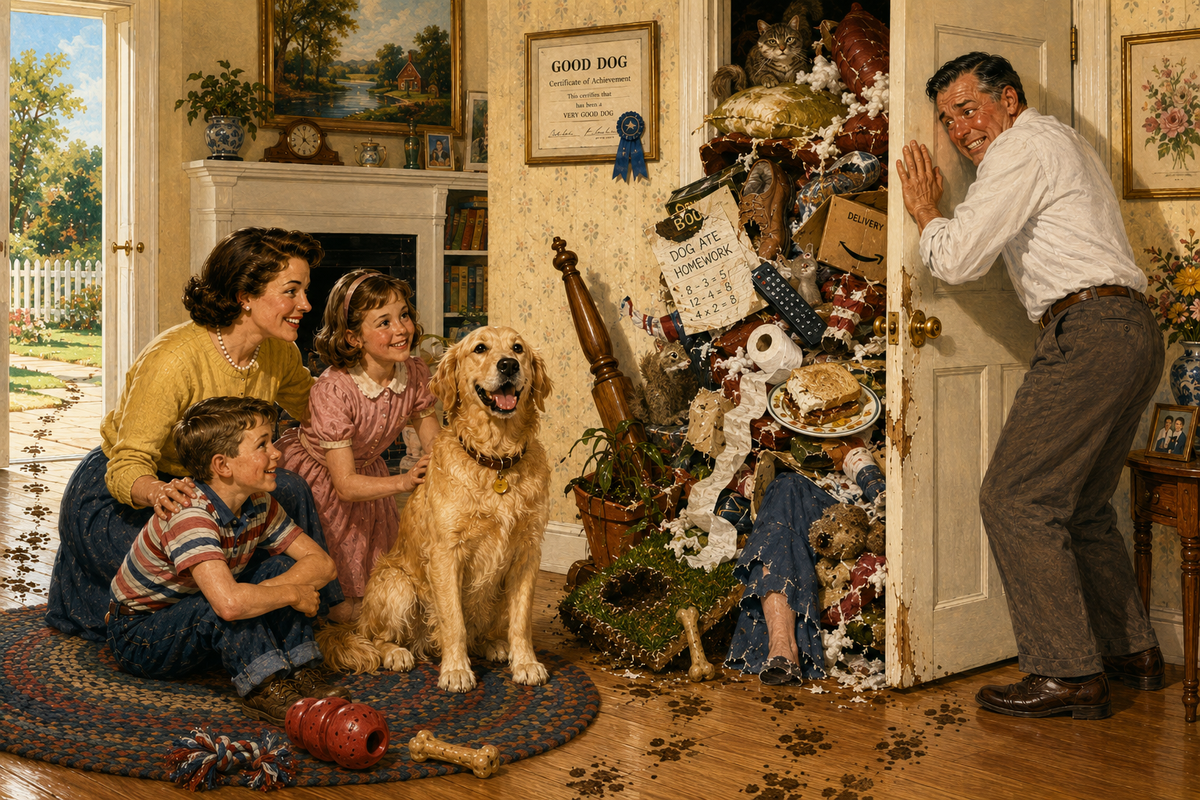
I have heard some version of “He’s such a good dog” thousands of times over the years. I say it myself all the time. We generally know what we mean by it, even if the definition changes a little from one household to another. A good dog might be friendly with people, easy to walk, quiet in the house, patient with children, comfortable around other dogs, or happy to spend an afternoon snoozing while the humans get some work done. Sometimes the definition is considerably simpler: the dog doesn’t destroy the furniture, terrorize the neighbors, or require the family to reorganize its entire life around canine management. These are perfectly reasonable things to appreciate in a dog.
In my work, though, I hear another version of that phrase, usually under very different circumstances. By the time someone calls me for help with a serious behavior problem, something has often already happened. A dog has bitten someone, snapped at a child, gotten into a serious fight, or begun reacting to people or other dogs in a way that frightens the family. Occasionally the change really is sudden, and part of my job is to consider pain, illness, neurological changes, traumatic experiences, or other factors that can produce an abrupt change in behavior. More often, however, the first conversation includes a sentence I have heard so many times that I have become very interested in what it means: “He’s always been such a good dog. This came out of nowhere.”
Those two ideas can feel contradictory. If this was such a good dog, how did we arrive here? Answering that question usually means going backward. We talk about what happened immediately before the incident, but then we keep going. What had been happening during the previous weeks or months? How had the dog behaved around the person who was bitten before the bite occurred? What did the dog do when uncomfortable? What happened when the dog tried to move away? Had there been growling, barking, freezing, avoidance, or other changes that seemed relatively unimportant at the time? What had the dog experienced, what had the dog learned, and what had the people around the dog learned in response?
Part of the difficulty is hidden inside our idea of what makes a dog “good” in the first place. We ask dogs to do something fairly extraordinary. They live inside our homes, walk through crowded neighborhoods, meet strangers, encounter unfamiliar dogs, tolerate veterinary care and grooming, travel in cars, adapt to our schedules, live alongside children, ignore food that happens to be within reach, and somehow learn that the couch is perfectly acceptable but the nearly identical expensive chair three feet away is apparently a priceless family heirloom. Living successfully with another species requires compromise, and training dogs to navigate the human world safely is good for dogs as well as people.
But listen closely to the words we often use to describe the very best dogs and an interesting pattern begins to emerge. They are quiet, tolerant, patient, obedient, calm, easygoing, and willing to let us handle them. They don’t bark much. They don’t growl. They don’t pull. They don’t resist. They don’t move away when we want to interact with them, and they don’t make everyday activities unnecessarily difficult. A surprising amount of what we call “good” behavior is defined not by what a dog does, but by what the dog doesn’t do.
Sometimes that absence of behavior tells us exactly what we think it does. A dog stretched out on the floor while people move around the house may simply be relaxed. A dog standing quietly for handling may genuinely be comfortable with it. A dog who watches another dog pass on the sidewalk without barking may have learned that there is nothing to worry about and that continuing the walk is a perfectly good option. One of the goals of thoughtful training is to help dogs reach exactly these kinds of outcomes.
The trouble is that very different emotional states can produce similar outward behavior. A dog can become quieter because the dog is comfortable, but also because the dog is frightened, exhausted, inhibited, overwhelmed, or has learned that attempts to change the situation accomplish nothing. A dog who no longer growls may feel better about whatever previously caused the growling, or the dog may simply have learned not to growl. If we measure success entirely by the disappearance of behavior, those possibilities can be remarkably difficult to distinguish.
A couple years ago, I was managing a specialized canine enrichment program at a large Bay Area dog daycare when a dog came into our care who presented as an extremely high bite risk. One of the advantages of the program was that we could provide individualized care to dogs who were not appropriate for a traditional group daycare environment, including housing them in private spaces and limiting their interactions to staff with additional behavioral training. In this dog's case, I restricted her care to myself and a small number of employees who had reached our specialist level, and our initial approach was appropriately cautious.
The circumstances that brought her to us were already difficult. Her primary caregiver had left town on a business trip, and the partner who remained home needed to work during the day. Leaving the dog home alone wasn't a reasonable option because she had a history of separation-related behavior that included inappropriate elimination and destructive behavior. She was also intensely bonded to the caregiver who was now away, so daycare was intended to solve a practical problem during what was already a significant disruption in her life. She wasn't simply a difficult dog who had arrived for us to fix. She was a dog with several overlapping behavioral challenges trying to cope with a very unusual week.
During her first few days with us, her behavior began to change. One of the specialists working in the program was an ambitious young employee who wanted to become a trainer, and he became convinced that he was making remarkable progress with her. This was happening faster than I was comfortable with and contrary to my instructions about how we should be interacting with the dog. Then one day he came to me excited about what he regarded as a breakthrough. “I can pet her anywhere,” he told me triumphantly.
I looked at the same dog and saw something very different. Her defensive behavior had diminished, but so had almost everything else. What he interpreted as successful desensitization to handling looked to me like a dog moving away from active reactivity and toward profound behavioral shutdown. The fact that she was no longer objecting to being touched didn't reassure me, because the rest of her behavior wasn't telling a story of increasing comfort. If anything, the dog seemed to be disappearing.
That observation prompted a question that had nothing directly to do with petting. I called the caregiver who was still at home and asked whether she was eating there. She wasn't. As we talked further, I learned something even more concerning: as of the previous day, she appeared to have stopped drinking water as well. At that point our discussion about behavior ended and this became a medical emergency. She was hospitalized at a veterinary clinic, where she required intravenous fluids and nutritional support until her primary caregiver was able to cut the business trip short and return home.
There were many things happening in this dog's life at once, and it would be irresponsible to reduce what happened to a single cause. She had significant separation-related behavior, an unusually intense attachment to her primary caregiver, an unfamiliar daily environment, serious preexisting behavioral concerns, and the additional challenge of interactions with people she did not know well. Nor would I retrospectively diagnose her behavior from a single episode with a tidy label simply because one happens to fit the story I want to tell. What mattered at the time was much more basic: her apparent improvement in one highly visible behavior was occurring alongside a catastrophic decline in her overall functioning.
Two people had looked at the same dog and interpreted the same change in opposite ways. My employee saw that a dog who had initially been dangerous to handle would now allow him to touch her almost anywhere, and understandably viewed the absence of resistance as progress. I saw the loss of resistance as one piece of a much larger behavioral picture, and the rest of that picture worried me enough to pick up the phone. In this case, the distinction between those interpretations wasn't academic. Continuing to interpret her increasing passivity as successful behavior modification could have allowed a serious behavioral and medical crisis to become life-threatening.
Dogs can't tell us in words whether they are quiet because they feel safe or because they have run out of strategies that seem to work. We have to infer their experience from behavior, context, history, and changes in how they interact with the world around them. That can be surprisingly difficult, particularly because humans are naturally drawn to the behaviors that affect us most directly. We notice the dog who barks, lunges, growls, pulls away, or refuses handling because those behaviors demand our attention. When those behaviors disappear, it is tempting to conclude that the problem disappeared with them.
Understanding why that conclusion can sometimes be so badly wrong requires us to go back to some of the oldest ideas in the science of learning. Long before anyone marketed an electronic collar for barking, or argued about training methods on the internet, researchers were asking a much more fundamental question: how does an animal learn that one event predicts another?
The name most people associate with that question is Ivan Pavlov, the Russian physiologist whose experiments with dogs around the turn of the twentieth century became so famous that “Pavlov’s dogs” has entered everyday language. The popular version usually involves a bell, some food, and a salivating dog, which is close enough to the basic idea but misses what made the discovery so important. Pavlov demonstrated that something with no particular biological significance could acquire meaning through association. If a previously neutral stimulus reliably predicted food, eventually the stimulus itself could produce a physiological response before the food ever appeared.
We now call this classical or respondent conditioning, and it is happening in our dogs constantly. The sound of a leash being picked up can predict a walk. The refrigerator opening can predict food. A particular turn in the road can predict arrival at the dog park. None of those things had to be formally trained, and nobody needed to schedule a five-minute session with a pouch full of treats. Through repeated experience, one event simply came to predict another, and the dog's response to the first event changed as a result.
The same process works when the thing being predicted is unpleasant. A dog who repeatedly experiences painful handling at a veterinary clinic may begin showing fear before anyone touches them. The examination room, the smell of the hospital, the parking lot, or eventually even getting into the car can become meaningful because of what those things have come to predict. The dog isn't reasoning through a chain of events and deciding that the parking lot itself is dangerous. The association has been learned through experience, just as surely as another dog learns that the sound of a treat jar opening means something wonderful is about to happen.
As the experimental study of learning expanded during the twentieth century, researchers became increasingly interested in fear, avoidance, escape, and punishment. Electric shock became a common tool in that research for an obvious and rather grim reason: it was intensely unpleasant, easy for an experimenter to control, and very effective at changing behavior. Researchers could pair a previously neutral stimulus with shock and watch that stimulus acquire significance. They could study how animals learned to avoid it, how they learned to escape it, and how behavior changed when an aversive consequence followed something the animal did.
Those experiments also revealed something fundamental that remains important every time we interact with an animal today. The experimenter may have been interested in one particular relationship between two events, but the animal wasn't limited to learning only the lesson the experimenter intended. Context mattered. Predictive cues mattered. Timing mattered. Whether an aversive event could be escaped or controlled mattered. Experiences that occurred together could become associated with one another, and those associations could influence behavior beyond the immediate moment when the unpleasant event occurred.
Researchers would eventually push those questions into considerably darker territory by asking what happened when an animal was exposed to an aversive experience it could neither escape nor control. Some of the most influential work involved dogs and electric shock, and the results would help shape our understanding of stress and behavior for decades afterward. We'll come back to those experiments, because they illuminate something important about the dog in the daycare program and about what we sometimes mistake for calmness. For now, the simpler lesson is enough: long before electronic collars were sold as training devices, we already knew that electricity was remarkably effective at changing animal behavior, and we knew that the learning it produced could extend beyond whatever behavior we happened to be watching.
This history matters because discussions about punishment in dog training sometimes begin from a strange premise: that the important question is whether punishment “works.” Of course punishment can work. In behavioral terms, if a consequence follows a behavior and that behavior becomes less likely in the future, punishment has occurred by definition. An unpleasant enough consequence can suppress behavior very quickly, and that immediate change is precisely what can make punitive interventions so convincing to the person using them.
A dog barks and something unpleasant happens. The barking decreases. A dog lunges and receives a correction. The lunging decreases. A dog growls during an interaction and the person responds with physical confrontation. Eventually the growling decreases. If the only thing we're measuring is the behavior we wanted to eliminate, each of these can look like a successful training outcome. The dog is quieter, easier to manage, and less openly resistant than before, which checks a surprising number of the boxes we often use when deciding that a dog is being “good.”
The difficulty is that learning doesn't politely restrict itself to the contingency we intended to create. Imagine a dog who barks every time another dog passes the front window and receives a painful consequence for barking. From our perspective, the lesson seems straightforward: barking makes something unpleasant happen, so bark less. But every time this occurs, another event is happening too. Another dog appears, and then something painful happens. The very same principles of association that allow the sound of a leash to become exciting or a veterinary parking lot to become frightening are still operating while we're trying to suppress the barking.
The dog can therefore learn more than one thing at the same time. Barking may become less likely because of its consequence, while the sight of another dog becomes an increasingly reliable predictor of something unpleasant. Depending on the circumstances, the same can happen with a person approaching a fence, a child riding past on a bicycle, a delivery worker walking toward the house, a particular location, or even the presence of the person administering the correction. None of those associations needs to be part of our training plan in order for the dog to learn them.
That is one of the problems with evaluating behavior modification only by asking whether the behavior stopped. We may be watching the lesson we intended to teach while an entirely different lesson is taking shape alongside it. And when the unwanted behavior disappears quickly, we have a particularly strong reason not to go looking for anything else. From our perspective, after all, the training worked.
There is another reason these methods have remained remarkably persistent in dog training, and it has less to do with the dog than with the person holding the leash. When we do something and an annoying, frightening, or difficult behavior immediately stops, our behavior is being shaped too. The dog lunges, we deliver a correction, and the lunging stops. The dog barks, we activate a collar, and the barking stops. Whatever else may be happening in that interaction, we have just experienced relief, and relief can be an extraordinarily powerful teacher. If something appears to solve a problem immediately, there is a very good chance we will try it again.
For a generation of American dog owners, some of the most visible examples of this approach arrived through television. Cesar Millan became enormously influential by presenting dog behavior through a framework of dominance, leadership, submission, and control. His programs regularly showed dogs being physically confronted, rolled onto their sides or backs, stared down, challenged spatially, corrected with the leash, or struck with what was often described as a “touch” delivered with the foot. Viewers could watch a dog resist an intervention and then, sometimes quite dramatically, stop resisting. The resulting stillness was routinely interpreted for the audience as calmness or submission.
The difficulty is that most people have never been taught to read dogs particularly well. They know what barking looks like. They recognize a lunge. They certainly recognize a bite. But the quieter language that often surrounds those behaviors can be much harder to see: changes in posture and facial tension, attempts to turn or move away, freezing, avoidance, changes in orientation, or a sudden reduction in exploratory and social behavior. No individual signal provides a magical window into a dog's emotional state, and context always matters, but dogs communicate through far more than the conspicuous behaviors that humans find disruptive.
This makes television an especially powerful teacher, because the audience isn't simply being shown what to do. It is also being told what it is seeing. If a dog struggles during a confrontation and then becomes motionless, an experienced observer and an inexperienced viewer may watch exactly the same footage and reach very different conclusions. If the accompanying explanation is that the dog has become “calm-submissive,” the disappearance of resistance becomes evidence that the technique succeeded. In some cases, the very behaviors that should make us wonder how the dog is coping can instead be presented as proof that the dog is finally behaving properly.
By 2009, however, there was already published clinical research examining many of these same confrontational practices. Meghan Herron, Frances Shofer, and Ilana Reisner surveyed owners of dogs presented to a veterinary behavior service and asked about training methods they had used and how their dogs responded. Because these were dogs already being seen for behavior concerns, the percentages should not be treated as estimates for the entire dog population. Within that clinical population, though, the results were striking. Owners reported aggressive responses in 43 percent of dogs subjected to hitting or kicking, 41 percent when people growled at their dogs, 39 percent when an item was forcibly removed from the mouth, 31 percent following an alpha roll, 30 percent when dogs were stared down, and 29 percent following a dominance down.
Those numbers are worth sitting with because these weren't obscure laboratory procedures. They closely resemble techniques that were being promoted to ordinary dog owners as ways to establish leadership and correct unwanted behavior. An intervention intended to control aggression or resistance could itself provoke an aggressive response in a substantial proportion of the dogs subjected to it. At the same time, many owners still perceived confrontational or corrective methods as effective, which makes sense if success is being judged primarily by what happens to the unwanted behavior in the immediate aftermath.
This isn't an argument that every dog subjected to an alpha roll will bite, any more than using an electronic collar guarantees that a dog will eventually become dangerous. Behavior doesn't work that way, and individual dogs arrive in these situations with different genetics, histories, environments, relationships, emotional states, and previous learning. It is an argument about risk. When a procedure intended to improve behavior produces defensive aggression at rates approaching one-third, and in some cases more than 40 percent, in a clinical population, that risk deserves to be taken seriously. It is particularly difficult to justify when less confrontational approaches can teach the behaviors we actually want without deliberately creating the same level of threat or conflict.
There is a broader problem here than any particular television personality or training philosophy. Dogs have lived alongside us for thousands of years and have become remarkably skilled at paying attention to human beings. They watch where we look, how we move, what we reach for, which door we open, what clothes we put on, and the hundreds of tiny routines that predict what is about to happen next. Anyone who has accidentally made eye contact with a dog five minutes before dinner knows just how closely they are monitoring the situation. We, meanwhile, can share a home with a dog for years without ever receiving even a basic education in how that animal communicates.
That imbalance matters because the loudest behaviors are often the easiest ones to punish. Barking is obvious. Growling is obvious. Lunging is impossible to ignore. A bite forces everyone to pay attention. The behaviors that came earlier may have been much quieter, and sometimes our attempts to eliminate the conspicuous behavior make those quieter signals even easier to overlook. If a dog learns that growling makes a difficult interaction worse, for example, the disappearance of growling may make the household feel safer without telling us whether the dog feels any safer at all.
I have seen the consequences of that misunderstanding many times in behavior cases, particularly when electronic devices have been used to suppress barking or reactivity. One case stands out because the intervention appeared to work extraordinarily well. It worked, in fact, for almost six months.
The family who called me had a German Shepherd who had become dangerous around people, including the people who lived with him. Every member of the household had been bitten at some level, and the most recent incidents had become severe. There had been Level 4 and Level 5 bites, with injuries serious enough to require medical attention. By the time I became involved, this was no longer a nuisance behavior problem or a question of teaching better manners. The dog presented an extraordinary safety risk, and the family was understandably frightened of an animal with whom they shared their home.
But that wasn't where the story had started. The dog lived primarily outside, in a dog house in the family's backyard. The property sloped downward toward a fence at the far end, and beyond that fence ran a fairly busy path. From the yard, the dog could watch a steady stream of people, dogs, bicycles, squirrels, and other activity moving past the property. He could see all of it, react to it, and move toward the fence, but he couldn't actually investigate or interact with whatever was passing on the other side.
Over time, he began barking at those things. Then he barked more. The neighbors complained, the situation escalated incrementally, and eventually the family was threatened with eviction if they couldn't stop the barking immediately. This is important context because the family wasn't sitting around contemplating different schools of learning theory or weighing the finer points of canine welfare research. They had a large dog barking persistently in the backyard, angry neighbors, and the very real possibility of losing their housing. They needed the barking to stop.
They purchased a sound-activated shock collar, and the collar did exactly what they bought it to do. It worked. For almost six months, the barking was successfully suppressed.
Consider what those six months looked like from the perspective of the learning processes we've already discussed. A person walked down the path and the dog began to vocalize. Shock. Another dog passed the fence and the dog tried to bark. Shock. A bicycle went by. Shock. A squirrel appeared. Shock. Again and again, the device delivered an aversive consequence automatically in response to vocalization, without anyone needing to be present to operate it.
From the family's perspective, the relevant relationship was obvious: barking produced an unpleasant consequence, and barking decreased. From the dog's perspective, however, those six months contained thousands of other relationships among events. People appeared immediately before an intensely unpleasant experience. Dogs appeared before it. Bicycles appeared before it. Activity along the path repeatedly occurred in the same context as shock. The collar could suppress the vocal response while classical conditioning continued to change what the things outside the fence predicted.
This is where the distinction between stopping a behavior and changing the underlying emotional response becomes enormously important. The collar did not teach the dog that people walking past the property were safe. It didn't teach him what to do when another dog appeared. It didn't give him an appropriate way to investigate, disengage, create distance, or redirect his attention. It made one particular response to those events costly enough that, for a substantial period of time, he largely stopped using it.
I wasn't there during those six months, so I can't tell you exactly what the dog's internal experience was or reconstruct every stage of the behavioral change that occurred. His history also contained other important factors, including chronic outdoor housing, repeated exposure to activity along the fence, and the frustration inherent in being able to see and react to things he could never reach. A retrospective behavior case cannot isolate variables the way a controlled experiment can, and it would be irresponsible to claim that an electronic collar inevitably turns a barking dog into a biting dog.
What I can tell you is what happened in this case. The apparent success did not last. By the time the family called me, the dog was no longer simply reactive toward things passing beyond the fence. His hostility had generalized to humans, including the members of his own household, and the resulting bites had become extraordinarily serious. The original problem had been a dog who barked too much. Six months after an intervention that appeared to solve that problem, the family was living with a dog they were afraid to approach.
This wasn't the only case in which I have encountered some version of that progression. Over the years, I have spoken with multiple families who used automatic bark collars or other strongly aversive approaches to suppress conspicuous behavior and later sought help for behavior that had become considerably more dangerous. That clinical experience isn't a controlled study, and I don't present it as one. But neither does it exist in a scientific vacuum. Decades of research into aversive conditioning have given us plausible and well-established mechanisms for understanding how fear and avoidance can become associated with surrounding stimuli, how those associations can persist beyond the moment of punishment, and how confrontational or painful interventions can sometimes provoke defensive aggression rather than eliminate it.
What makes this particular case so instructive is the delay. Had the family put the collar on the dog and been bitten the following afternoon, the connection would have been difficult to miss. Instead, they experienced months of apparent success. The barking that threatened their housing had stopped, which reinforced their decision to use the collar just as effectively as the collar was suppressing the dog's barking. Everyone involved was learning, but the consequences they were experiencing unfolded on very different timelines.
Immediate consequences are easy to see. Learning histories are not. We are especially vulnerable to mistaking the two when an intervention produces exactly the result we wanted today while the associations surrounding that intervention accumulate quietly over weeks or months. By the time another behavior emerges, the original intervention may feel like ancient history. The dog was fine. The collar worked. Everything had been going well, right up until suddenly it wasn't.
That gap between immediate success and long-term outcome is one reason the older experimental research on aversive learning remains so relevant. Researchers discovered that it wasn't enough to know whether an unpleasant event changed behavior in the moment. They also needed to understand whether the animal could predict it, whether the animal could control it, what became associated with it, and what happened afterward. Eventually, some of the most famous and troubling experiments in behavioral psychology asked an even darker version of that question: what happens when an animal learns that nothing it does can make the aversive experience stop?
The experiments most closely associated with this question were conducted by psychologists Martin Seligman and Steven Maier in the 1960s. Their work involved exposing dogs to electric shock under different conditions of control. Some dogs could perform a behavior that terminated the shock. Others received the same aversive stimulation but had no control over when it stopped. Later, when the dogs were placed in a situation in which escape was possible, their previous experience profoundly affected what they did. Dogs that had learned they could control the aversive event were much more likely to escape. Many of the dogs previously exposed to inescapable shock did not, even though the circumstances had changed and an escape route was now available.
The phenomenon became known as learned helplessness, and the research eventually became influential far beyond animal learning. Decades of subsequent work have substantially refined the original theory, including research by Maier and Seligman themselves. The modern understanding places even greater emphasis on the importance of controllability and the neural processes involved in detecting and learning control over aversive events. The history is scientifically fascinating and, by modern animal-welfare standards, difficult to read. Dogs were deliberately exposed to experiences we would never consider acceptable simply to demonstrate a point about behavior, but what researchers learned from those experiments has remained important: whether an animal can predict and control what happens to it can profoundly affect how that animal responds to stress.
I am careful with the term “learned helplessness” in everyday dog behavior because it is tempting to turn a complex experimental phenomenon into a convenient label for any dog who appears shut down. I can't go backward in time and put the dog from the daycare program into an experiment, nor would I want to. I don't know that learned helplessness explains what happened to her, and her situation involved several significant factors that make any simple explanation unlikely. What the research gives us instead is a reason to take seriously something we can observe without pretending to know more than we do: sometimes an animal stops trying because the situation has become comfortable, and sometimes an animal stops trying because trying has repeatedly failed to improve the situation.
That distinction brings us back to my employee's excited announcement that he could pet the dog anywhere. What mattered wasn't simply that she no longer resisted his touch. The question was whether the disappearance of resistance was accompanied by evidence that she was becoming more comfortable and engaged with the world. In her case, the broader evidence pointed dramatically in the opposite direction. She wasn't eating. She had apparently stopped drinking. Her behavioral repertoire was contracting rather than expanding. The absence of resistance was not evidence of wellness, and fortunately we recognized that before her physical condition deteriorated further.
Control also helps explain why it makes little sense to lump every consequence a dog dislikes into the same category. Dog training discussions can become strangely absolutist around this subject, as though the only possibilities are either a world in which a dog never experiences frustration or disappointment, or one in which pain and intimidation are necessary because “that's how the real world works.” Learning theory gives us considerably more useful ways to think about consequences than either of those positions.
Consider something as ordinary as a dog who jumps on people for attention. If the dog jumps and I turn my back for a moment, access to the thing the dog wanted has temporarily disappeared. In learning-theory terms, that is negative punishment: something desirable has been removed following a behavior, making that behavior less likely to occur. But I don't have to stop there. The moment four paws return to the floor, I can turn back, offer attention, and positively reinforce the behavior I actually want. The dog has an easy way to control what happens next, the consequence is mild and predictable, and an appropriate alternative is immediately available.
That learning environment is very different from introducing pain or intense fear into an already emotionally charged situation. The relevant distinction isn't simply whether the dog experienced something they would rather avoid. We should be asking how intense the consequence is, how clearly it relates to the dog's behavior, whether the dog can predict it, whether the dog can control it, what emotional state the dog is already in, and whether we have provided an alternative behavior that actually works. We should also be asking the question that runs through the history of conditioning research and through both of the dogs I've described here: what else might the dog be learning?
This is one reason I am less interested in arguments about being “positive only” or “balanced” than I am in what a training procedure actually does. Labels can become identities surprisingly quickly, and once that happens we can spend a great deal of time defending camps instead of looking at dogs. A useful behavior plan should be understandable in terms of learning, risk, welfare, and outcome. It should give the dog a realistic path toward successful behavior rather than relying primarily on making the unwanted behavior sufficiently unpleasant to perform.
That becomes especially important when the behavior we're trying to eliminate is itself communication. Growling is probably the clearest example. Nobody wants a dog growling at a child, and if a dog is growling at a child I want the situation changed immediately. But the growl is also extraordinarily useful information. It tells us that something about the interaction has become difficult enough that the dog is communicating discomfort, conflict, fear, guarding, pain, or a need for distance in a way we can readily detect.
If the consequence for growling is confrontation, intimidation, or punishment, the growling may decrease. From the human perspective, that can look like improvement. The dog doesn't growl at the child anymore. But unless we have also changed whatever caused the dog to growl, we have very little reason to assume that the disappearance of the warning means the underlying problem disappeared with it. We may simply have made one useful piece of information less likely to occur.
The same principle applies to quieter communication that many people never learn to recognize in the first place. Dogs turn away, change posture, alter their movement, create distance, freeze, disengage, and modify their behavior in ways that can tell us a great deal when we learn to notice patterns rather than waiting for a bark, growl, lunge, or bite. None of these behaviors has one universal meaning, and reading dogs isn't a matter of memorizing a chart of body-language signals. It means paying attention to the whole animal, the context, what changed, and what happens next.
Sometimes one of the simplest ways to learn more is to give the dog a little choice. Choice is sometimes discussed in animal welfare as though it were primarily an ethical consideration, and it certainly can be, but from a behavior standpoint it is also information. If I stop petting a dog, what happens next? Does the dog move closer and solicit more interaction, remain where they are, or take the opportunity to leave? If I pause during handling, does the dog voluntarily re-engage? If I create more distance from another dog on a walk, does my dog's body loosen and attention return to me or the environment? Giving the dog some control over an interaction can tell us things that compliance alone cannot.
This is particularly useful because humans are surprisingly good at confusing tolerance with enjoyment. We do it with one another too, although at least another person can eventually tell us that the annual office holiday party is not, in fact, the highlight of their year. Dogs have fewer options. A dog who remains beside us while being hugged may enjoy being hugged, tolerate being hugged, or simply have learned that moving away doesn't work particularly well. If we loosen our arms and the dog immediately leaves, we have learned something useful. If the dog turns around and shoves their head under our hand, we've learned something useful there too. Neither observation requires us to pretend we can read the dog's mind. We're simply allowing behavior to provide more information.
The same principle can be incorporated into training and husbandry in much more deliberate ways. Cooperative veterinary and grooming care can teach a dog that maintaining a position allows an examination or procedure to continue, while moving out of that position pauses it when circumstances safely allow. A dog worried about another dog on a walk can learn that checking in with the handler, changing direction, or moving away are effective options. A dog who becomes uncomfortable during an interaction can be given opportunities to create distance before the situation escalates. These aren't ways of handing the household over to the dog or requiring written canine consent before trimming a toenail. They are ways of building useful communication into situations where dogs have historically had very little control.
Once we begin thinking this way, our definition of successful behavior change becomes more demanding, not less. “The dog stopped barking” is certainly an observable outcome, but it doesn't tell us why the dog stopped or what will happen the next time the trigger appears. A dog who can notice someone passing the house, remain comfortable enough to think and learn, and choose another behavior gives us considerably more information. “The dog doesn't growl during handling” tells us less than knowing the dog can participate comfortably in handling, understands what is expected, and has a reliable way to communicate when the interaction becomes difficult.
The same is true for reactivity. If a dog who previously lunged at other dogs can now notice one, remain within a workable emotional range, disengage, and continue walking, we haven't simply eliminated a problem behavior. We've expanded the dog's repertoire. The dog has more successful options than before, and those options can be reinforced until they become increasingly reliable. Environmental management, desensitization and counterconditioning, reinforcement of alternative behaviors, appropriate enrichment, and thoughtful use of distance and choice all give us ways to change what the dog does without making the entire project depend on how effectively we can suppress what we don't want.
None of this means that living with dogs becomes a permanent negotiation in which every household rule is subject to a canine referendum. My dogs don't get to decide whether running into traffic is an acceptable recreational activity, and a dog presenting an immediate bite risk doesn't get unlimited freedom to work through that problem independently. Management is sometimes restrictive because safety matters. We close doors, use leashes and barriers, prevent access to dangerous situations, and make decisions for animals who cannot possibly understand all of the consequences themselves. The distinction is that management acknowledges the limitation we're imposing rather than mistaking the dog's inability to act for evidence that the dog is comfortable with it.
That brings us back to the word “good.” I don't think we need to stop using it, and I certainly have no intention of doing so myself. Affectionate language doesn't need to pass a behavioral-science peer review before we tell a dog he's a good boy. The problem begins when “good” becomes our behavioral assessment, particularly when what we really mean is quiet, compliant, or no longer doing the thing that bothered us. If our intervention makes a behavior disappear, we should absolutely notice that change, but it should prompt another question rather than end the inquiry: what took its place?
Sometimes the answer is exactly what we hoped for. The dog who used to bark at every passerby now notices people and goes back to sleep. The dog who once panicked during nail trims has learned a cooperative routine and participates comfortably. The dog who lunged at other dogs can now move through the neighborhood without spending the entire walk in a state of conflict. In those cases, the absence of the old behavior is part of a much larger pattern of improvement. We haven't simply made the dog's world smaller until there is less behavior left for us to dislike. We have helped the dog develop better ways to live in it.
Other times, the picture is less reassuring, and this is where the history matters. When someone calls me after a serious bite and says, “He's always been such a good dog. This came out of nowhere,” I don't hear those two statements as a contradiction anymore. I hear them as the beginning of an investigation. We talk about what happened immediately before the bite, and then we keep going backward. We talk about health, routines, relationships, previous experiences, changes in the environment, earlier behavior, training history, and what happened when the dog tried different ways of responding. Sometimes that history reveals something genuinely abrupt. Pain, illness, neurological changes, a frightening event, maturation, or a major environmental disruption can change behavior, and it would be a serious mistake to begin every case assuming that somebody simply failed to notice the warning signs.
More often, though, we discover that there was a history. There were behaviors that didn't seem important at the time, associations developing through repeated experience, strategies that worked until they didn't, or strategies that disappeared because they had stopped working. The dog had been learning, and the people around the dog had been learning too. Sometimes everyone was responding quite reasonably to the information available to them, while missing information they had never been taught to look for in the first place. By the time the behavior becomes frightening enough to demand attention, months or years of that history can collapse in our memory into a single bewildering moment when the dog suddenly seemed to change.
I still like the phrase “good dog.” I probably use it every day, and I suspect dogs would be disappointed if we retired it on scientific grounds. But after working with thousands of dogs, I've become much less interested in whether a dog looks good in a particular moment and much more interested in what the dog is experiencing, what they're learning, and what they're trying to tell us. When those things become part of how we measure progress, quiet behavior can still be something worth celebrating, but silence by itself is no longer enough to convince us that everything is fine. Because by the time someone tells me, “This came out of nowhere,” somewhere is exactly what I'm looking for.