The Debt We Owe to Dogs
The debt is not a promise to save every dog at any cost. It is an obligation to stop creating preventable suffering, to provide meaningful care for the animals already here, and to exercise restraint when our ambitions would impose further costs on them.

Giving Thanks
Thanksgiving is a peculiar American holiday, an annual exercise in gratitude conducted around a table groaning under the weight of agricultural abundance, complicated family relationships, and enough food to sustain a small village for several days. We gather to acknowledge our good fortune, however unevenly distributed, and to recognize the people whose labor, sacrifice, and affection have made our lives possible. There is something worthwhile in the ritual, even if the familiar story of Pilgrims and Indigenous people celebrating together conceals a history of colonization, dispossession, disease, and violence. For Indigenous peoples, the consequences of European settlement included the destruction of communities, the seizure of ancestral lands, and centuries of policies intended to eradicate their cultures and sovereignty. The comforting national mythology has too often obscured those realities, and the tradition's association with gratitude does not absolve us of the responsibility to acknowledge them. We can find genuine value in gathering to give thanks without celebrating a sanitized account of the country's origins.
If there is a dog in the household, it will probably have its own interpretation of the occasion. Some will patrol the kitchen, alert to the possibility that an inattentive cook might drop something interesting. Others will station themselves beneath the table, where generations of selective breeding and a lifetime of observation have prepared them to identify the relative generosity of individual dinner guests. A particularly fortunate dog may spend the afternoon asleep on a couch, secure in the knowledge that the household's peculiar seasonal activities are unlikely to interfere with its comfort. Whatever the arrangement, the dog will be participating in a human tradition whose meaning is considerably more complicated than the cheerful domestic gathering taking place around it.
We are accustomed to thinking of dogs as beneficiaries of human civilization. We feed them, shelter them, provide medical care, and invite them into our homes. In much of the contemporary Western world, we celebrate their place in our families with an enthusiasm that would have seemed extravagant to many of our ancestors. There are dog birthday parties, elaborate daycare facilities, specialized diets, orthopedic beds, and entire industries devoted to the proposition that the modern dog deserves a comfortable and entertaining life. We call them our best friends, our children, our companions, and sometimes, with only a little embarrassment, the most important members of the household.
All of this encourages a particular understanding of the relationship. We imagine ourselves as the providers and dogs as the fortunate recipients of our generosity. Even the language of rescue, a subject to which I will return, places humans in the role of benefactors. We save dogs, give them homes, and offer them better lives. In exchange, they provide companionship, affection, entertainment, and the occasional opportunity to feel that we have done something good in a world where opportunities for uncomplicated goodness can seem increasingly scarce. It is a comforting arrangement, but it is an incomplete account of our history together.
Long before anyone built a dog park, established an animal shelter, or invented a commercially available orthopedic pet mattress, dogs were participating in the development of human societies. They accompanied people across difficult landscapes, helped them obtain food, guarded their settlements, transported their possessions, and eventually worked alongside them in agricultural systems that transformed the organization of human life. They expanded what people could accomplish and, in some environments, where people could survive. Their contributions extended beyond the immediate tasks they performed, influencing the movement of communities, the organization of labor, and the relationships through which people made their living.
The relationship reaches back far beyond recorded history, beyond agriculture and cities, into a period when the ancestors of modern humans and dogs were beginning an association that would alter the evolutionary trajectories of both species. We did not simply encounter a useful animal, domesticate it, and put it to work. The relationship developed over thousands of years, changing the behavior, biology, and circumstances of the populations involved. Humans shaped dogs, certainly, but dogs also helped shape the human world. To understand domestication only as something we did to them is to miss the reciprocal nature of a partnership that became one of the most consequential relationships between species in all of human history.
This is a difficult history to see precisely because its consequences are everywhere. We are surrounded by the accumulated achievements of people who lived and worked with dogs, yet we rarely recognize canine participation in the story. The buildings, roads, farms, communities, and institutions of modern life appear to us as human accomplishments, which of course they are. But human accomplishments have never occurred in isolation from the other living things with which we share the world. Our civilization emerged through relationships with plants, animals, and ecosystems that made certain ways of living possible and others impossible. Among those relationships, the one we developed with dogs is remarkable for its antiquity, intimacy, and extraordinary range of consequences.
There is another reason the story deserves reconsideration. The benefits of this partnership have not been distributed equally, and neither has the authority to determine its terms. Humans have acquired almost complete control over the circumstances of canine existence. We decide which dogs reproduce, which characteristics are desirable, where dogs may live, what work they perform, how they are confined, and often when their lives will end. We have developed extraordinary expertise in shaping their bodies and behavior to suit our preferences, from the small companion dog selected for an appealing appearance to the specialized working dog bred for stamina, scent detection, or responsiveness to human direction. Some of these choices have improved canine welfare. Others have imposed profound costs on animals who have no meaningful ability to refuse the arrangements we create for them.
The contradictions are not confined to the distant past. We live in a society capable of extraordinary affection for individual dogs while tolerating widespread suffering among dogs whose needs are less visible or whose care is less convenient. We devote considerable resources to celebrating the animals who share our homes, yet the public institutions and nonprofit organizations responsible for dogs without secure homes frequently operate under conditions that make adequate care difficult or impossible. We have become remarkably sophisticated at rescuing individual animals from crises that we remain unwilling to invest sufficiently in preventing.
I have spent much of my professional life working within these contradictions, as a trainer and behavior consultant, a manager of canine care and enrichment programs, and a leader in shelter behavior and training. I have worked with families who would rearrange their entire lives to help a struggling dog, and with dedicated animal welfare professionals attempting to provide humane care under circumstances that would challenge even a generously funded institution. I have also visited shelters where the scale of need so thoroughly exceeded the available resources that the usual language of rescue and compassion seemed inadequate to describe what was happening. These experiences have left me with enormous respect for the people doing the work, but considerably less patience for the systems that make their work so unnecessarily difficult.
The question that increasingly occupies me is not whether humans love dogs. Many of us plainly do, sometimes with an intensity that surprises even ourselves. Nor is it whether dogs have benefited from their association with us. The domestic dog has achieved an extraordinary global distribution, and countless individual dogs enjoy lives characterized by security, pleasure, companionship, and care. The relationship has produced genuine benefits for both species, even if those benefits have never been universal or equal.
What interests me is the distance between our professed affection and our collective willingness to accept responsibility for the animals whose existence we have so profoundly shaped. We possess the scientific knowledge to prevent a great deal of unnecessary suffering, the practical experience to improve the lives of dogs already in our care, and the wealth to support institutions capable of doing both on a meaningful scale. Yet we continue to organize much of our response around the immediate rescue of animals from conditions that more serious investment might have prevented. At the same time, new technologies promise to extend our control over canine reproduction and behavior still further, opening possibilities that deserve far more ethical scrutiny than the excitement surrounding their commercial potential might suggest.
Thanksgiving seems an appropriate occasion to consider all of this. Gratitude, properly understood, involves more than enjoying the benefits of another's contribution. It requires some recognition of what has been given, what it has cost, and what responsibilities might follow from receiving it. We do not ordinarily apply that reasoning to our relationship with another species, perhaps because doing so would require us to examine assumptions about ownership, usefulness, and human entitlement that have become almost invisible through familiarity.
The dog asleep beneath the Thanksgiving table is not thinking about any of these things. Its immediate concerns are likely to be considerably more practical, and there is something reassuring about that. But the animal's presence in our home is the living consequence of a relationship that reaches back into prehistory, through migrations, settlements, empires, economies, and countless ordinary human lives. It is a relationship from which we have received more than we generally acknowledge, and over which we now exercise a degree of power that would have been unimaginable to the people and animals who first began living alongside one another. Before considering what we owe dogs, then, it is worth understanding how much of our world we made together.
The World We Made Together
Sometime toward the end of the last Ice Age, thousands of years before the first cities appeared in Mesopotamia or anyone began cultivating wheat in the Fertile Crescent, people were already living alongside dogs. We do not know precisely where the relationship began, how many times it emerged independently, or what the first encounters between humans and the ancestral wolves of modern dogs looked like. There was no single moment when a wolf became a dog, no identifiable prehistoric genius who first recognized the possibilities of domestication. Whatever happened unfolded across generations of animals and people, within environments and societies that have largely disappeared from the archaeological record.
What we do know is becoming considerably more interesting as the evidence accumulates. In 2026, researchers reported genomic evidence identifying dogs in what is now Türkiye approximately 15,800 years ago and Britain around 14,300 years ago. These were not merely wolf remains whose identification depended on ambiguous skeletal characteristics. Their genetic relationships provided evidence that domestic dogs were already distributed across substantial portions of western Eurasia during the Paleolithic, long before agriculture became the organizing principle of human subsistence. The researchers also found indications that dogs moved between culturally distinct human populations, suggesting that these animals were already participating in networks of human contact and exchange. By the time people began establishing permanent agricultural settlements, the relationship between our species was already ancient.
The findings add to a growing body of evidence that has transformed the study of canine origins. A major genomic analysis published in Science in 2020 identified at least five distinct ancestral dog lineages by approximately 11,000 years ago. These populations were already differentiated across broad geographic regions, and their histories did not simply mirror those of the humans living alongside them. Subsequent research has continued to reveal a complicated picture of migration, population replacement, admixture, and changing relationships between dogs and people. The archaeological record remains incomplete, and the earliest stages of domestication are still debated, but the emerging picture is of a relationship that had become widespread and deeply established while humans were still living predominantly as hunter-gatherers.
For much of the twentieth century, the conventional explanation for how this happened was relatively straightforward. Wolves began scavenging around human camps, the least fearful animals gained access to food, and successive generations became increasingly tolerant of human proximity. Eventually, people began deliberately selecting animals for useful characteristics, producing the first domestic dogs. This account remains one plausible component of domestication, but its apparent simplicity conceals a number of unresolved questions. The ecological circumstances of Late Pleistocene humans were not those of agricultural villages with permanent refuse heaps. Human hunters and wolves also competed for some of the same prey, and both species were capable of presenting substantial danger to the other. The idea that domestication arose simply because wolves discovered an easy meal outside a campsite is difficult to reconcile with the full complexity of the relationship.
Other hypotheses emphasize more active forms of association. Humans may have incorporated wolf pups into their communities, creating opportunities for social attachment and selective breeding. Wolves and people may have developed mutually beneficial relationships around hunting, particularly in environments where cooperation or tolerance offered advantages to both. Different processes may have operated in different places and periods, and behaviors that initially developed through ecological opportunity could eventually have become embedded in social relationships. These possibilities are not mutually exclusive, nor should we expect a process unfolding over thousands of years to resemble a single deliberate human project.
The more consequential point is that domestication was not simply a sequence of human decisions imposed upon passive animals. Wolves were already highly social mammals, capable of coordinating activities, maintaining long-term relationships, responding to the behavior of others, and adapting their conduct to changing circumstances. Humans possessed their own remarkable capacities for cooperation, communication, social learning, and ecological flexibility. The association brought two socially sophisticated predators into sustained contact, creating opportunities for behavioral adjustments that could benefit both. Over time, the animals best able to navigate this unusual relationship would have experienced different opportunities for survival and reproduction from those available to wolves living entirely apart from humans.
The resulting evolutionary changes were profound. Domestic dogs eventually became extraordinarily diverse in size, appearance, temperament, and behavior, but many of the most important changes involved their relationships with people. Dogs developed an unusual capacity to attend to human behavior and participate in forms of interspecies communication that are difficult to reproduce with other animals. They can learn to follow human gestures, respond to our attention, discriminate among familiar social partners, and coordinate their actions with us in ways that reflect both inherited predispositions and individual experience. None of these capacities is entirely absent from wolves, and it would be a mistake to imagine that dogs possess some universal instinctive understanding of human intentions. Their behavior is shaped by development, learning, environment, and the enormous variation among individual animals. Nevertheless, the species has evolved within a social world in which understanding and responding to humans can have extraordinary consequences.
One particularly revealing line of research concerns the biological processes associated with social attachment. In a widely discussed 2015 study, researchers led by Miho Nagasawa examined interactions between dogs and their guardians and found evidence of a reciprocal relationship involving mutual gaze and oxytocin, a hormone associated with aspects of social bonding. Dogs that gazed longer at their guardians were associated with increased oxytocin concentrations in those humans, and experimentally administered oxytocin in female dogs was associated with increased gazing and subsequent changes in their guardians' oxytocin. The researchers proposed that this feedback process may have contributed to the development of human–dog attachment during domestication.
The study does not establish that dogs and humans experience affection identically, nor does it mean that oxytocin provides a complete explanation for a relationship involving learning, reinforcement, attachment, social experience, and individual history. The popular tendency to reduce complicated behavior to a single hormone has rarely improved our understanding of either species. What makes the findings interesting is the possibility that an interaction between two animals could engage biological systems associated with social relationships in both of them. A dog looking at a familiar person is not simply extracting information about the availability of food or the likelihood of receiving a command. Depending on the individuals and their history together, that interaction can be part of a mutually reinforcing social relationship with measurable physiological consequences.
Anyone who has worked closely with dogs will recognize the practical significance of this reciprocity, even if the evolutionary mechanisms remain incompletely understood. A dog learns to anticipate the behavior of the people around it, while those people learn to interpret the dog's posture, movement, attention, and responses. Successful communication is rarely a matter of one participant transmitting instructions to another. It is an ongoing process of adjustment, in which both parties acquire information and modify their behavior. A person who learns to recognize a dog's hesitation before approaching an unfamiliar animal may begin changing direction earlier on walks. The dog, in turn, may learn that remaining close to that person produces more predictable and comfortable outcomes. Over time, each participant's behavior becomes part of the environment shaping the other's.
The relationship can be remarkably sophisticated without requiring either participant to understand it in the same way. Dogs do not need human language to influence our decisions, and humans do not need access to a dog's subjective experience to recognize that its behavior communicates meaningful information. In my work as a trainer and behavior consultant, much of the process involves helping people become more attentive to this exchange. A dog who stops moving, turns away, approaches cautiously, or begins scanning its surroundings is participating in a conversation, although not necessarily the one its guardian believes is taking place. Improving the relationship often requires changing the human participant's behavior at least as much as the dog's.
Across thousands of years, countless interactions of this kind occurred within the larger ecological circumstances of human communities. Dogs that could successfully live and work with people gained access to resources and opportunities unavailable to their wild ancestors. Humans living with dogs acquired new possibilities for cooperation, detection, protection, and movement through their environments. Those possibilities could alter hunting strategies, patterns of settlement, the use of territory, and the social organization of work. In evolutionary biology, relationships that change the conditions under which organisms survive and reproduce can become part of the processes shaping subsequent evolution. The environment is not merely a fixed backdrop against which natural selection occurs. Organisms continually modify their surroundings, and those modifications can influence the selective pressures experienced by themselves and other species.
This idea, often discussed under the framework of niche construction, is especially useful for understanding the history of dogs and humans. People changed the environments in which ancestral dogs lived by providing food, shelter, social opportunities, protection, and eventually deliberate reproductive selection. Dogs changed the environments in which people lived by expanding their capacities to detect, pursue, transport, defend, and cooperate. The consequences accumulated through generations, sometimes in ways neither species could have anticipated. A relationship that may initially have involved relatively modest advantages could eventually transform the practical possibilities available to entire communities.
The evidence for human–dog coevolution should be understood in this broader sense. It does not require demonstrating that every important change in human biology resulted from the presence of dogs, or that canine domestication followed a single universal pathway. Human evolution includes genetic change, but it also includes the cultural transmission of knowledge, the development of technologies, transformations in subsistence and social organization, and the continual modification of the environments in which people live. Dogs became participants in these processes at an extraordinarily early stage of our history. Their influence was not confined to the bodies of the animals themselves, nor to the immediate usefulness of a particular dog performing a particular task.
The archaeological record offers occasional glimpses of relationships that were evidently more complicated than the exchange of labor for food. At Bonn-Oberkassel in Germany, a dog was buried with two humans approximately 14,000 years ago. Subsequent analysis of the dog's remains suggested that it had experienced serious illness during its relatively short life, potentially requiring sustained human care to survive for as long as it did. The diagnosis and the extent of that care remain matters of interpretation, but the burial itself places a dog within a human mortuary context, a striking indication that at least some Paleolithic communities incorporated these animals into practices extending beyond immediate subsistence.
We should resist the temptation to impose contemporary ideas of pet ownership onto people whose lives and social worlds were profoundly different from our own. A dog buried with humans does not prove that its guardians thought of it as a child, or that every dog in the community enjoyed comparable treatment. Nor does evidence of care establish an absence of exploitation. Human relationships with animals have always been capable of containing affection, practical dependence, violence, and contradiction at the same time. What the burial reveals is that the significance of dogs to people could exceed their value as instruments of work, even in societies whose material circumstances were far removed from our own.
The same complexity appears in ethnographic research examining relationships between dogs and people across different cultures. A comparative study drawing on accounts from 144 societies found that the treatment of dogs varied substantially with their practical roles, social relationships, and the cultural circumstances in which they lived. Dogs were sometimes understood in ways that acknowledged individual identity and personhood, while in other contexts they were treated primarily through the demands of labor, subsistence, or social convention. The relationship between utility and care was not uniform, and the categories through which modern Western societies distinguish working animals from companions do not adequately describe the full range of human–dog relationships.
These differences matter because they challenge the assumption that the modern Western companion dog represents the inevitable culmination of domestication. Dogs have lived with people under an enormous variety of arrangements, from intimate household relationships to relatively independent associations with communities, and from demanding working partnerships to circumstances of neglect or outright cruelty. Their social status has never been determined solely by their biological identity. It has depended on the human societies around them, the purposes for which they were valued, and the moral assumptions governing their treatment.
Yet beneath this diversity lies an extraordinary continuity. For thousands of years, people and dogs have learned to live within each other's social worlds, adapting their behavior to one another and creating relationships that changed what both species could accomplish. The resulting history cannot be reduced to a sentimental story of friendship, any more than it can be reduced to a utilitarian account of domestication. It contains cooperation and coercion, affection and calculation, mutual dependence and profound inequality. Those contradictions are not later corruptions of an otherwise uncomplicated partnership. They have accompanied the relationship through much of its development.
The dogs living among Paleolithic hunter-gatherers could not have anticipated the extraordinary diversity of animals that would eventually descend from their populations, from tiny companions bred to fit comfortably in a person's arms to powerful working dogs capable of traveling enormous distances or detecting substances invisible to human senses. Nor could the people living alongside them have imagined the cities, agricultural economies, transportation networks, and technologies that would emerge over the following millennia. But the relationship they established became part of the historical processes through which those changes occurred, sometimes directly and sometimes through consequences that extended far beyond any individual human or dog.
To understand the magnitude of that contribution, we need to leave the question of origins and follow dogs into the human societies they helped transform. Their work carried people across frozen landscapes, changed the ways communities obtained food, supported the management of domesticated livestock, and extended human capabilities into environments that would otherwise have been considerably more difficult to inhabit. The history of civilization is filled with accounts of remarkable human ingenuity, ambition, and endurance. Running alongside many of those stories, sometimes literally, is another animal whose participation has too often been treated as incidental to the achievement.
The Work of Civilization
The history of human achievement is generally told through the lives of people, the development of technologies, and the societies that emerged from their use. We celebrate the ingenuity of the first farmers, the endurance of explorers, the organization of ancient cities, and the transformations brought about by trade, transportation, and industry. Animals appear throughout these histories, but usually as resources, background figures, or equipment. Horses carry armies, cattle pull plows, sheep provide wool, and dogs accompany hunters or guard the places where people live. Their presence is acknowledged, but their participation is rarely examined as a force that helped determine what human societies could become.
This is particularly curious in the case of dogs, whose relationship with humans predates the domestication of the livestock species that would later become central to agricultural economies. Dogs were already living alongside people when much of humanity still depended on hunting, fishing, gathering, and seasonal movement. Their contributions began in societies that left relatively few written records because writing itself had not yet been invented. Consequently, some of the most important chapters in the history of human–dog cooperation must be reconstructed through archaeology, genetics, ethnography, and the practical demands of living in particular environments. The evidence does not allow us to assign dogs a precise share of humanity's accomplishments, but it reveals how deeply canine participation became embedded in the activities through which people survived and transformed their world.
Consider the Arctic, where the practical consequences of living with dogs are unusually visible. Across vast northern landscapes, human communities developed sophisticated ways of surviving in environments characterized by extreme cold, seasonal scarcity, shifting sea ice, and enormous distances between resources. Success required detailed ecological knowledge, specialized equipment, cooperation, and an intimate understanding of the animals on which subsistence depended. Dogs became part of this system, not merely as companions traveling beside people but as animals whose strength, endurance, sensory abilities, and social coordination could substantially alter the possibilities of movement and work.
The development and refinement of dog-powered transportation allowed people to move supplies, hunting equipment, food, and other materials across snow and ice in ways that would have been far more difficult through human labor alone. The practical advantages extended beyond the weight a team could pull. Transportation influences where people can live, how frequently they can move, which resources they can reach, how communities maintain relationships, and what they can carry between settlements. A change in the capacity to travel can alter the geography of everyday life, expanding the effective range of a household or community without changing the physical distance between places.
It would be inaccurate to imagine a single moment when the invention of the dogsled suddenly opened the Arctic to human habitation. Arctic peoples developed diverse technologies and subsistence systems over long periods, and the chronology of dog traction varies across regions. Human communities occupied northern environments before the widespread adoption of the sophisticated sledding systems familiar from more recent history. Nevertheless, the archaeological and historical evidence demonstrates that dog-powered transportation became fundamental to life in many Arctic societies, enabling patterns of mobility, hunting, communication, and exchange that were inseparable from the animals performing the work.
Archaeological evidence from sites such as Ust'-Polui in the Siberian Arctic reveals the complexity of these relationships. Dog remains, equipment associated with their use, and evidence of differing treatment of individual animals suggest that dogs occupied multiple positions within human communities. They could be working partners, sources of material resources, participants in ritual practices, and animals whose remains received distinctive treatment. These categories were not necessarily mutually exclusive. The same society could depend heavily on canine labor while incorporating dogs into systems of meaning that cannot be understood through economic utility alone.
The historian Bathsheba Demuth has explored this entanglement of labor, affection, and political economy in the Arctic borderlands of North America. Her work describes relationships in which dogs were essential to transportation, hunting, trade, and the movement of people and goods, while also occupying intimate places within the emotional lives of the humans who depended on them. These animals were not interchangeable machines. Their temperaments, physical capacities, relationships with handlers, and experiences mattered to the success of the work. People knew individual dogs, cared for them, relied upon them, and sometimes made decisions that exposed them to extraordinary hardship or death.
The history is especially revealing because the work of dogs could shape relationships far beyond the immediate human–animal partnership. As commercial networks expanded into Arctic regions, the movement of supplies, correspondence, and trade goods depended in part on transportation systems sustained by canine labor. Colonial expansion, resource extraction, and the development of northern economies intersected with Indigenous technologies and knowledge that had been refined over generations. Dogs helped make these movements possible, although the benefits and burdens of expanding commercial and colonial systems were distributed very unevenly among the people and animals involved.
Recognizing the contribution of dogs should not obscure the ingenuity of the Indigenous peoples who developed and maintained these systems. The expertise required to breed, train, feed, handle, and travel with working dogs was itself a substantial body of human knowledge, transmitted through experience and across generations. Dogs did not independently create Arctic transportation networks, any more than humans could simply attach a harness to an unfamiliar animal and expect an effective team to emerge. The achievement belonged to a relationship between species, supported by technological knowledge, environmental understanding, and the capacity of both humans and dogs to cooperate under demanding conditions.
That relationship also depended on the dogs' own capabilities and choices. An effective working team required animals able to tolerate proximity, coordinate movement, respond to direction, sustain effort, and navigate the demands of their environment. Handlers could influence these behaviors through selection, learning, and management, but they could not manufacture endurance, sensory capacity, or social coordination out of nothing. The dogs brought their own evolutionary inheritance to the work, and the resulting partnership produced capabilities neither species possessed independently.
Hunting offers another window into the antiquity and significance of this cooperation. Humans were accomplished hunters long before dogs entered their lives, and there is no reason to imagine that canine assistance was necessary for the development of hunting itself. What dogs offered was an additional set of abilities that could change the strategies available to human communities. Their olfactory capacities, hearing, speed, endurance, and ability to pursue or locate animals could complement human knowledge, planning, tool use, and cooperation. Depending on the environment and prey species, dogs could help locate animals, track wounded game, drive prey toward hunters, retrieve captured animals, or alert people to the presence of creatures they might otherwise fail to detect.
These advantages were not uniform. Dogs could also interfere with hunting, frighten prey, consume resources, or create risks that outweighed their usefulness. Different societies developed different relationships with hunting dogs, and some hunting traditions relied little or not at all on canine assistance. The historical significance lies not in a claim that dogs made hunting possible, but in the ways their presence expanded the repertoire of human hunting strategies and altered the balance of effort, opportunity, and risk in particular environments.
The relationship between hunting and social organization is especially interesting. Successful cooperative hunting requires the coordination of individuals whose abilities and information differ. Humans already possessed sophisticated capacities for collective action, but incorporating another species into those activities introduced new possibilities. A dog might detect an animal before a person could see it, follow a scent trail beyond the limits of human perception, or respond to movement in ways that provided useful information to its human partners. The resulting exchange did not require a shared language or identical understanding of the task. It required sufficient mutual responsiveness for the behavior of one participant to influence the decisions of the other.
Such cooperation also changed the experience of moving through a landscape. A person accompanied by a dog inhabits a somewhat different sensory environment from a person traveling alone. The dog notices things the human does not, reacts to sounds and odors beyond ordinary human perception, and may provide information about approaching animals or unfamiliar activity. The human learns to interpret these responses, sometimes consciously and sometimes through habits developed over years of association. The animal's sensory world becomes, imperfectly but meaningfully, an extension of the human's awareness.
This remains familiar to anyone who spends substantial time outdoors with dogs. A sudden change in posture, a raised head, or an abrupt interruption of movement may reveal that something has entered the dog's perceptual world well before the human notices it. The information is not always useful, and the dog's interpretation of events may differ considerably from ours. Nevertheless, the relationship allows two animals with different perceptual capacities to influence one another's understanding of their surroundings. Across the long history of human–dog association, that exchange must have shaped countless ordinary decisions about movement, hunting, safety, and the use of territory.
As human societies began adopting agriculture and domesticating livestock, the roles available to dogs expanded and changed. The transition was neither universal nor simultaneous, and agricultural communities developed through different combinations of cultivation, animal husbandry, trade, and continued reliance on wild resources. Dogs accompanied these transformations, sometimes continuing to hunt and guard while eventually taking on specialized responsibilities associated with livestock management and the protection of settlements.
The relationship between dogs and pastoralism became especially consequential. Herding and guarding livestock require managing the movements and behavior of animals whose own interests do not necessarily coincide with those of their human keepers. Dogs could help people move groups of animals, maintain boundaries, detect predators, and protect valuable livestock across large areas. Over generations, selective breeding and training produced dogs with increasingly specialized behavioral characteristics, including patterns of movement, responsiveness, vigilance, and controlled pursuit that suited particular forms of work.
The familiar image of a sheepdog moving a flock across a hillside represents the outcome of an extraordinarily sophisticated interspecies arrangement. The human directs the dog, the dog responds to the movements of the livestock, and the livestock respond to the presence and behavior of the dog. Each participant affects the others, producing coordinated movement that can appear almost effortless when performed well. Yet the apparent simplicity conceals the accumulated effects of domestication, selective breeding, learning, environmental management, and generations of practical knowledge.
In some working breeds, humans have selectively emphasized components of predatory behavior while reducing the likelihood that the sequence will culminate in an attack. The orientation, stalking, and pursuit behaviors that can be observed in predatory mammals have been modified through selection and training to produce patterns useful for controlling livestock. Other dogs have been selected for vigilance, territorial behavior, and the ability to live among animals they are expected to protect. These differences demonstrate the extraordinary extent to which humans have shaped canine behavior, but they also reveal our dependence on capacities that originated in the evolutionary history of dogs' ancestors.
The development of these specialized relationships had consequences beyond the work performed on any particular day. Livestock management influenced food production, land use, settlement, trade, and the accumulation of wealth. Dogs could reduce some of the labor and risks associated with maintaining animals, particularly where herds ranged across large territories or faced significant predation pressure. Their contribution became part of agricultural and pastoral systems that supported increasingly complex human societies. Once again, the significance of canine participation extended beyond the individual task to the economic and social arrangements that task helped sustain.
Dogs also became important to the protection of human settlements and possessions. Their capacity to detect unfamiliar activity and respond vocally or physically could provide warning in circumstances where human attention was limited. In communities without modern lighting, surveillance systems, or reliable means of summoning assistance, an animal capable of detecting approaching people or predators could offer a meaningful practical advantage. Guarding behavior could also create conflict and danger, and the same characteristics valued in one setting might become serious liabilities in another. Nevertheless, the widespread use of dogs for protection reflects a long history of incorporating canine perception and behavior into human systems of security.
These relationships became more specialized as societies changed. Dogs served in warfare, accompanied armies, carried messages, searched for missing people, and eventually entered forms of public service that depended on increasingly systematic training. Their roles in detection, search and rescue, assistance to disabled people, and other specialized activities draw upon combinations of sensory capacity, physical ability, social responsiveness, and learned behavior. Modern training methods and equipment have transformed what people can ask dogs to do, but the underlying relationship remains recognizable: humans use canine capabilities to accomplish tasks that would otherwise be more difficult, dangerous, expensive, or impossible.
The history of military dogs is particularly revealing because it brings the benefits and moral contradictions of the partnership into unusually sharp focus. Dogs have been used to guard installations, detect threats, carry supplies, locate injured people, and participate in combat-related operations. Their contributions can protect human lives, but the work may also expose them to injury, psychological distress, and death in circumstances they did not choose and cannot meaningfully understand in human political terms. The fact that a dog can be trained to perform dangerous work does not, by itself, resolve the question of whether humans are justified in requiring it. That question will become important later, when we consider contemporary efforts to extend canine military capabilities through reproductive biotechnology.
It is tempting to tell this history as a sequence of increasingly impressive achievements, culminating in the highly specialized working dogs of the present. Such a narrative would be incomplete for much the same reason that conventional histories of human civilization are incomplete when they treat animals as equipment. The story of canine labor is also a story of the conditions under which that labor was obtained, the authority humans exercised over the animals performing it, and the consequences for dogs whose usefulness was diminished by injury, age, temperament, or changing circumstances.
Dogs have not participated in human history as a uniform population enjoying the same benefits or enduring the same costs. Some have lived in close relationships characterized by affection, relative security, and sustained care. Others have experienced demanding labor, inadequate resources, coercive handling, abandonment, or death when their usefulness ended. Many have occupied positions somewhere between these extremes, receiving genuine care from people who nevertheless regarded their lives as subordinate to human objectives. The same individual dog could be loved, depended upon, and exposed to serious harm through decisions made by the people responsible for it.
This complexity is important because it prevents us from romanticizing the partnership. The long history of canine contribution does not establish that every use of dogs was mutually beneficial, nor that dogs understood or accepted the purposes for which they were employed. It demonstrates that human societies repeatedly incorporated canine capabilities into their systems of survival, labor, transportation, security, and expansion. Those systems created opportunities for dogs, but they also subjected them to demands and risks determined primarily by human interests.
The scale of the contribution is difficult to calculate, partly because its consequences have become inseparable from the broader history of human societies. How does one measure the value of transportation that made a distant resource accessible, the additional food obtained through cooperative hunting, or the protection of livestock on which a household depended? How does one account for the generations of human knowledge accumulated through working with dogs, or the ways in which those relationships changed the possibilities available to communities? We can identify particular tasks and historical examples, but the effects of the partnership extend through networks of consequence that resist simple accounting.
Nor should we imagine that the absence of dogs would have prevented humans from developing complex societies. People are remarkably inventive, and other technologies, animals, and forms of cooperation might have provided alternative solutions to many practical problems. History does not offer a controlled experiment in which one version of humanity developed with dogs and another without them. What it does reveal is that the world we actually inhabit emerged through processes in which dogs participated, sometimes in ways that were central to the survival and prosperity of particular communities. The existence of hypothetical alternatives does not diminish the significance of what actually occurred.
There is a difference, however, between recognizing an animal's historical importance and acknowledging what that importance might require of us. Human societies have often celebrated the achievements made possible by labor while paying considerably less attention to the lives of those who performed it. The benefits of work become part of a collective inheritance, while the suffering associated with producing those benefits can disappear from the story. Dogs occupy an especially vulnerable position within this arrangement because they cannot record their experiences, contest the purposes imposed upon them, or demand recognition for their contributions.
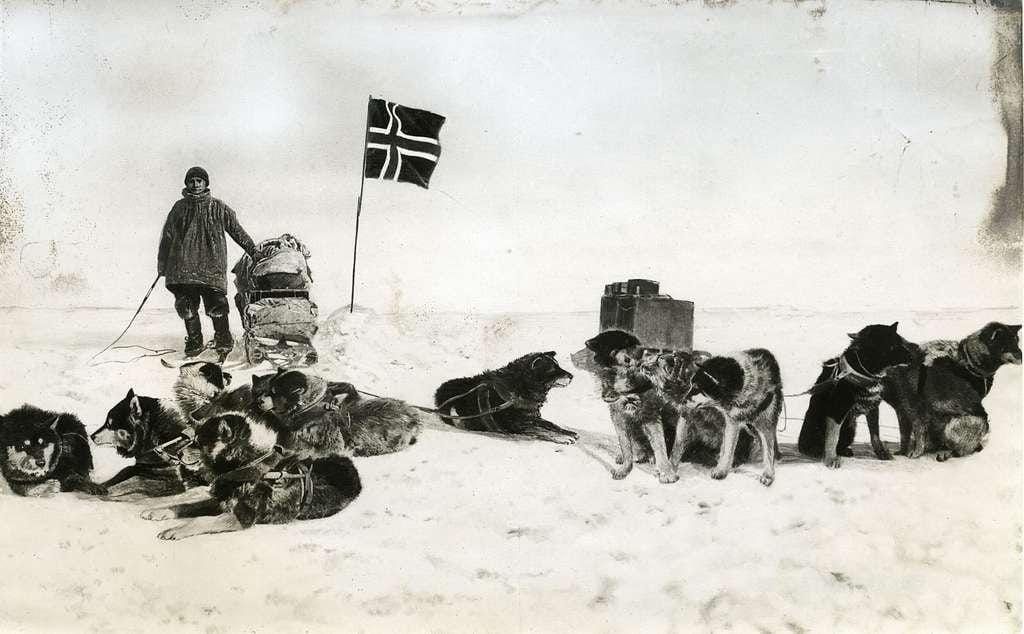
Nowhere is the contradiction more stark than in accounts of exploration, where extraordinary human accomplishments were sometimes made possible by animals whose lives were calculated as expendable provisions. The history of polar travel contains some of the most dramatic examples, and few are more revealing than the expedition that carried Roald Amundsen and his companions to the South Pole in 1911. Their achievement depended upon careful planning, remarkable endurance, and an intimate practical understanding of what dogs could accomplish in one of the most unforgiving environments on Earth. It also depended upon decisions about which dogs would continue the journey and which would not survive it, decisions made within a system that could regard the same animal as an indispensable partner and a source of food.
The Butcher's Shop
On December 14, 1911, Roald Amundsen and four companions reached the South Pole, becoming the first people known to have stood at the southernmost point on Earth. Their achievement was the culmination of years of preparation, extraordinary logistical discipline, and a journey across one of the most inhospitable landscapes on the planet. The Norwegian flag they planted in the Antarctic snow would become an enduring symbol of human exploration, a triumph subsequently recounted in books, commemorated in photographs, and incorporated into the history of an age when European nations competed to claim the remaining geographic extremes of the world.
Amundsen's success was also a triumph of canine labor, although the dogs who made it possible have received considerably less attention than the men who traveled behind them. His expedition departed its Antarctic base at Framheim with four men accompanying him and 52 dogs pulling four sledges. The animals carried food, equipment, and other supplies across the Ross Ice Shelf and toward the formidable mountain range separating the coastal ice from the high Antarctic Plateau. Their work was not incidental to the expedition's strategy. Amundsen had organized the journey around their capabilities, calculating how many animals would be needed at different stages, how much food they would consume, and how their numbers could be reduced as the expedition advanced.
The decision to rely so heavily on dogs reflected Amundsen's considerable respect for Arctic travel traditions. He had spent time among Inuit communities during his earlier Northwest Passage expedition, learning from people whose knowledge of snow, ice, clothing, equipment, and dog handling had developed through generations of practical experience. The lessons were not romantic curiosities collected by a European explorer. They were essential components of his approach to surviving and traveling efficiently in polar environments. Amundsen understood that successful exploration depended on adapting to the conditions of the landscape rather than attempting to overcome them through determination alone.
His admiration for dogs was similarly practical and informed. He knew their strength, their limitations, and the advantages they offered over other forms of transport. He understood that they required appropriate feeding, careful management, and an organized system of work. Unlike Robert Falcon Scott's British expedition, which employed a combination of motor sledges, ponies, dogs, and extensive human hauling, Amundsen built his polar strategy around experienced skiers and dog teams. The comparison between the expeditions has sometimes been simplified into a lesson about technological choices, but it also illustrates the importance of cultural knowledge and the willingness to learn from people who had already solved many of the problems presented by travel in extreme cold.
There was, however, another component of Amundsen's strategy, one that makes the expedition particularly revealing for an examination of the human relationship with dogs. The animals were not simply expected to carry the supplies needed for the journey. Some of them were themselves incorporated into the expedition's provisions. As the men advanced toward the Pole and their loads became lighter, Amundsen planned to kill dogs that were no longer required for pulling, using their bodies to feed the remaining animals and supplement the men's food. The arrangement reduced the amount of provisions that had to be transported from the coast and allowed the expedition to begin with a larger working population than it intended to bring home.
From the standpoint of expedition logistics, the calculation was brutally efficient. Every dog required food, and every additional pound of food required transportation. Dogs could pull far more than they consumed under favorable conditions, but the balance changed as the expedition progressed and supplies were depleted. By deliberately reducing the number of animals at a predetermined point, Amundsen could concentrate the remaining resources on the dogs and men who would continue toward the Pole. The plan converted part of the expedition's working population into a reserve of food, allowing the animals to contribute to the journey both through their labor and through their deaths.
The place where this calculation became reality was a camp on the Antarctic Plateau that Amundsen named the Butcher's Shop.
The expedition reached the location in November 1911, after an arduous ascent through the Transantarctic Mountains by way of the Axel Heiberg Glacier. The climb had demanded tremendous effort from the dogs, whose teams hauled heavy loads through deep snow and across difficult terrain while the men struggled to maintain progress. By the time they reached the plateau, the expedition had completed one of its most demanding stages. The terrain ahead remained dangerous and exhausting, but the sledges no longer needed to carry the same quantities of equipment and provisions required earlier in the journey.
Amundsen's plan called for the slaughter of 24 dogs at this point. The animals were killed, butchered, and divided into food for the men and the surviving dogs. Their bodies, which had carried the expedition through the mountains, became part of the means by which the expedition would continue. The location's name was a direct acknowledgment of what had happened there, a practical designation that entered the geographic record of one of the most celebrated journeys in the history of exploration.
The scene is difficult to contemplate without imposing our own emotional reactions upon it, and yet the historical account does not require embellishment. The men had traveled for weeks in intimate proximity to the animals. They knew the dogs as individuals, observed their temperaments and working habits, managed their conflicts, and depended on their cooperation for survival. The slaughter was not an encounter with unfamiliar livestock purchased for consumption. It involved animals whose labor had made the expedition's progress possible and whose continued existence had been part of the men's daily responsibilities.
Amundsen did not describe the event as an occasion of uncomplicated satisfaction. His published account acknowledged the emotional difficulty of killing animals that had served the expedition so faithfully. He understood the practical necessity within the plan he had devised, but that understanding did not eliminate the distress associated with carrying it out. The dogs were simultaneously companions in a demanding enterprise, valuable working animals, and resources whose lives had been assigned a place in the expedition's calculations.
This combination of affection and expendability is what makes the episode so revealing. It would be easy to condemn Amundsen as a man who cared nothing for his dogs, but the historical evidence does not support such a simple characterization. He valued them, admired their capabilities, and understood their contribution to the expedition's success. His decisions reflected a coherent strategy developed within the circumstances and assumptions of his time. He also regarded their deaths as an acceptable and necessary cost of accomplishing his objective, an objective the dogs had no capacity to understand or choose.
The distinction between necessity and choice deserves attention. Amundsen was operating in an environment where errors could result in the deaths of everyone involved, and his decisions were made within a demanding system of physical and logistical constraints. But the expedition itself was a human undertaking, organized to achieve a human ambition. The dogs had not elected to travel to the South Pole, and the circumstances that made their slaughter advantageous were created by the purposes and plans of the people responsible for them. Their deaths were necessary within a particular strategy, but the strategy and the goal it served were products of human choice.
This is not a judgment that Amundsen should have possessed the ethical vocabulary or animal welfare expectations of the twenty-first century. Historical analysis becomes impoverished when it merely prosecutes the past according to contemporary standards, ignoring the conditions under which people acted and the alternatives they understood to be available. The more interesting question is what the episode reveals about a relationship in which genuine respect for an animal's abilities can coexist with the assumption that its life may be sacrificed for human purposes.
The surviving dogs continued south with the expedition, pulling the reduced loads across the plateau toward the Pole. The men traveled through a landscape of immense white distances, crevasses, bitter temperatures, and persistent uncertainty about the terrain ahead. They relied on their instruments, their navigation, their physical endurance, and the animals moving before them. When they finally reached the Pole, the achievement belonged in practical terms to a traveling system that included both humans and dogs, although the historical distinction between explorers and equipment would largely determine how the event was remembered.
The expedition's return to Framheim in January 1912 completed a remarkable feat of planning and endurance. Amundsen and his four companions survived, and 11 dogs returned with them. Other dogs had died or been killed during the journey, their losses absorbed into the calculations through which the expedition had achieved its objective. The men returned to a world prepared to celebrate their accomplishment. The dogs who survived had completed the same extraordinary journey, while those who had died had contributed no less materially to its success.
The historical record is filled with similar asymmetries of recognition. We remember the names of explorers, military commanders, inventors, and political leaders, while the labor that supported their achievements often recedes into the background. In the case of animals, the disappearance is especially complete because they leave no written accounts of their experiences. Their participation is preserved in expedition journals, inventories, photographs, and occasional expressions of affection from the people who worked with them. The history of what they experienced must be reconstructed through records created primarily to document human activities.
Amundsen's dogs occupy an unusual position because their contribution is impossible to overlook. The expedition's dependence on them was explicit, and the deliberate slaughter at the Butcher's Shop makes the relationship between their usefulness and their expendability impossible to separate. The dogs were valued precisely because they could accomplish work that humans could not perform as efficiently, yet their value did not confer protection from decisions that subordinated their lives to the expedition's objectives. They were indispensable until the calculations determined that some of them were not.
There is a temptation to regard the episode as a relic of a harsher age, an extreme example drawn from circumstances so distant from ordinary life that it has little relevance to the way we treat dogs today. Most modern guardians will never ask their dogs to pull supplies across an Antarctic glacier, and the idea of deliberately killing a beloved companion to feed other animals would be horrifying to them. Contemporary expectations of canine welfare have changed substantially, and those changes represent genuine moral progress. We should recognize them rather than pretending that nothing has improved.
Yet the underlying relationship between affection, utility, and human authority has not disappeared. We continue to determine the purposes for which dogs are bred, the conditions under which they work, and the risks they are expected to accept. We distinguish among animals according to their suitability for particular human objectives, sometimes assigning extraordinary value to those who meet our requirements while providing far fewer protections or opportunities to those who do not. The circumstances are different, and the moral significance of those differences should not be minimized, but the fundamental imbalance of power remains.
The Butcher's Shop also exposes a limitation in the way we commonly understand gratitude. Amundsen could admire his dogs, depend upon them, and feel genuine sorrow at their deaths without concluding that their interests should override the expedition's requirements. Appreciation did not necessarily produce restraint. The animals' contribution was acknowledged, but the terms of the relationship remained entirely within human control.
That distinction matters far beyond polar exploration. We can recognize an animal's intelligence, loyalty, endurance, and capacity for attachment while continuing to organize its life around our own preferences. We can provide excellent care in some circumstances and impose substantial suffering in others, sometimes without perceiving a contradiction. Our affection may be entirely sincere, yet sincerity alone does not tell us whether the arrangements we create are justified from the animal's perspective.
The dogs at the Butcher's Shop had helped carry five men toward one of the most celebrated achievements in the history of exploration. Their labor was essential, their deaths were planned, and their contribution became part of a story remembered principally as a triumph of human determination. More than a century later, we possess vastly greater scientific knowledge about canine behavior, cognition, welfare, and the biological consequences of the choices we impose upon them. We also have far greater material resources and technological capabilities than Amundsen could have imagined. The question is whether those advances have been accompanied by a comparable willingness to reconsider the authority we assume over canine lives.
To answer that, we need to examine the place dogs occupy in contemporary society, where the language of companionship and rescue has become central to our understanding of the relationship. We have become accustomed to describing dogs as members of our families, celebrating their individuality, and regarding their welfare as an important moral concern. Those developments have transformed the lives of countless animals, but they have also created a peculiar contradiction between the affection we express for dogs and the institutions through which we decide which dogs will receive care, which will be rescued, and which will be left behind.
Who Rescued Whom?
At some point in the long history of our relationship with dogs, the animals who helped us hunt, travel, guard our settlements, and manage our livestock also became creatures we invited to sleep in our beds. The transformation was neither sudden nor universal. Dogs had occupied intimate places in human households for thousands of years, and the distinction between a working animal and a beloved companion was never as absolute as contemporary categories might suggest. Nevertheless, the modern companion dog occupies a remarkable position in societies that have become increasingly separated from the agricultural and subsistence economies in which much of our historical partnership developed.
For millions of people, the dog's principal occupation is now the maintenance of a relationship with its human family. It may never be expected to locate game, protect livestock, transport supplies, or perform any task more demanding than tolerating a trip to the veterinarian. Its value is understood through companionship, affection, amusement, and the emotional significance of sharing daily life with another living creature. This is a profound departure from the arrangements under which many of its ancestors lived, although the relationship remains rooted in capacities for social attachment and cooperation that developed long before the modern household existed.
The change has produced genuine improvements in the lives of many dogs. Veterinary medicine has extended the possibilities for treating injuries and diseases that once meant prolonged suffering or death. Advances in nutrition, preventive care, behavior science, and our understanding of animal welfare have made it possible to provide levels of comfort and security that would have been unimaginable to most earlier generations. In many households, dogs receive sustained attention to their physical and emotional needs, and their guardians willingly devote considerable time and resources to ensuring that they enjoy good lives.
The contemporary dog also benefits from an expanding recognition that animals possess experiences and interests of their own. Research into canine cognition, emotion, learning, and social behavior has helped challenge the idea that dogs are merely biological mechanisms responding to stimuli or performing functions assigned by humans. We increasingly understand that their lives involve preferences, expectations, attachments, frustration, fear, pleasure, and the capacity to experience their circumstances as better or worse. These are not reasons to attribute human thoughts or motives indiscriminately to dogs, but they are compelling reasons to take canine experience seriously when deciding how dogs should be treated.
Yet the elevation of dogs to family membership has produced a peculiar arrangement. We speak of them as children, companions, and loved ones while continuing to classify them legally, in most circumstances, as property. We determine where they live, with whom they associate, whether they reproduce, and what opportunities they have to engage in ordinary canine behavior. Their access to food, exercise, social interaction, veterinary care, and even the outdoors depends almost entirely on human decisions. A dog may be loved as a member of the family while possessing remarkably little control over the conditions of its own existence.
This does not mean that dependence itself is inherently exploitative. Human children, people with substantial care needs, and many other individuals depend on others to make decisions that affect their welfare, and responsible care necessarily involves exercising judgment on another's behalf. The ethical significance lies in how that authority is used, whose interests are considered, and whether the dependent individual's experience is treated as important in its own right. In the case of dogs, we have often assumed that affection provides sufficient evidence of good guardianship, even when the arrangements we create leave little room for the animal's preferences or needs.
The problem becomes particularly visible in the way we have shaped canine bodies through selective breeding. The extraordinary physical diversity of domestic dogs is frequently celebrated as evidence of human ingenuity, and in some respects it is. But many of the characteristics we have selected reflect aesthetic preferences or commercial demands rather than benefits to the animals themselves. Dogs bred for extremely shortened muzzles may experience serious respiratory difficulties, while exaggerated body proportions, inherited orthopedic conditions, and other selectively maintained characteristics can impose substantial lifelong welfare costs. The fact that a physical feature is desirable to human buyers does not mean that it is compatible with the well-being of the dog who must live with it.
Behavioral selection presents related questions. We have developed dogs with extraordinary capacities for sustained activity, vigilance, pursuit, social responsiveness, and specialized work, sometimes placing those animals in households whose circumstances provide few opportunities to satisfy the behavioral needs associated with those characteristics. A dog selected for intense activity may spend much of its life confined indoors, while an animal whose behavioral tendencies once supported a particular form of work may be expected to remain quiet and inactive through long periods of human absence. When the resulting frustration, distress, or unwanted behavior becomes difficult to manage, we frequently describe the problem as something wrong with the dog rather than examining the mismatch between the animal we have created and the life we expect it to lead.
None of this diminishes the sincerity of the relationships people form with their dogs. Indeed, the strength of those relationships is often what motivates guardians to seek professional assistance when difficulties arise. In my work, I regularly encounter people who care deeply about their animals but have received incomplete, misleading, or contradictory information about what those animals need. They may have been told that a dog requires firmer discipline when the underlying problem involves fear, pain, frustration, or inadequate opportunities for normal behavior. They may interpret distress during separation as disobedience, or regard a dog's attempts to increase distance from an unfamiliar person as a challenge to their authority. Often, meaningful improvement begins not with teaching the dog to comply more reliably, but with helping the human understand what the dog's behavior is communicating.
This is one reason I find the language of rescue both necessary and inadequate. The modern animal welfare movement has accomplished an enormous amount through the rescue, rehabilitation, and rehoming of dogs who would otherwise have faced neglect, abandonment, or death. Countless animals have benefited from the dedication of shelter workers, volunteers, foster caregivers, veterinarians, trainers, and adopters. The transformation of sheltering practices over recent decades, including the development of more sophisticated medical and behavioral care and a greater emphasis on finding appropriate homes, represents an important achievement that deserves recognition.
But rescue has also become a remarkably narrow way of imagining what it means to help dogs. In its most familiar form, the story begins with an animal in danger and ends with that animal entering a loving home. The structure is emotionally satisfying because it offers a recognizable victim, an identifiable intervention, and a conclusion in which the suffering has apparently been resolved. It is also readily communicated through photographs, videos, fundraising campaigns, and adoption announcements. A frightened dog becomes a relaxed dog, a neglected animal receives medical treatment, or a puppy leaves a crowded shelter in the arms of a delighted adopter. The transformation is visible, and the people who made it possible can reasonably feel proud of their work.
What the story frequently leaves out is everything that happened before the dog needed rescuing, along with the circumstances affecting the animals who remain outside the frame. Why was the dog born into conditions where adequate care was unlikely? What prevented its previous guardians from keeping it? Were affordable veterinary services, sterilization, behavior support, or housing assistance available? How many other dogs were experiencing similar difficulties, and what would have been required to prevent those difficulties from developing? The rescue of an individual animal may be entirely worthwhile while doing little to change the conditions that produced its suffering.
The distinction matters because the problems confronting dogs are not limited to the absence of adoptive homes. Dogs enter shelters for many reasons, including unwanted reproduction, housing instability, financial hardship, medical needs, behavioral difficulties, family changes, and the breakdown of relationships between animals and their guardians. Some are lost and never reunited with their families. Others are relinquished because the people responsible for them cannot obtain the resources or assistance needed to continue providing care. Still others have experienced neglect, abandonment, or circumstances in which their welfare was never adequately considered. These problems differ in their causes and require different responses, even when they eventually produce the same visible result: a dog in a kennel awaiting an uncertain future.
A comprehensive understanding of rescue must therefore extend beyond removing dogs from shelters. It should include preventing unwanted births, helping guardians retain animals they can care for, improving access to veterinary services, addressing behavior problems before relationships collapse, and ensuring that dogs entering shelters receive care appropriate to their physical and psychological needs. In some circumstances, the most consequential intervention may be one that prevents a dog from entering the shelter system at all. Such an outcome produces no adoption photograph and may never be recorded as a rescue, but its significance for the animal can be considerable.
The importance of these less visible interventions becomes clearer when we consider how dogs experience institutional care. A shelter may provide safety from immediate danger, reliable food, medical attention, and the possibility of a new home, but it is not necessarily an environment in which a dog can maintain good psychological welfare indefinitely. Kennels are often noisy, socially restrictive, and unpredictable. Dogs may have limited opportunities to control their surroundings, engage in preferred activities, or establish stable relationships with caregivers. For some animals, the experience is tolerable, particularly when their stays are brief and their needs are well managed. For others, prolonged confinement can produce serious distress or exacerbate existing behavioral difficulties.
The development of more humane shelter practices has helped address these problems, but the limitations of institutional care remain substantial. Enrichment, exercise, opportunities for choice, appropriate social contact, and careful behavioral assessment can improve welfare, yet all require time, staffing, space, and resources. When shelters operate beyond their practical capacity, even dedicated professionals may struggle to provide the individualized attention that some dogs require. The animal who has technically been rescued from one dangerous circumstance may enter another environment in which its welfare remains compromised, sometimes for weeks or months.
This is not an argument against shelters or the people who work within them. It is an argument for recognizing the difference between keeping an animal alive and providing that animal with a life worth living. Both matter, and the first is often a necessary condition for the second, but they are not interchangeable. An organization may achieve impressive live-release outcomes while still confronting serious welfare challenges among the animals in its care. Conversely, difficult decisions about quality of life, public safety, and the limits of treatment do not automatically indicate a failure of compassion. The moral seriousness of animal welfare work lies partly in acknowledging that good intentions cannot eliminate every conflict between competing needs and limited resources.
Our changing relationship with dogs also invites us to reconsider what we mean when we call them family. The word suggests intimacy, affection, and obligation, but it can conceal substantial differences in how those obligations are understood. A dog who shares a home with people may receive extraordinary medical care while being denied opportunities for ordinary social or exploratory behavior. Another may enjoy considerable freedom of movement but have little access to veterinary treatment. A working dog may experience a demanding, stimulating life characterized by close cooperation with humans, while a companion dog surrounded by expensive possessions may spend much of its time bored, isolated, or distressed. Welfare cannot be inferred reliably from the emotional language people use to describe their animals, nor from the amount of money spent on them.
The diversity of human–dog relationships across cultures provides an important corrective to the assumption that one particular arrangement represents the natural or ideal form of companionship. In some societies, dogs live in close physical proximity to humans while retaining considerable freedom to move and interact with other animals. In others, their relationships with people are organized primarily around work, community membership, or practical cooperation. Some cultural traditions recognize dogs as beings with individual identities and forms of social standing that do not fit neatly within Western distinctions between persons and property. These arrangements vary enormously in their welfare consequences, and none should be romanticized simply because it differs from contemporary American pet ownership.
What they reveal is that our assumptions about dogs are cultural as well as biological. The animal we call a family member is the same species that another community may regard as a working partner, a free-roaming neighborhood animal, or a creature occupying a very different position within its moral and social world. The dog's underlying capacities for attachment, learning, distress, pleasure, and social interaction do not disappear when the cultural interpretation changes. But the opportunities available to express those capacities, and the obligations humans recognize toward the animal, can differ profoundly.
The language of family has nevertheless created an opening for a more serious ethical understanding of our responsibilities. If we genuinely regard dogs as individuals whose experiences matter, then our concern cannot reasonably end with the animals who happen to belong to us. Nor can it be limited to those whose appearance, temperament, age, or circumstances make them appealing candidates for adoption. A dog living in a crowded municipal shelter has welfare interests no less real than those of a dog sleeping on an expensive bed in a comfortable home. The fact that one animal has a devoted guardian and the other does not may determine the resources available to them, but it does not establish a corresponding difference in their capacity to suffer or flourish.
The same principle applies to dogs whose behavior makes them difficult to place. An animal experiencing severe fear, aggression, separation-related distress, or other complex problems may require far more assistance than a healthy, socially confident puppy. Its prospects may be uncertain, and in some cases its needs or risks may exceed what can reasonably be managed. But the difficulty of helping an animal does not make its experience less important. It makes the decisions surrounding its care more demanding, requiring careful assessment, appropriate expertise, and an honest consideration of both the dog's welfare and the safety of others.
These are uncomfortable questions for a culture that has become adept at celebrating rescue as an uncomplicated moral victory. We prefer stories in which every deserving animal finds a loving home, every behavioral problem can be resolved through patience, and every act of compassion produces a happy ending. The actual work of animal welfare is considerably less accommodating. Resources are finite, outcomes are uncertain, and decisions made on behalf of one animal can affect the opportunities available to many others. A serious commitment to dogs requires more than the desire to feel good about helping them. It requires the willingness to confront the systems through which help is distributed and the consequences of the choices those systems make.
I have encountered this tension repeatedly in professional settings where people were doing their best to save dogs while operating within institutions whose definitions of success did not always capture the full scope of the problem. A dog leaving a shelter for a new home is an important outcome, but it tells us relatively little about the conditions that produced the animal's need for sheltering, the welfare of the dogs who remain, or the effectiveness of efforts to prevent future suffering. An adoption count can demonstrate that an organization has helped many animals without establishing that the broader population is becoming healthier, more stable, or less dependent on emergency intervention.
The distinction is not merely philosophical. It shapes how organizations allocate money, how communities measure progress, which animals receive attention, and which forms of suffering remain largely invisible. When success is defined primarily through the number of animals transferred, treated, or adopted, institutions have powerful incentives to prioritize interventions that produce those measurable outcomes. Prevention, guardian support, and improvements in the welfare of animals who never enter the shelter system can be more difficult to document, communicate, and fund, even when their long-term benefits are substantial.
There is a profound irony in the way we have arrived at this point. We began our association with dogs as participants in a shared ecological and social world, developing relationships that expanded the possibilities available to both species. Over thousands of years, we acquired increasing control over their reproduction, behavior, movement, and living conditions, eventually creating populations whose welfare depends heavily on human decisions. We now celebrate ourselves for rescuing dogs from circumstances that are often direct or indirect consequences of those decisions, while devoting comparatively less attention to the responsibilities created by our power to shape their lives.
The question of who rescued whom is therefore more than a sentimental reversal of the familiar adoption story. Dogs have contributed to human survival, prosperity, social life, and emotional well-being across an extraordinary span of history. We have benefited from their labor, their sensory capacities, their adaptability, and their willingness to participate in relationships with us. In return, we have provided care and protection to many, while also creating conditions of dependence and vulnerability that leave countless others exposed to preventable suffering.
Understanding that contradiction requires looking beyond the individual dog and into the institutions responsible for deciding which animals receive assistance. It requires examining the difference between the outcomes an organization can proudly report and the conditions that continue to produce animals in need. And it requires confronting a particularly uncomfortable possibility: that some of our most celebrated forms of rescue, however sincere and beneficial to the animals involved, may coexist with systems that leave the larger problem substantially unchanged.
The Dogs We Save, and the Dogs We Don't
In California's Central Valley, the distance between an animal shelter and a wealthy metropolitan community can be measured in a few hours of driving. The distance between their resources, however, can be considerably greater. In one place, a nonprofit organization may have access to sophisticated veterinary facilities, professional behavior staff, extensive volunteer networks, and donors capable of supporting ambitious programs. In another, a municipal shelter may be struggling to provide adequate housing, medical attention, and daily care for a population of animals that substantially exceeds its capacity. Both institutions may describe their work through the language of rescue, but they operate within profoundly different material circumstances.
I encountered this disparity firsthand while working in the behavior and training department of one of the nation's leading nonprofit animal welfare organizations, headquartered in Silicon Valley, one of the wealthiest regions on Earth. The organization possessed substantial expertise, a committed staff, and the capacity to provide levels of care unavailable to many of the public shelters from which it received animals. Its work helped thousands of dogs and cats find homes, and many of its programs reflected a genuine commitment to improving animal welfare. I was proud of much of what my colleagues accomplished, particularly the dedication with which they approached animals whose needs demanded patience, specialized knowledge, and sustained attention.
Part of my work involved visiting municipal and regional shelters, observing the conditions in which animals were being housed, and helping develop procedures for assessing dogs who might be transferred into our care. These visits took me into communities where the scale of unwanted animal reproduction, abandonment, and inadequate access to veterinary services had overwhelmed the available sheltering infrastructure. The circumstances varied from one jurisdiction to another, but the underlying pattern was familiar: too many animals entering systems with too few resources to meet their needs, and too few effective interventions addressing the conditions that continually replenished the population.
The contrast with Silicon Valley was difficult to ignore. Our organization could offer a dog a comparatively well-resourced environment, access to professional medical and behavioral care, and exposure to a substantial population of potential adopters. The shelters we visited were often confronting much more immediate questions about space, staffing, and the number of animals they could safely accommodate. The practical value of transferring a dog from one institution to another was therefore obvious. A dog who might have faced an uncertain or dangerous future in an overcrowded municipal facility could be brought into an organization with greater resources and a stronger prospect of adoption.
I participated in developing and implementing policies governing which dogs would be selected for those transfers. The central preference was for medically and behaviorally healthy, adoptable puppies, with limited exceptions that could include nursing mothers and their litters. This was not an accidental outcome of individual staff preferences. It was an institutional approach to rescue, shaped by considerations of capacity, resources, adoption prospects, and the organization's ability to place animals successfully.
From an operational standpoint, the logic was readily understandable. Healthy puppies generally present fewer placement barriers than adult dogs with complicated medical histories or significant behavioral concerns. They are appealing to adopters, can often be moved through the shelter system relatively quickly, and offer a comparatively predictable path from transfer to adoption. In a facility where kennel space, staffing, and financial resources are finite, those characteristics matter. Selecting animals likely to be adopted promptly allows an organization to help more individuals over a given period, and successful placements are legitimate outcomes rather than merely attractive statistics.
But the selection process also revealed the limitations of understanding rescue primarily through the animals who successfully pass through it. Every dog transferred into our care represented an opportunity for that individual animal, while the dogs who remained in the source shelter continued to face the conditions that had made rescue necessary. Some would eventually be adopted locally or transferred through other arrangements. Others would remain confined in overcrowded facilities, and some would be euthanized when their shelters could no longer accommodate them or when medical, behavioral, or other circumstances made continued care untenable.
The fate of those dogs did not become part of our organization's adoption statistics. Our outcomes described what happened to animals who entered our system, not what happened to the larger population from which they had been selected. A successful transfer could therefore improve the receiving organization's reported performance while leaving the underlying conditions at the source shelter largely unchanged. The distinction is not evidence that the transfers were meaningless or that the animals rescued should have been left behind. It is evidence that the success of an individual intervention and the success of a population-level strategy are different questions.
I remember the experience of visiting shelters where the number of dogs needing assistance made the limits of selective rescue painfully apparent. The animals did not arrive in convenient categories corresponding to the resources available to help them. There were puppies, adolescents, adults, dogs with uncertain histories, animals whose behavior could not be adequately evaluated under the circumstances, and dogs whose medical needs exceeded what the shelter could reasonably provide. Their prospects depended not only on their individual characteristics but on the capacities of the institutions responsible for them and the availability of other organizations willing to intervene.
A dog who appeared socially confident, physically healthy, and readily adoptable might be an excellent candidate for transfer. Another, perhaps older or more fearful, might be passed over because the receiving organization could not confidently predict its placement prospects or the resources its care would require. Those judgments were not necessarily arbitrary or professionally indefensible. They reflected real constraints, and making them responsibly required careful attention to both animal welfare and the consequences of accepting a dog whose needs might exceed available capacity.
Nevertheless, the process was morally uncomfortable. The animals were not competing for admission to a program they had voluntarily applied to join. They were living beings whose circumstances had been shaped by human decisions, human institutions, and failures of human provision. Their chances of receiving assistance depended partly on whether they possessed characteristics that made them attractive candidates for an organization operating under its own financial and operational constraints. We were making choices about which dogs could be helped, while the circumstances requiring those choices continued to produce more dogs than the combined system could accommodate.
The problem was not that our organization had failed to recognize the importance of prevention. In conversations among staff and leadership, we discussed the need for more sustained intervention in the communities from which animals were being transferred. The obvious question was whether some of the resources devoted to moving and rehoming puppies might produce greater long-term benefits if invested in accessible sterilization services and other measures designed to reduce the number of animals entering crisis in the first place. The issue was not a lack of awareness that unwanted reproduction contributed to shelter overcrowding. It was the difficulty of reorganizing a successful rescue model around interventions whose results would be less immediate, less visible, and potentially less attractive to donors.
Fundraising was part of that conversation. Puppies arriving from overcrowded shelters offered a compelling story, one that could be communicated through photographs, adoption announcements, and accounts of individual animals receiving a second chance. Dramatic medical rescues could be similarly powerful, particularly when treatment produced a visible transformation. Sustained sterilization programs in distant communities offered a different proposition: substantial expenditure over time, complicated coordination with local providers, and success measured partly through animals who would never be born into circumstances of inadequate care.
There was concern that moving resources away from highly visible rescue activities toward less emotionally immediate prevention work might undermine donor support. I cannot establish that donors would actually have responded that way, because the anticipated reaction was not the same thing as a demonstrated outcome. But the concern itself mattered. It influenced how people thought about the organization's options and exposed a tension between the interventions most readily celebrated by supporters and those that might address the causes of suffering more directly.
This was not a conflict between compassionate staff and indifferent administrators, nor between people who cared about animals and people who cared only about money. The individuals involved understood that resources were limited and that maintaining donor support was necessary to continue providing services. Many were deeply committed to improving outcomes for animals across the region. The difficulty was structural: an institution could become exceptionally effective at a particular form of rescue while depending on a financial and public narrative that made it difficult to redirect substantial resources toward preventing the need for that rescue.
The result was a kind of rescue paradox. The more successfully an organization transferred and adopted animals, the more evidence it could present of its effectiveness. That success could generate additional public support, allowing it to continue and perhaps expand the same activities. Yet the number of animals requiring rescue might remain substantial if the conditions producing unwanted births, abandonment, and inadequate care were not being addressed at a comparable scale. An institution could improve its own outcomes while the broader system continued to generate suffering faster than the available resources could resolve it.
The distinction becomes especially important when organizations operate across communities with sharply unequal resources. A receiving shelter in a wealthy region can relieve immediate pressure on a facility elsewhere, but it cannot indefinitely absorb the consequences of inadequate veterinary access, uncontrolled reproduction, housing instability, and limited public investment in the communities supplying those animals. Transfer programs redistribute some of the animals already in need. They do not necessarily reduce the number of animals who will need help tomorrow.
In Fresno, the pressures on municipal animal services have illustrated how severe the mismatch between need and capacity can become. The city has at times restricted the routine intake of healthy found stray dogs, instead asking residents who encounter them to provide temporary care or help locate their guardians. Such policies are often defended as ways to avoid overcrowding and reduce the harms associated with unnecessary shelter admission. In principle, keeping a healthy found dog in the community while searching for its family can be preferable to placing it in a stressful institutional environment, particularly when effective reunification services and practical support are available.
But the consequences depend heavily on the resources and circumstances of the community. Asking residents to hold found dogs assumes that they possess suitable housing, time, money, transportation, and the ability to manage an unfamiliar animal safely. Some people can provide that assistance; others cannot. When a shelter's intake restrictions are not accompanied by adequate alternatives, the burden of caring for stray animals shifts from public institutions to individuals whose capacity to help may be even more limited. The dogs do not disappear because a shelter cannot admit them, and the risks associated with roaming, injury, illness, reproduction, and conflict remain.
There is an important distinction between carefully designed community-based sheltering and the effective withdrawal of institutional capacity. Programs that support temporary caregivers, provide veterinary services, facilitate reunification, and respond appropriately to animals in danger can reduce unnecessary shelter confinement. But a policy of declining intake is not, by itself, a solution to the population pressures that produced the restriction. Without sufficient prevention, affordable care, and meaningful assistance for residents, it may simply move the consequences of inadequate resources beyond the walls of the shelter.
Tulare County presents another perspective on the same problem. In visits to the region, I encountered conditions reflecting the difficulties of providing animal services across a large geographic area with substantial unmet need. Access to sheltering and veterinary care can be complicated by distance, transportation, staffing, and the practical limitations of facilities serving widely dispersed communities. Free-roaming dogs and unwanted reproduction become particularly difficult to address when residents cannot readily obtain affordable sterilization services or assistance with animals they are unable to keep.
The county's animal services system has continued to accept stray dogs from its jurisdiction, and it would be inaccurate to characterize its policies as a formal program of allowing dogs to roam and reproduce without intervention. The issue is more fundamental than any single intake policy. A public agency may retain legal responsibility for animal control while lacking the personnel, veterinary capacity, kennel space, and community infrastructure required to meet the full scale of need. Formal responsibility and practical accessibility are not the same thing, particularly when the people most in need of services face substantial barriers to obtaining them.
Plans to expand kennel capacity can provide meaningful relief under these circumstances. Additional housing may reduce overcrowding, improve animal welfare, and give staff more flexibility to manage intake and placement. Such investments should not be dismissed simply because they do not address every cause of the problem. Animals already in the system need adequate care, and facilities cannot provide it through good intentions alone.
But expanding a shelter without investing in the conditions that determine how many animals enter it risks creating a recurring cycle of capacity shortages. New kennels may fill, staffing demands may increase, and the institution may eventually find itself confronting the same pressures at a larger scale. The question is not whether shelters need more space, but whether additional space is part of a broader strategy that includes prevention, access to veterinary care, community support, and credible measures of population-level progress.
The contradictions are not confined to rural or economically disadvantaged regions. San Jose, located within the same extraordinarily wealthy metropolitan economy that supports some of the world's most valuable corporations, has faced serious and publicly documented challenges in its municipal animal care system. Overcrowding, staffing limitations, gaps in sterilization access, and concerns about the quality and consistency of animal care have become subjects of public scrutiny. The proximity of immense private wealth has not automatically produced a municipal sheltering system equipped to meet every animal's needs.
A 2026 Santa Clara County civil grand jury report examining San Jose's animal services identified problems extending beyond the immediate condition of the shelter. Among its concerns were the availability of public spay and neuter services, the decline in rescue transfers, inconsistencies in data, and the need for greater transparency about animals turned away because of capacity limitations. These issues are interconnected. A shelter cannot be evaluated adequately through adoption and euthanasia statistics alone if substantial numbers of animals needing assistance never enter the facility or if the information required to understand population pressures is incomplete.
San Jose has also reported improvements in some outcomes, and it would be misleading to portray the system as one in which nothing has changed or every difficulty remains unaddressed. Public agencies operate under financial, legal, and political constraints, and their performance can improve in one area while serious problems persist in another. The purpose of examining these cases is not to construct a simple narrative of institutional incompetence. It is to recognize that even communities possessing extraordinary economic resources can fail to organize sufficient public investment, preventive services, and accountable systems of care for animals whose welfare depends on them.
The same problem complicates national discussions of sheltering. Recent data from Shelter Animals Count indicate that millions of dogs continue to enter American shelters each year, with large numbers adopted and hundreds of thousands euthanized. Those figures represent substantial animal welfare activity, but they do not tell the entire story. National trends have shown improvement in some measures, and conditions vary significantly across regions. A community experiencing severe overcrowding may coexist with another whose shelters have available capacity, just as a national decline in a particular outcome can obscure worsening circumstances in specific jurisdictions.
Moreover, shelter statistics primarily describe animals who become visible to the reporting system. They may not capture dogs whose guardians cannot obtain assistance, animals turned away because facilities are full, free-roaming populations outside institutional care, or the consequences of delayed access to affordable veterinary services. The absence of an animal from a shelter's intake records does not establish that the animal is safe, healthy, or adequately cared for. If we measure only the dogs who enter our institutions, we risk mistaking the boundaries of our data for the boundaries of the problem.
This limitation has important consequences for how animal welfare organizations define success. Adoption totals, live-release rates, length of stay, and other operational measures provide valuable information about institutional performance. They can reveal improvements, identify problems, and support accountability. But none of them, individually or collectively, establishes whether a community is producing fewer animals in need, whether guardians are better able to provide care, or whether dogs outside the shelter system are experiencing improved welfare.
An organization may report an excellent live-release rate because it has developed effective medical care, behavior support, foster programs, and adoption services. Another may achieve a similarly impressive figure partly through restricting admission to animals with favorable placement prospects. The number alone cannot explain the difference. Likewise, a municipal shelter that accepts a broad range of animals, including those with serious medical or behavioral needs, may report more difficult outcomes while providing a service that other institutions are unwilling or unable to offer. Meaningful evaluation requires understanding which animals each organization serves, which it does not, and what happens to those outside its care.
The distinction between selection and responsibility is central to this accounting. Private nonprofit organizations often possess greater discretion over the animals they accept, while municipal agencies may have statutory obligations to respond to strays, dangerous animals, and other circumstances affecting public safety and animal welfare. These different roles can make direct comparisons misleading. A rescue organization selecting healthy puppies from a crowded public shelter and a municipal agency receiving animals regardless of their adoption prospects are not operating under equivalent conditions, even when both describe their work through the language of saving lives.
None of this means that selective rescue should end. A healthy puppy transferred from a crowded shelter into a well-resourced adoption program has received a genuine benefit, and the people who made that possible have accomplished something worthwhile. The difficulty arises when those successes become the principal evidence that the larger system is working. They can demonstrate the effectiveness of a particular intervention without showing whether the community's underlying problems are diminishing.
The question I came to ask during my work in sheltering was therefore not simply how many dogs we could transfer, rehabilitate, or adopt. It was whether our activities were reducing the number of dogs who would need those interventions in the future. The distinction changes the way success is understood, because it directs attention toward outcomes that may never produce a photograph, a compelling individual story, or a celebratory announcement.
A puppy who is adopted after transfer from an overcrowded shelter has benefited from rescue. A puppy who is never born into circumstances where adequate care is unavailable represents a different kind of outcome, one that may be less emotionally immediate but no less consequential to the welfare of the population. A dog who remains safely with its guardian because affordable veterinary treatment or effective behavior assistance was available may never appear in an organization's adoption statistics. A community in which fewer animals are abandoned, fewer litters are unwanted, and fewer dogs experience prolonged shelter confinement may be accomplishing something more substantial than a community that has become exceptionally efficient at moving animals through a continually overwhelmed system.
The difficulty is that the first kind of success is easy to see, while the second often requires sustained investment, careful measurement, and a willingness to recognize achievements that cannot be reduced to individual rescue narratives. It also requires institutions to examine whether their funding models and public identities reward the interventions most likely to reduce suffering or merely those most readily presented as evidence of compassion.
My experience in Silicon Valley left me convinced that this is one of the central challenges facing contemporary animal welfare. We have developed organizations capable of extraordinary interventions on behalf of individual animals, staffed by people whose skill and dedication deserve genuine respect. We have also constructed systems in which the visibility of rescue can overshadow the less dramatic work required to reduce the conditions that make rescue necessary.
The dogs selected for transfer deserved the opportunities they received. The dogs left behind deserved consideration no less serious, even when the receiving organization could not accommodate them. And the communities from which those animals came deserved more than a continuing arrangement in which the most readily adoptable dogs were periodically removed while the circumstances producing unwanted animals remained substantially unchanged.
If we are serious about improving the lives of dogs, the measure of our success cannot stop at the number we save. It must also include the number who no longer need saving, and the willingness to invest in making that number grow.
The Arithmetic of Prevention
There is something profoundly unsatisfying about preventing a tragedy that nobody ever sees. No frightened animal is carried from a crowded kennel into the arms of a rescuer. No dramatic surgery transforms a badly injured dog into an exuberant survivor. There is no photograph of a grateful adopter, no reunion video, and no individual whose story can be told as a journey from suffering to salvation. The achievement consists of an event that never happens, a litter never born into circumstances where adequate care is unavailable, a family never forced to surrender a dog because veterinary treatment was beyond its means, or a shelter kennel that remains empty because the animal who might have occupied it never needed to enter the system.
This is a peculiar disadvantage for prevention in a culture that has learned to communicate compassion through images of rescue. The immediate suffering of an identifiable animal is emotionally compelling, and the desire to relieve it is both natural and admirable. We respond to faces, stories, and circumstances we can understand. An injured dog requiring surgery presents a concrete problem with a recognizable solution, and a successful recovery offers the satisfaction of knowing that an intervention made a visible difference. A program designed to reduce unwanted births across an entire county asks us to imagine a different kind of outcome, one whose beneficiaries may never exist as identifiable individuals and whose success may only become apparent through changes in population-level data over several years.
Psychologists have studied aspects of this distinction through what is commonly called the identifiable victim effect, the tendency for people to respond more strongly to the circumstances of a particular individual than to equivalent or greater suffering described statistically. Research by Deborah Small, George Loewenstein, and Paul Slovic helped establish the importance of identifiable victims in charitable decision-making, although subsequent studies have shown that the relationship between identification, emotion, and giving is more variable than a simple universal rule would suggest. People are capable of responding generously to large-scale problems, particularly when they understand the stakes and believe their contributions can produce meaningful results. Nevertheless, the appeal of an individual rescue story is obvious, and animal welfare fundraising has become exceptionally skilled at presenting such stories.
The resulting incentives are not necessarily the product of cynical manipulation. A development professional who raises substantial funds through a compelling medical rescue may be enabling genuinely valuable care. A donor who contributes to the treatment of an injured dog has helped an animal whose suffering matters. The difficulty emerges when the forms of intervention that attract attention and money become disproportionately influential in determining how institutions organize their work. An organization may find it easier to finance a succession of expensive individual rescues than to sustain the less visible programs that could prevent large numbers of animals from entering dangerous circumstances.
The arithmetic is particularly consequential when unwanted reproduction contributes substantially to shelter intake. A single unplanned litter may produce several puppies, each requiring food, shelter, veterinary care, socialization, and eventually a suitable home. If those puppies are not placed responsibly or sterilized when appropriate, some may reproduce in turn. The familiar exponential illustrations of canine population growth are often exaggerated because they ignore mortality, reproductive variation, resource limitations, and the many animals who never reproduce. But the underlying problem does not require fantastical projections. In communities where substantial numbers of dogs reproduce without adequate planning or access to veterinary care, new animals can enter the population faster than existing systems can provide secure homes and appropriate care.
The consequences extend beyond the puppies themselves. Unwanted litters consume household resources, increase pressure on shelters and rescue organizations, and create additional demand for veterinary services in places where those services may already be scarce. Animals who cannot be accommodated may remain in unstable homes, roam without reliable care, or enter facilities whose capacity has been exhausted. Even where shelters successfully place large numbers of dogs, the continual arrival of additional animals can prevent meaningful improvement in the overall system. The problem becomes a recurring emergency, with institutions measuring their effectiveness through how many animals they move out while insufficient attention is paid to how many continue to enter.
We cannot adopt our way out of an unchecked reproductive population crisis. Adoption is indispensable for animals who already need homes, and rescue transfers can provide immediate relief to overwhelmed facilities, but neither intervention prevents the next unwanted litter. A shelter may double its adoption capacity and still face severe overcrowding if the number of animals entering the system continues to exceed the number it can safely accommodate. The essential question is whether our efforts are changing the conditions that produce the demand for rescue, rather than merely improving our ability to respond after the animals have arrived.
Sterilization is among the most important tools available for addressing this problem, but its effectiveness depends on how programs are designed and sustained. A few subsidized surgeries offered intermittently in a community with substantial unmet need may provide meaningful benefits to the participating animals and their guardians without producing a measurable reduction in the broader population. A geographically targeted program with sufficient veterinary capacity, accessible appointments, community participation, and sustained coverage offers a different prospect. The relevant measure is not simply how many surgeries an organization performs, but whether the intervention reaches enough of the animals contributing to unwanted reproduction to change the population's trajectory.
That distinction sounds straightforward until one considers the practical demands involved. Affordable sterilization requires veterinarians, technicians, facilities, equipment, medications, transportation, administrative support, and systems for identifying communities where access is most limited. A nominally low-cost clinic may remain inaccessible to a guardian who cannot take time off work, lacks transportation, or must wait months for an appointment. Programs may also fail to reach dogs whose guardians are distrustful of institutions, unfamiliar with available services, or unable to navigate complicated application procedures. Providing a service and making it genuinely accessible are not the same accomplishment.
Effective prevention therefore requires understanding the circumstances in which animals and people actually live. In one community, the principal barrier may be the cost of surgery. In another, it may be the absence of veterinary professionals within a reasonable distance. Elsewhere, housing instability, limited transportation, language barriers, or inadequate information may prevent people from obtaining services they would otherwise welcome. Free-roaming dog populations present additional challenges involving ownership, community relationships, capture, recovery, movement between areas, and the continuing arrival of unsterilized animals. A successful strategy must respond to these differences rather than assuming that a single intervention will produce equivalent results everywhere.
The experience of large-scale dog sterilization programs outside the United States illustrates both the promise and the limitations of population management. In 2025, researchers reported results from a randomized controlled trial of a sterilization intervention involving free-roaming dogs in Goa, India. The program sterilized approximately 3,222 dogs and achieved estimated female sterilization coverage of roughly 58 to 66 percent in intervention areas. Researchers observed reductions in puppies and lactating females, evidence that the program was affecting reproduction. Yet the study did not find a statistically significant reduction in the adult dog population over the two-year observation period.
It would be a serious mistake to interpret that result as evidence that sterilization does not work. The study demonstrated effects on reproduction, while also revealing how difficult it can be to produce rapid changes in an established, open dog population. Adult dogs already living in the community do not disappear when new births are prevented, and animals may move into treated areas from surrounding locations. Population changes can take years to emerge, particularly when interventions do not achieve sufficiently broad and sustained coverage. The findings reinforce the importance of designing programs around the ecology and movement of the animals involved, rather than expecting a limited campaign to resolve a complex population problem almost immediately.
The circumstances of free-roaming dogs in India differ substantially from those of dogs entering American municipal shelters. Legal frameworks, cultural relationships with community animals, patterns of ownership, veterinary infrastructure, and the ecology of free-roaming populations all influence which interventions are appropriate and how their outcomes should be evaluated. The lesson is not that California is destined to reproduce the conditions found in another country. It is that population pressures become increasingly difficult and expensive to manage when prevention is delayed, access to care remains inadequate, and interventions are too fragmented to alter the underlying dynamics.
There is also an ethical reason to prefer early, sustained prevention over repeated emergency response. Once large numbers of animals are living without reliable access to food, shelter, veterinary care, and protection from injury, the available choices become more difficult. Public agencies may face conflicts involving animal welfare, human safety, environmental impacts, and limited resources. Communities may become divided over how animals should be managed, particularly when proposed interventions involve confinement, removal, or euthanasia. Preventing avoidable population growth before these conflicts become severe is not merely a matter of administrative efficiency. It can reduce the likelihood that animals and people will eventually face choices in which every available option carries substantial costs.
None of this means that sterilization should be treated as a universal solution to every problem confronting dogs. Animals enter shelters because of housing restrictions, financial emergencies, guardian illness, behavioral difficulties, inadequate veterinary access, and changes in family circumstances, among many other reasons. A sterilized dog can still become homeless, experience neglect, develop serious behavioral problems, or require care beyond its guardian's resources. Population stabilization is essential where unwanted reproduction is a major driver of suffering, but it must be accompanied by services that help existing animals remain healthy, secure, and appropriately cared for.
Guardian retention is one of the most important of these services, and one of the least visible in conventional accounts of rescue. When a family seeks to surrender a dog because it cannot afford veterinary treatment, assistance with that treatment may preserve a relationship that would otherwise end. When a guardian is struggling with separation-related distress, reactivity, or another behavioral problem, timely access to qualified professional support may prevent the situation from deteriorating into relinquishment. Temporary housing assistance, pet food support, transportation to veterinary appointments, and other practical interventions can sometimes make the difference between a dog remaining in a stable home and entering an already burdened shelter system.
Such programs should not be romanticized as inexpensive solutions that invariably succeed. Medical treatment can be costly, behavior modification may require sustained effort, and some households face circumstances that cannot reasonably be resolved through limited assistance. There are also cases in which retaining an animal in its current home is not compatible with the welfare or safety of the dog, the guardian, or others. Responsible retention work must recognize those limits and avoid pressuring people to maintain arrangements that are no longer viable. But when an appropriate intervention can preserve a safe and mutually beneficial relationship, its value should not depend on whether it produces an adoption statistic.
The same reasoning applies to behavior support before a crisis develops. Many guardians receive little meaningful education about canine development, normal behavior, learning, and the conditions necessary for good welfare. They may acquire a dog whose physical or behavioral characteristics are poorly matched to their circumstances, or they may encounter problems for which the available advice is contradictory and ineffective. Early assistance can improve the relationship, reduce frustration, and prevent difficulties from escalating. It can also help people recognize when pain, illness, fear, or environmental stressors are contributing to behavior that might otherwise be interpreted as defiance or disobedience.
In my own work, I have seen how consequential these interventions can be. A guardian who learns to recognize early signs of discomfort may stop repeatedly exposing a fearful dog to situations it cannot tolerate. A family who understands separation-related behavior may begin addressing distress rather than punishing its consequences. A household struggling with resource guarding may implement management procedures that reduce the risk of conflict while a carefully designed treatment plan develops. None of these interventions guarantees a successful outcome, but each can change the conditions under which a dog lives and potentially prevent a more serious crisis.
The financial implications are worth examining with care. A shelter admission can involve intake processing, housing, feeding, cleaning, veterinary assessment, vaccination, sterilization, behavior evaluation, enrichment, administrative work, and adoption services. Animals with complex needs may require considerably more. Preventing an avoidable admission can therefore conserve resources while sparing the dog the disruption and potential distress of institutional confinement. But the savings are not always immediate or easily captured within the budget of the organization paying for prevention. A county may fund a sterilization program while the benefits emerge gradually through reduced shelter intake, improved community welfare, and lower demand for services across multiple agencies.
This creates a familiar problem in public policy. The institution responsible for financing an intervention may not receive all of its benefits, while the costs of failing to act are distributed across households, shelters, veterinary providers, rescue organizations, and the animals themselves. Prevention can appear expensive when evaluated as a discrete program, particularly if its results take years to become measurable. Emergency response, meanwhile, may be treated as an unavoidable operating expense even when a portion of that demand could have been reduced through earlier investment.
The accounting becomes still more complicated when private philanthropy is involved. Donors often support organizations because they trust their missions and respond to compelling evidence that their contributions are helping animals. There is no inherent reason they cannot be persuaded to support prevention, particularly when organizations explain its importance and demonstrate credible results. But communicating population-level success requires a different approach from presenting the recovery of an individual dog. It asks supporters to value reductions in suffering that may not produce emotionally satisfying narratives, and it requires institutions to invest in measurement, transparency, and long-term relationships with the communities they serve.
The concern I encountered in Silicon Valley was that shifting resources away from visible rescue might weaken the donor support on which the organization depended. That possibility deserved serious consideration, but it should not have been treated as an immutable law of philanthropy. Donor preferences are influenced by the stories organizations tell, the outcomes they choose to emphasize, and the expectations they establish about what effective animal welfare work looks like. If supporters are repeatedly shown that saving dogs means transporting puppies from crowded shelters into adoptive homes, it should not surprise us when that becomes the activity they most readily recognize and celebrate.
Organizations can choose to tell a more complete story. They can explain how accessible sterilization changes reproductive patterns, how guardian support reduces avoidable relinquishment, and how investments in veterinary capacity improve welfare across entire communities. They can report not only the animals adopted but the animals retained in appropriate homes, the demand for services that remains unmet, and the changes occurring in the populations from which shelter intakes originate. These outcomes may be more difficult to measure than adoptions, but difficulty is not a sufficient reason to exclude them from our understanding of success.
The question of funding is especially important because animal welfare institutions operate within a society capable of directing extraordinary resources toward activities it considers valuable. The United States possesses immense private wealth, sophisticated veterinary and biomedical industries, and public institutions capable of organizing complex programs across large geographic areas. Yet access to basic veterinary care remains uneven, municipal shelters struggle with staffing and facilities, and communities experiencing substantial unwanted reproduction may lack sustained, affordable sterilization services. The precise national funding gap is difficult to establish because responsibilities and expenditures are fragmented across public agencies, nonprofit organizations, private providers, and households. But the recurring evidence of unmet need makes it difficult to argue that our collective investment is adequate.
This is not simply a question of finding more money for the existing system. Additional resources are necessary in many places, but how they are allocated matters just as much. Expanding kennel capacity without addressing the conditions producing admissions may provide temporary relief while leaving the underlying trajectory unchanged. Increasing adoption volume without investing in prevention may improve institutional performance without stabilizing the population. Financing expensive interventions for a small number of highly visible animals while basic care remains inaccessible to many others raises difficult questions about priorities, even when every individual intervention is motivated by compassion.
A more serious approach would begin by treating population welfare as a responsibility that extends across the entire community, rather than as a series of emergencies managed by whichever institution happens to encounter an animal in crisis. That requires public agencies, nonprofit organizations, veterinary professionals, and community members to coordinate their efforts around shared objectives. It requires identifying where unwanted births, relinquishment, inadequate care, and preventable suffering are concentrated, then investing in interventions capable of changing those conditions over time. It also requires measuring outcomes honestly, including the animals who never enter the shelter system and the people who cannot obtain the assistance they need.
Such work is unlikely to eliminate the need for rescue. Dogs will continue to become lost, injured, abandoned, or unable to remain in their homes, and shelters will remain necessary institutions for protecting their welfare and public safety. Some animals will require extensive medical treatment, specialized behavioral care, or long-term placement assistance. Others will present circumstances in which humane euthanasia is the most responsible available decision. A mature animal welfare system must be capable of responding to these realities without treating every difficult outcome as evidence that compassion has failed.
But a system organized around prevention would change the circumstances under which those decisions are made. Fewer unwanted litters would reduce pressure on shelters and rescue organizations. Better access to veterinary and behavioral services could help more guardians provide appropriate care. Reduced overcrowding would give shelter staff greater capacity to meet the needs of animals who genuinely require institutional assistance. Resources currently consumed by recurring emergencies could become available for more thoughtful, individualized interventions, including care for dogs whose needs are too complex to be addressed through rapid adoption.
The distinction is not between saving individual dogs and caring about populations. It is between a system that repeatedly responds to suffering after it occurs and one that also accepts responsibility for reducing the conditions that produce it. Both forms of work are necessary, but their relationship should be understood through the outcomes they create rather than the emotional satisfaction they provide.
The dog whose life is saved by a dramatic medical intervention deserves the care it receives. So does the dog whose guardian needs assistance obtaining an ordinary veterinary appointment, the fearful animal whose behavior can improve with appropriate support, and the unwanted puppy whose birth might have been prevented through accessible sterilization. Their circumstances differ, but the obligation to take their welfare seriously does not depend on whether their stories are compelling enough to support a fundraising campaign.
If we want to measure the success of animal welfare work honestly, we must become willing to count what does not happen. We must recognize the significance of dogs who never experience abandonment, confinement, untreated illness, or the consequences of uncontrolled reproduction. We must invest in outcomes that cannot be photographed because the suffering they prevent never occurs. And we must be prepared to judge our institutions not only by the number of animals they rescue from crisis, but by whether their work is helping create communities in which fewer animals are placed in crisis to begin with.
The arithmetic of prevention is not complicated in its moral implications, even when the practical work is demanding. An animal spared avoidable suffering has benefited whether or not anyone can attach a name and photograph to the outcome. The challenge is to build institutions, funding systems, and public expectations capable of recognizing that benefit before another generation of dogs is born into circumstances where rescue will once again be our principal response.
The Dogs Without Happy Endings
A dog arrives at a shelter with a badly broken leg. The injury is serious, the animal is in pain, and the treatment will be expensive. But the problem is visible, the medical intervention can be described, and the prospects for recovery may be reasonably good. A surgeon repairs the fracture, the dog receives appropriate postoperative care, and over the following weeks its condition improves. Eventually, it is photographed standing comfortably, perhaps running again, and the story concludes with an adoption into a loving home. The expense may have been considerable, but the result is recognizable to almost anyone. An animal was suffering, people intervened, and its life improved.
Now consider a different dog, one whose suffering is no less real but whose condition cannot be demonstrated through an X-ray or resolved through a surgical procedure. The animal may have spent much of its early life in circumstances characterized by fear, deprivation, inconsistent care, or inadequate opportunities for normal social development. It may be intensely frightened of unfamiliar people, unable to tolerate ordinary household activity, or prone to defensive aggression when approached. Another dog may experience severe distress whenever separated from its guardian, while another may have developed patterns of behavior that create substantial risks for people or other animals. Some of these problems emerge from identifiable experiences, others reflect combinations of genetic predisposition, developmental history, learning, health, and environmental conditions that cannot be neatly separated.
These dogs do not necessarily arrive with a diagnosis, a predictable course of treatment, or a compelling story that can be told through a sequence of photographs. Their difficulties may become apparent only after days or weeks of observation, and the shelter environment itself may make accurate assessment more difficult. A fearful dog can appear quiet and compliant while experiencing profound distress, while another may bark, lunge, or struggle with confinement in ways that make its behavior immediately conspicuous. The absence of visible agitation does not establish good welfare, just as the presence of difficult behavior does not tell us everything we need to know about the animal's prospects.
The distinction between these cases reveals an important limitation in the way we understand rescue. Physical injuries and illnesses can be extraordinarily complicated, and successful treatment is never guaranteed, but many medical problems offer relatively familiar pathways from diagnosis to intervention and recovery. Behavioral difficulties often require a different kind of work, involving careful assessment, environmental management, changes in human behavior, learning over time, and sometimes veterinary treatment directed toward underlying medical or behavioral conditions. Progress may be slow, uneven, and difficult to demonstrate. A dog who becomes capable of resting comfortably for twenty minutes in circumstances that previously produced panic may have achieved a meaningful improvement in welfare, but the result does not offer the visual drama of an animal walking again after orthopedic surgery.
Behavior is also inseparable from context. A dog who struggles in a crowded shelter may function considerably better in a quiet, predictable home, while another who appears manageable in an institutional setting may exhibit serious difficulties once the demands of ordinary household life become apparent. Fear, frustration, arousal, pain, social relationships, confinement, and environmental predictability can all influence what an animal does. A behavior assessment provides information about a dog under particular circumstances; it does not reveal an immutable essence or reliably predict every response the animal will have in every future environment.
This uncertainty creates substantial challenges for organizations responsible for deciding which dogs can be safely and humanely placed. A shelter may have access to qualified behavior professionals, but even excellent assessment cannot eliminate the limits imposed by an unfamiliar history, restricted observation, and the artificial circumstances of confinement. Some dogs need time and environmental stability before their behavior can be understood. Others require treatment plans that depend on resources or living arrangements unavailable within the shelter. In still other cases, the risks associated with the dog's behavior may be serious enough that placement cannot responsibly be recommended.
The first obligation is to distinguish the welfare needs of the animal from the institution's desire to produce a successful outcome. A dog is not necessarily benefiting from remaining alive in a shelter if its daily experience is dominated by severe fear, distress, or frustration that the organization cannot adequately relieve. Nor does the fact that an animal is difficult to place establish that its quality of life is poor or that euthanasia is justified. These judgments require individualized consideration of the dog's behavior, health, circumstances, opportunities for improvement, and realistic prospects for living safely and comfortably. They cannot be reduced to a single behavioral label or an institution's preferred statistical outcome.
In my professional experience, one of the most persistent difficulties in shelter behavior work is the assumption that an animal's behavior can be understood separately from its physical and emotional condition. A dog who resists handling may be experiencing pain. An animal who reacts aggressively when approached in a kennel may be frightened, frustrated, or responding to a history of interactions in which its attempts to avoid contact were unsuccessful. A dog who appears withdrawn may be overwhelmed by the environment rather than naturally calm. Appropriate assessment begins by considering these possibilities and by recognizing that behavior is information about the interaction between an animal and its circumstances.
Pain deserves particular attention because it is both common and frequently underestimated as a contributor to behavioral difficulties. Musculoskeletal discomfort, dental disease, gastrointestinal problems, dermatological conditions, and other medical issues can affect an animal's tolerance for handling, movement, social contact, and environmental demands. A dog experiencing chronic pain may become increasingly defensive or irritable, particularly when people or other animals approach in ways that anticipate discomfort. Behavioral intervention that ignores a significant medical contributor may accomplish little and can expose the animal to repeated experiences that worsen its distress.
The same is true of fear and anxiety, which are often treated as obstacles to obedience rather than welfare concerns in their own right. A dog who cannot tolerate the approach of unfamiliar people may be experiencing a level of distress that makes ordinary interactions profoundly difficult. A dog with severe separation-related behavior may panic when left alone, sometimes engaging in destructive activity, vocalization, attempts to escape, or other behaviors associated with substantial emotional arousal. These are not simply inconvenient habits that must be eliminated before the animal becomes adoptable. They are conditions that can substantially diminish quality of life and require interventions designed to improve the animal's experience, not merely suppress the behavior that makes its suffering visible.
Modern behavior science provides powerful tools for addressing many of these problems. Desensitization, counterconditioning, reinforcement-based training, environmental modification, and carefully designed management procedures can help dogs develop more comfortable and adaptive responses to situations they find difficult. Veterinary behavioral medicine can contribute assessment and treatment options when underlying medical conditions, anxiety disorders, or other clinical concerns are involved. But these interventions require appropriate application, and their effectiveness depends on the individual animal, the severity and history of the problem, the surrounding environment, and the resources available to sustain treatment.
The work is often less dramatic than people expect. A dog who is frightened of strangers may initially need the opportunity to observe people from a distance at which it remains comfortable, without being approached or required to interact. A dog experiencing separation-related distress may need a carefully managed program that avoids repeated episodes of panic while gradually developing tolerance for absence. A dog who guards resources may require changes to the household environment and predictable interactions that reduce the circumstances in which defensive behavior becomes necessary. The visible exercises are sometimes simple, but the underlying assessment, timing, management, and adjustment can be demanding.
In private behavior consulting, I have the advantage of working with dogs in environments where their guardians can participate directly in treatment and where the animal may already possess a stable social relationship and familiar surroundings. Even then, progress can be difficult. Families must learn new skills, change routines, manage risk, and sometimes accept that improvement will require months rather than weeks. Medical evaluation and treatment may be necessary, and the costs can become substantial. The dog's welfare depends not only on the technical quality of the training plan but on whether the people responsible for it can realistically carry out the work.
A shelter faces additional limitations. Staff and volunteers may be responsible for dozens or hundreds of animals, each requiring feeding, cleaning, medical attention, enrichment, handling, and opportunities for exercise. The facility may lack quiet spaces, stable social environments, or sufficient personnel to provide consistent individualized treatment. Dogs may be moved between kennels, handled by different people, exposed to frequent noise, and subjected to unpredictable routines. These conditions can interfere with the very processes through which fearful or distressed animals might improve.
This is why the distinction between basic welfare and intensive behavioral rehabilitation matters. Every dog in institutional care requires appropriate housing, sanitation, nutrition, veterinary attention, humane handling, opportunities for normal behavior, and efforts to reduce avoidable fear and distress. These are not specialized privileges reserved for animals with favorable adoption prospects. They are fundamental responsibilities created by taking an animal into custody. When shelters cannot consistently provide them, the problem is not a shortage of advanced behavior modification programs but a failure of the conditions necessary for humane care.
Intensive rehabilitation is a different proposition. It may involve substantial professional time, specialized environments, medical treatment, carefully managed exposure to challenging situations, and ongoing assessment over weeks or months. Some dogs can benefit enormously from such investment, particularly when their difficulties are responsive to treatment and suitable placement opportunities exist. Others may make limited progress despite considerable effort, or may require conditions that cannot realistically be maintained after adoption. The decision to pursue intensive treatment should therefore be based on an honest evaluation of the animal's welfare and prospects, not simply the desire to avoid a difficult outcome.
These decisions become more consequential when resources are scarce. An organization may devote substantial funds and staff time to rehabilitating one dog with severe behavioral difficulties, while many other animals need routine medical care, enrichment, or assistance finding homes. The expenditure may be justified, particularly when the individual has a reasonable prospect of achieving good welfare and safe placement. But the decision carries an opportunity cost, and pretending otherwise does not make the competing needs disappear. Resources used for one intervention are unavailable for others, whether those resources consist of money, kennel space, professional expertise, or the attention of staff already working near the limits of their capacity.
The ethical challenge is not to establish a formula assigning monetary value to individual dogs. Such an approach would obscure the importance of their distinct experiences and the uncertainty inherent in predicting outcomes. Rather, it is to recognize that responsible care requires both attention to the individual animal and consideration of the broader population affected by institutional decisions. A shelter that commits to indefinite rehabilitation without realistic prospects for improvement may prolong suffering while consuming resources that could benefit other animals. An organization that rejects every dog requiring substantial behavioral assistance may achieve impressive placement efficiency while abandoning animals whose difficulties could have been successfully addressed.
Neither extreme provides a satisfactory account of humane sheltering. The appropriate response depends on the circumstances, including the severity of the behavior, the animal's medical condition, the possibility of meaningful improvement, the availability of suitable environments, the risks to others, and the consequences of continued confinement. These considerations are difficult precisely because they involve living beings rather than abstract units of institutional productivity. They demand professional judgment, transparency, and a willingness to acknowledge uncertainty.
Behavioral euthanasia belongs within this discussion, however uncomfortable the subject may be. Some dogs present severe and persistent risks that cannot be adequately managed in any realistic placement, while others experience distress so profound and resistant to available treatment that continued life under the circumstances offers little prospect of acceptable welfare. In such cases, humane euthanasia can be an ethically defensible decision, provided it follows appropriate assessment and is not merely a convenient substitute for reasonable care. The fact that a dog has a serious behavioral problem does not establish that euthanasia is necessary, but neither does the possibility of keeping an animal alive establish that doing so is humane.
The distinction is particularly important in a culture that increasingly equates saving lives with avoiding euthanasia under almost any circumstances. The desire to preserve life is understandable, and the historical use of euthanasia as a response to shelter overcrowding gives us good reason to scrutinize decisions made under resource pressure. But a commitment to welfare cannot be reduced to the maintenance of biological life. The quality of an animal's experience, the availability of meaningful treatment, and the consequences for others must also be considered. A dog confined indefinitely in conditions of severe distress has not necessarily been rescued in any morally satisfactory sense simply because it remains alive.
The same complexity applies to placement decisions. A dog with a history of serious aggression may be capable of living comfortably in a carefully managed environment with knowledgeable guardians, while another may present risks that exceed what any reasonably available household can manage. Adopters deserve accurate information about known behavior, and dogs deserve placements that offer realistic prospects for welfare rather than arrangements likely to fail. Transferring an animal's problems from an institution to an unprepared household is not a successful rescue merely because the shelter records an adoption.
This is where the familiar narrative of the heroic rescue can become particularly misleading. An organization may present the adoption of a difficult dog as evidence of extraordinary compassion without adequately communicating the demands that will follow. A guardian may accept an animal out of sympathy and subsequently discover that its needs exceed their resources, experience, or living circumstances. The resulting failure can be devastating for both parties, particularly when the dog has formed attachments or the behavior has escalated in ways that create additional risks. Responsible placement requires honesty about what is known, what remains uncertain, and what support will be available after the animal leaves the shelter.
There is also a broader question about why so many guardians must navigate these difficulties without adequate assistance. Behavioral problems are a significant source of strain in human–dog relationships, yet qualified services can be expensive or difficult to obtain. Veterinary behavior specialists are relatively scarce, and many communities lack affordable access to professionals equipped to assess complex cases. Guardians may encounter training advice that relies on intimidation, punishment, or simplistic explanations of dominance, approaches that can worsen fear and damage the relationship when applied to vulnerable animals. By the time some dogs enter shelters, opportunities for earlier and less disruptive intervention have already been lost.
The financial and emotional burden on guardians can be considerable. A family caring for a dog with severe separation-related distress may find that ordinary employment, travel, and household routines become difficult to maintain. A guardian managing serious reactivity or aggression may need to reorganize the dog's environment, limit exposure to particular situations, and invest substantial time in treatment. Medical conditions can complicate the picture, and progress may be nonlinear even when the interventions are appropriate. These are not circumstances in which affection alone can substitute for expertise, practical support, and realistic planning.
When appropriate assistance is available early, some of these relationships can be preserved and the dogs' welfare substantially improved. When it is not, the problems may intensify until relinquishment appears to be the only remaining option. The dog then enters a shelter system that may be less capable of providing the individualized care it needs than the household from which it came. The institution inherits the consequences of a problem that might have been addressed more effectively before the animal was surrendered, but now must attempt treatment under conditions that may make improvement considerably more difficult.
This is another reason the arithmetic of prevention extends beyond sterilization. Preventing unwanted births is essential in communities where reproduction contributes substantially to shelter overcrowding, but preventing avoidable relinquishment and behavioral deterioration also deserves serious investment. Accessible veterinary care, qualified behavior support, guardian education, and practical assistance can reduce suffering before it becomes an institutional emergency. These interventions may be expensive, and they will not succeed in every case, but their value should be assessed against the alternatives, including the costs and welfare consequences of shelter admission, prolonged confinement, failed placement, and euthanasia.
The contrast with dramatic medical rescue remains instructive. A dog requiring an expensive orthopedic procedure may receive substantial public attention because the problem is visible and the intervention offers a compelling story. A dog experiencing severe anxiety may require equally costly treatment over a much longer period, with progress that is difficult to communicate and an outcome that remains uncertain. Neither animal is more deserving of consideration simply because its suffering is easier to photograph. Yet the difference in visibility can influence which cases attract funding, which programs organizations develop, and how the public understands the meaning of compassionate care.
It would be a mistake to respond by arguing that organizations should abandon expensive medical rescues in favor of behavior rehabilitation. The same opportunity costs apply in both directions, and the welfare benefits of particular interventions depend on their circumstances. The more serious question is whether our allocation of resources reflects a coherent commitment to improving animal welfare or a collection of incentives shaped disproportionately by emotional appeal, institutional reputation, and the ease with which success can be demonstrated.
A mature system would be capable of making these distinctions without treating difficult decisions as moral failures. It would provide baseline welfare to every animal in custody, assess medical and behavioral needs with appropriate expertise, pursue rehabilitation when realistic prospects justify the investment, and recognize when continued treatment or confinement is no longer humane. It would also invest outside the shelter, where early assistance may prevent animals from entering institutional care under circumstances that diminish their chances of recovery.
Such a system would require more resources than many communities currently provide, but it would also require a different understanding of what those resources are meant to accomplish. The goal cannot simply be to maximize the number of dogs who leave a shelter alive, regardless of their subsequent circumstances. Nor can it be to reserve assistance for animals whose needs are inexpensive or whose outcomes are easy to predict. The goal must be to improve the welfare of dogs as living individuals, while making responsible decisions about how to use limited resources across the population.
The dogs without happy endings are not a single category. Some are animals whose lives end despite sustained and appropriate efforts to help them. Others are dogs who remain confined for prolonged periods, whose distress is overlooked because it does not fit the familiar image of suffering, or whose needs are too complicated to attract the resources required for treatment. Still others never enter the shelter system at all, living in households or communities where inadequate access to care leaves their difficulties unresolved.
Their experiences expose the limitations of a moral framework organized around rescue stories. A successful adoption can be a genuine achievement, but the absence of an adoption does not tell us everything about whether an animal was treated responsibly. A difficult euthanasia decision may reflect careful consideration of welfare and safety, while a celebrated live release may conceal a placement that was never likely to succeed. The categories through which institutions report outcomes are necessary for accountability, but they cannot substitute for an examination of what animals actually experience.
If dogs possess interests that matter independently of their usefulness to us, then our responsibilities cannot depend on whether their circumstances offer an emotionally satisfying conclusion. We owe serious consideration to the frightened dog who cannot tolerate a crowded kennel, the animal whose pain has been mistaken for aggression, the guardian struggling to provide appropriate care, and the dog whose risks or suffering make continued life an ethically difficult question. We owe them more than optimism, more than slogans, and more than the desire to produce another successful rescue story.
The challenge is to build an animal welfare system capable of taking those interests seriously even when the outcomes are uncertain, expensive, or painful to acknowledge. That requires both compassion and restraint, a willingness to intervene when intervention can improve an animal's life and an equally serious willingness to question whether the circumstances we impose upon dogs are justified in the first place. The distinction leads beyond the practical decisions of shelters and guardians toward a more fundamental examination of the moral authority humans have assumed over another species, and the responsibilities that authority creates.
The Moral Circle
For most of human history, the moral status of animals has been determined less by what they experience than by what people believe themselves entitled to do with them. Animals have been hunted, bred, traded, worked, confined, sacrificed, and killed within systems of thought that generally placed human purposes above their interests. Some societies developed elaborate obligations toward particular animals, while others regarded them primarily as possessions or resources. Affection and reverence could coexist with exploitation, just as practical dependence could coexist with indifference to suffering. The history of human relationships with animals is not a simple progression from cruelty toward compassion, but a complicated record of changing assumptions about who deserves consideration and what that consideration requires.
Dogs occupy an unusual position within this history. They are among the animals with whom humans have developed the closest and most enduring social relationships, yet their intimacy with us has never guaranteed protection from the consequences of human power. We have praised their loyalty while demanding dangerous labor, celebrated their intelligence while restricting their choices, and admired their adaptability while breeding them into bodies and circumstances that can compromise their welfare. The contradiction is so familiar that it rarely strikes us as remarkable. We can regard a dog as a beloved member of the family and, at the same time, assume an almost unlimited authority to determine the conditions of its existence.
The philosophical foundations of that authority deserve examination. In much of the Western intellectual tradition, humans have been distinguished from other animals through capacities such as reason, language, moral judgment, and self-consciousness. These distinctions have often served to justify a hierarchy in which human interests receive primary consideration and animals occupy a subordinate position. The hierarchy has taken different forms across religious, philosophical, and legal traditions, and it would be inaccurate to suggest that Western thought has ever offered a single uniform account of animals. Nevertheless, the assumption that animals exist principally within a world of human purposes has proved remarkably durable.
René Descartes is frequently invoked as an emblem of this tradition because of his account of animals as mechanistic beings whose behavior could be explained without attributing to them the kind of rational mind he associated with humans. His actual philosophical position is more complicated than the popular caricature of a man who believed animals were nothing more than unfeeling machines, but the broader intellectual legacy is familiar. If an animal's behavior can be understood entirely as mechanism, then its apparent distress may be treated as something fundamentally different from human suffering. The ethical consequences of that distinction can be considerable, particularly when it permits people to discount experiences that would otherwise demand concern.
Other traditions within Western philosophy challenged this reasoning. Jeremy Bentham's famous question about animals was not whether they could reason or speak, but whether they could suffer. The importance of the question lies in its refusal to make human-like intellectual abilities the prerequisite for moral consideration. An animal need not understand philosophy, participate in political institutions, or articulate its interests in language for its suffering to matter. The capacity to experience harm provides a reason to consider the consequences of our actions, even when the individual experiencing that harm belongs to another species.
Contemporary animal ethics has developed this argument in several directions. Peter Singer's account of equal consideration emphasizes the importance of taking comparable interests seriously regardless of species, while Tom Regan's rights-based approach argues that certain animals possess moral standing that should not be overridden simply because their exploitation benefits others. Other philosophers have examined animal flourishing, capabilities, relationships, vulnerability, and the obligations created by domestication and human control. These approaches disagree about important questions, including the meaning of rights, the legitimacy of animal use, and the circumstances under which competing interests may justify harm. What they share is a challenge to the assumption that human preference alone provides sufficient justification for whatever we choose to do to animals.
For dogs, the question is particularly difficult to evade because we possess such extensive evidence of their capacity to experience the world in meaningful ways. They form attachments, learn from experience, develop expectations, respond to social relationships, and exhibit recognizable patterns of fear, frustration, pleasure, and distress. Their behavior changes in response to predictability, control, social opportunity, pain, and the conditions of their environment. The science does not give us direct access to canine subjective experience, nor does it establish that dogs understand the world as humans do. But the evidence is more than sufficient to reject the notion that their welfare can be evaluated solely through their usefulness or their physical survival.
The question is not whether dogs are sufficiently human to deserve consideration. It is whether the experiences and interests they possess create obligations for the people who exercise power over them. A dog does not need to understand the concept of liberty to benefit from opportunities for movement and choice. It does not need to possess a human conception of dignity for coercive handling or prolonged distress to be ethically significant. It does not need to articulate a preference in language for that preference to deserve attention when we decide how the animal will live.
This distinction matters because efforts to expand moral consideration are sometimes criticized for anthropomorphizing animals, as though recognizing their interests necessarily involves pretending that they are human. Anthropomorphism can indeed distort our understanding when we attribute motives, emotions, or intentions without adequate evidence. But the opposite error is equally consequential. Denying the significance of an animal's experiences because they differ from our own is not scientific restraint. It is a failure to take seriously what we know about the animal in front of us.
In professional behavior work, the consequences of this distinction are immediate. A dog who attempts to move away from an unfamiliar person is providing information about its experience of the interaction. A dog who repeatedly struggles during handling may be communicating fear, discomfort, pain, or a history of interactions in which avoidance has been unsuccessful. Treating those responses as meaningful does not require assigning the dog human motives. It requires recognizing that its behavior emerges from an organism with its own interests, perceptions, and capacity for distress.
The practical response may be to provide greater distance, change the environment, modify the procedure, investigate possible pain, or develop a gradual learning process that allows the animal to participate more comfortably. These interventions can improve safety and training outcomes, but their ethical importance extends beyond effectiveness. They acknowledge that the dog's experience matters when deciding how an interaction should proceed. The animal is not merely an object whose behavior must be brought into conformity with human expectations.
The concept of consent becomes complicated in this context. Dogs cannot provide informed consent in the human legal or medical sense, and it would be misleading to pretend that they can understand the full implications of procedures, training arrangements, or reproductive decisions imposed upon them. But they can express willingness, hesitation, avoidance, and preference within particular interactions. Cooperative care practices, for example, can teach dogs to participate voluntarily in aspects of grooming or veterinary handling, with opportunities to pause or withdraw when appropriate. Such arrangements do not eliminate the human responsibility to make necessary decisions, but they can reduce coercion and give the animal greater influence over what happens to its body.
The difference between consent and cooperation is important. A dog who has learned to remain still during a procedure is not necessarily comfortable with it, and an animal whose attempts to escape have ceased may be experiencing resignation rather than relaxation. Conversely, a dog who voluntarily approaches, remains engaged, and can withdraw without adverse consequences provides more meaningful evidence that the interaction is tolerable or rewarding. The goal is not to imagine that every necessary aspect of animal care can be made entirely voluntary. It is to recognize that human authority should be exercised with attention to the animal's experience and with restraint where alternatives are available.
The ethical obligations created by domestication are especially substantial because the dependence of dogs upon humans is not an accidental feature of their existence. We have shaped their reproduction, development, behavior, and living circumstances over thousands of years. Many dogs now live in environments where their access to food, safety, social contact, veterinary care, and opportunities for normal behavior depends almost entirely on human provision. We have also produced animals whose physical characteristics or behavioral tendencies can create vulnerabilities that would not exist in the same form without our selective breeding.
This history creates responsibilities that cannot be discharged merely by refraining from deliberate cruelty. A person who acquires a dog assumes an obligation to provide appropriate care because the animal's welfare becomes dependent on that person's decisions. A breeder assumes responsibility for the foreseeable consequences of selecting particular physical and behavioral characteristics. An institution that confines dogs assumes responsibility for the conditions of their confinement, including the opportunities available for movement, social interaction, environmental engagement, and relief from distress. These obligations arise not simply because dogs are useful or affectionate, but because we exercise control over circumstances that profoundly affect their lives.
The responsibilities extend beyond individual guardianship. Communities regulate breeding, housing, veterinary services, public safety, and the institutions responsible for animals who lack secure homes. Governments determine how much public money will be devoted to animal services, which populations will have access to affordable care, and what standards of welfare will be enforced. Nonprofit organizations influence the distribution of resources, the public understanding of rescue, and the priorities through which animals receive assistance. These are collective decisions with consequences for animals who have no political representation and no meaningful ability to contest the systems governing their lives.
The language of moral progress can be useful here, but only if we resist the temptation to imagine that history moves inevitably toward greater compassion. Human societies have expanded recognition of moral obligations in many areas while continuing to tolerate practices that future generations may regard with astonishment. The fact that a particular arrangement is familiar, economically valuable, or legally permitted does not establish that it is ethically defensible. Nor does the existence of a longstanding tradition relieve us of the responsibility to examine its consequences in light of what we now know.
There are obvious dangers in drawing careless analogies between the treatment of animals and the historical oppression of human beings. Human slavery, colonial domination, and other systems of exploitation possess specific histories, political structures, and moral dimensions that should not be collapsed into a generalized account of suffering. The recognition that power can be abused across different relationships does not make those relationships equivalent. We can examine the ethical consequences of treating animals as property without erasing the distinct experiences of people who have been subjected to systems of human domination.
The more useful comparison concerns the way authority can become normalized when those who benefit from an arrangement also control the terms by which it is judged. People who possess power over others may regard their own purposes as sufficient justification for imposing costs, particularly when the affected individuals cannot effectively challenge the decision. In our relationships with dogs, the imbalance is unusually complete. We determine the circumstances of their reproduction, the work they perform, the environments they inhabit, and the conditions under which their lives may end. The animals bear the consequences, but the justification is almost always supplied by humans.
This does not mean that every form of human use of dogs is morally objectionable. Many working relationships provide dogs with meaningful activity, social engagement, opportunities to exercise their capacities, and lives characterized by good welfare. Assistance dogs, search-and-rescue dogs, livestock guardians, and other working animals can participate in arrangements that benefit humans while also providing the animals with rewarding experiences. The ethical question is not resolved by declaring all work exploitative, any more than it is resolved by assuming that usefulness guarantees good welfare. We must examine the actual conditions of the relationship, the risks imposed, the alternatives available, and whether the animal's interests receive appropriate consideration.
A dog who enjoys working with a skilled handler may experience considerable pleasure and engagement in the activity, while another performing superficially similar tasks may be subjected to fear, exhaustion, or coercive methods. A working arrangement may be compatible with good welfare under ordinary circumstances but become ethically troubling when the risks of injury or death are substantial and imposed for purposes that primarily benefit humans. The animal's willingness to perform a trained behavior is relevant to its immediate experience, but it does not establish informed acceptance of the broader risks or objectives associated with the work.
This is where the history of Amundsen's dogs becomes more than an account of a distant expedition. The animals were capable, valuable, and in many respects carefully managed. Their labor made an extraordinary human achievement possible, and their handlers understood the importance of maintaining them in working condition. Yet the expedition's objectives ultimately determined which dogs would live and which would be killed. Their welfare mattered within the boundaries established by human ambition, but it did not independently determine those boundaries.
The same underlying question confronts us whenever we develop new ways to use dogs for purposes that expose them to substantial harm. We may improve their equipment, refine their training, extend their physical capabilities, or employ sophisticated technologies to monitor their performance. These advances can reduce particular risks and improve aspects of welfare, and their benefits should be evaluated seriously. But technological sophistication does not answer the prior ethical question of whether the work itself is justified or whether creating animals specifically for that work is a responsible exercise of human power.
The distinction between capability and justification is central to modern discussions of biotechnology. We are increasingly able to manipulate reproduction, select genetic characteristics, and intervene in biological processes that earlier generations could scarcely imagine. Some applications offer meaningful prospects for preventing disease and reducing suffering. Others promise to produce animals whose characteristics are optimized for commercial, aesthetic, or institutional purposes. The fact that a technology can achieve a desired result does not establish that the result is worth pursuing, particularly when the animals created through the process will bear consequences they cannot understand or refuse.
The moral obligations involved become even more demanding when we deliberately create new animals to serve dangerous human objectives. A dog already living in the world has interests that deserve protection regardless of the circumstances of its birth. Creating additional dogs through cloning or genetic engineering introduces a separate question: whether we are justified in bringing animals into existence for purposes that may expose them to substantial risks, especially when the welfare of animals already dependent on us remains inadequately supported.
The distinction is not an argument that every act of breeding is inherently wrong or that all technological intervention in animal reproduction should be prohibited. Responsible breeding can seek to reduce inherited disease, improve functional health, and produce dogs suited to environments in which they can enjoy good lives. Medical biotechnology may eventually offer important benefits for animal welfare. But these possibilities do not exempt particular projects from scrutiny. Their purposes, methods, foreseeable consequences, and alternatives must be examined, including the welfare of breeding animals, offspring, and any individuals whose lives are affected by experimentation.
The question of moral consideration therefore reaches beyond how kindly we treat dogs while they are useful to us. It asks whether their interests place meaningful limits on what we are entitled to create, demand, and destroy. It asks whether we can recognize an obligation to animals that persists when fulfilling that obligation is inconvenient, expensive, or inconsistent with our ambitions. And it asks whether our extraordinary power over another species has been accompanied by a comparable development in our willingness to exercise restraint.
We have made substantial progress in understanding dogs as sentient, socially sophisticated animals whose welfare cannot be reduced to obedience, productivity, or survival. We have developed humane training methods, improved veterinary medicine, and created institutions dedicated to protecting animals from suffering. Yet the same society that possesses this knowledge continues to tolerate widespread unmet need among dogs already living within its care. Shelters struggle with inadequate resources, guardians lack access to essential services, and preventable suffering remains a persistent feature of canine life.
Against that background, the emergence of new commercial ambitions to redesign dogs for military purposes raises questions that cannot be answered through enthusiasm for technological innovation alone. The relevant issue is not whether scientists and entrepreneurs can produce animals with desirable characteristics or integrate them into increasingly sophisticated systems of equipment and surveillance. It is whether the purposes being pursued justify the lives we propose to create and the risks we intend those animals to bear, particularly when our existing obligations remain so incompletely fulfilled.
If the history of our relationship with dogs has taught us anything, it is that human admiration for canine abilities has never guaranteed adequate consideration of canine interests. We have repeatedly celebrated what dogs make possible while treating the costs imposed upon them as necessary features of our own achievements. The moral challenge of the present is whether we will continue extending that pattern through increasingly powerful technologies, or whether our understanding of the animals themselves will finally place meaningful limits on what we are willing to ask of them.
Man's Best Technology
In October 2026, while municipal shelters across California continued to struggle with overcrowding, inadequate access to veterinary care, and the difficult business of keeping dogs alive and well, a group of technology entrepreneurs announced a new venture devoted to creating better military dogs. The company was called Warhound, a name that dispensed with the usual euphemisms of biotechnology and identified its ambitions with unusual clarity. Its founders included Ben Lamm, the entrepreneur associated with Colossal Biosciences and its efforts to revive characteristics of extinct animals, and Palmer Luckey, the founder of defense technology company Anduril Industries. The proposed enterprise would bring together canine cloning, genetic engineering, and military technology in an effort to produce dogs with exceptional capabilities for defense and security work.
The financial announcement was extraordinary. Warhound disclosed $200 million in seed financing at a valuation of approximately $1.2 billion, a level of investor enthusiasm that would be remarkable for almost any new enterprise, let alone one whose central ambition involved engineering dogs for military applications. Its proposed activities included cloning particularly capable working animals, eventually modifying genetic characteristics, and equipping dogs with technology developed by Anduril. The company also discussed the possibility of providing trained canine capabilities through a service model, an arrangement described in the language of contemporary technology businesses as Canine-as-a-Service.
The announcement did not establish that Warhound had already produced genetically engineered military dogs, demonstrated a functioning genetic enhancement program, or secured paying customers for the proposed service. These were ambitions and business plans, not accomplished scientific or operational results. The distinction matters because the extraordinary financing and valuation could easily be mistaken for evidence that the underlying technological promises had already been fulfilled. They had not, at least according to what was publicly disclosed at the time.
What had been demonstrated was something different: the willingness of investors to commit enormous capital to the prospect of making dogs more useful instruments of military power. The enterprise combined several of the most fashionable currents in contemporary technology, including synthetic biology, advanced defense systems, the commercialization of genetic manipulation, and the promise of transforming a traditional activity into a scalable service. The animal at the center of the proposition was presented not primarily as a living individual with interests of its own, but as a biological platform whose capabilities might be optimized, reproduced, equipped, and sold.
I find the premise morally repugnant. There is something almost absurdly theatrical about the convergence of billion-dollar biotechnology, military hardware, and genetically modified war dogs, a proposition that sounds as though it belongs in the laboratory of a particularly extravagant James Bond villain. But the theatrical quality should not distract from the seriousness of the underlying ambition. The company is proposing to direct sophisticated scientific and financial resources toward creating animals specifically because of the dangerous work humans want them to perform. It is an old relationship of domination dressed in the language of technological progress.
Dogs have served military purposes for centuries, and their contribution to human conflict is not a recent invention. They have carried messages, guarded positions, located explosives, tracked people, searched dangerous environments, and worked alongside soldiers under conditions that can expose them to injury and death. Some of these activities have saved human lives, including those of civilians and military personnel, and the capabilities dogs bring to certain tasks remain difficult to reproduce through machines alone. Recognizing those contributions does not require accepting every future proposal to expand or intensify their use.
Indeed, the history of military working dogs should make us especially cautious about the temptation to treat canine capabilities as resources available for unlimited exploitation. Dogs do not understand the political objectives of a military campaign, the strategic interests of a government, or the financial arrangements through which their labor is purchased. They can learn tasks, develop close relationships with handlers, and participate willingly in particular activities, but they cannot consent to the broader purposes or risks of war. Their involvement is determined by institutions that possess the authority to breed, train, deploy, and retire them.
A well-trained military dog may enjoy aspects of its work, particularly when the tasks involve searching, tracking, or other activities compatible with its behavioral capacities. It may form a powerful attachment to its handler and experience the satisfaction associated with successful cooperation. These possibilities matter to welfare assessment, and it would be simplistic to imagine that every working dog experiences its duties as continuous suffering. But enjoyment of a task does not resolve the ethics of placing an animal in circumstances where the risks arise from human conflict, nor does it justify deliberately creating additional animals to expand those capabilities.
Warhound's proposed use of cloning introduces another layer of concern. Cloning is often discussed as though it could reproduce an exceptional animal in its entirety, preserving not only its genetic characteristics but the qualities that made it valuable in the first place. That assumption misunderstands the relationship between genes, development, learning, and behavior. A cloned dog may share the nuclear genetic material of the animal from which it was derived, but it will not inherit that animal's memories, training history, experiences, or relationships. Its temperament and performance will emerge through interactions among genetic predispositions, prenatal and early development, environment, learning, and the circumstances in which it lives.
This is particularly important in working dogs, whose abilities depend on far more than inherited potential. Successful detection, tracking, and other specialized tasks require suitable physical and behavioral characteristics, but they also depend on training, motivation, health, the quality of the relationship with the handler, and the dog's responses to unfamiliar or demanding environments. Cloning an exceptional performer does not reproduce the experiences that made the original animal exceptional. At most, it creates another individual with a similar genetic starting point, whose development and performance remain uncertain.
The biological process also carries welfare concerns that are largely absent from the promotional language of technological replication. Animal cloning commonly involves the production and manipulation of embryos, their transfer into surrogate mothers, and pregnancies that do not all result in healthy offspring. The efficiency and risks vary with species, laboratory methods, and experience, but unsuccessful pregnancies, developmental abnormalities, and the use of animals as reproductive intermediaries remain ethically relevant. The welfare of donor animals, surrogate mothers, and offspring cannot be dismissed simply because the eventual product is expected to possess commercially valuable characteristics.
The British Small Animal Veterinary Association's 2026 position opposing the commercial cloning of companion animals reflects some of these concerns, including animal welfare and the ethical justification for producing genetically similar replacements. That position addresses commercial companion-animal cloning rather than Warhound's proposed military enterprise, and the two should not be treated as identical. Nevertheless, the underlying questions about reproductive welfare, the creation of animals for human preferences, and the difference between genetic similarity and individual identity are directly relevant.
Genetic engineering would take the proposition further. Rather than attempting to reproduce the inherited characteristics of an existing dog, the technology could eventually be used to alter particular biological traits. The possibility invites speculation about animals with improved endurance, enhanced sensory capabilities, greater resistance to environmental stress, or other characteristics considered useful for military work. Whether such modifications can be achieved safely and reliably in dogs, and whether they would produce the intended operational benefits, are separate scientific questions. The announcement of an ambition is not evidence that the ambition is technically achievable.
Even if particular enhancements became possible, the ethical problem would remain. An alteration that improves a dog's performance under dangerous conditions is not necessarily an improvement in the dog's welfare. Greater endurance might allow an animal to work longer under circumstances that would otherwise require rest. Increased tolerance of environmental stress could make it possible to deploy dogs in conditions that would previously have been considered unsuitable. The ability to withstand more demanding work may benefit the institution employing the animal without improving the quality of the animal's life.
The distinction between welfare and performance is fundamental. A technology can make an animal more useful while making its life worse, just as selective breeding can produce characteristics admired by humans at substantial biological cost to the dog. We have already demonstrated an extraordinary willingness to compromise canine health in pursuit of appearance, predictability, and specialized function. Genetic engineering offers the possibility of extending that control with greater precision, but precision does not establish wisdom. It may simply allow us to impose our preferences more effectively.
Warhound's proposed integration of dogs with military equipment raises similar questions. Technology that improves communication between handlers and dogs, allows remote monitoring of health, or reduces exposure to particular hazards could provide genuine welfare benefits. Those possibilities deserve evaluation on their merits. But the same equipment may also increase the operational demands placed upon animals, extend the environments in which they can be deployed, or make them components of systems designed primarily around military efficiency. The presence of sophisticated hardware does not tell us whether the dog wearing it is safer, less distressed, or living a better life.
The language of Canine-as-a-Service is revealing in this respect. It borrows the commercial vocabulary of subscription software and managed technology platforms, where customers purchase access to capabilities rather than assuming responsibility for the underlying infrastructure. Applied to living animals, the phrase suggests that dogs can be packaged as repeatable units of performance, supplied and managed according to institutional demand. Whatever the eventual contractual arrangements might involve, the terminology reflects a way of thinking in which the animal's existence is organized around the service it provides.
That framing is especially troubling because dogs are not interchangeable units of biological equipment. They are individuals with distinct temperaments, preferences, vulnerabilities, learning histories, and relationships. Their welfare cannot be adequately understood through a specification sheet, and their suitability for particular work cannot be guaranteed simply by reproducing genetic material or attaching advanced technology. The language of scalability may appeal to investors, but it risks obscuring the individual animals whose lives would constitute the enterprise's operations.
The financial scale of the venture also demands attention, although the comparison must be made carefully. Warhound's $200 million in private seed financing was not public money appropriated from municipal shelters, and it would be inaccurate to claim that those funds were directly diverted from spay and neuter programs, veterinary services, or animal welfare institutions. Investors chose to support a particular commercial opportunity, and there is no evidence that the same money would otherwise have been donated to shelters.
The contrast is nevertheless morally revealing. Capital can be mobilized on an extraordinary scale when investors anticipate substantial returns from new forms of military technology, including the possibility of modifying and commercializing dogs. Meanwhile, institutions responsible for the welfare of animals already living among us struggle to provide basic services, and communities continue to face preventable suffering associated with inadequate veterinary access, uncontrolled reproduction, and insufficient shelter capacity. The disparity does not establish a direct financial transfer between the two worlds. It exposes the difference between what our economic systems find exciting enough to finance and what our ethical responsibilities require us to maintain.
The most damning evidence of this disparity comes not from a shelter or an animal welfare advocacy organization, but from the United States military's own oversight system. In February 2026, the Department of Defense Inspector General released an evaluation of the Military Working Dog Program's management of canine welfare. Investigators examined kennel facilities, care practices, and the conditions under which military working dogs were housed and managed. Their findings were not an abstract warning about possible future problems. They documented serious deficiencies affecting animals already serving the institutions that Warhound now proposes to supply with a new generation of technologically enhanced dogs.
Of the 12 military working dog kennel facilities inspected, 10 were found to have aging or unsatisfactory conditions. The report identified failures involving facility maintenance and environmental conditions, and attributed the deaths of four military working dogs between fiscal years 2021 and 2023 to inadequate kennel conditions. These were not hypothetical risks associated with untested biotechnology. They were documented failures of basic care within an established military program, involving animals whose work was already considered important enough to justify substantial institutional investment.
The investigation also identified inadequate opportunities for physical activity, social engagement, and cognitive enrichment among dogs in non-training status at the Air Force's 341st Training Squadron. The distinction between dogs actively engaged in training and those temporarily outside it is significant. Animals performing demanding work may receive stimulation and social interaction through their training routines, while dogs awaiting assignment, recovery, or other changes in status can spend much of their time confined. Their welfare needs do not disappear when they are no longer performing the activities for which they were acquired.
Investigators observed behaviors associated with distress and inadequate environmental conditions, including repetitive activity and excessive vocalization. They found that staffing limitations prevented the facility from consistently meeting requirements for exercise and enrichment. The Inspector General recommended reducing the number of dogs in non-training status until sufficient personnel were available to provide appropriate care, and developing a broader plan to upgrade deficient kennel facilities. Military officials agreed with the intent of the recommendations, but the report established that the existing system had failed to provide adequate conditions for a substantial portion of the animals under its responsibility.
The contrast with Warhound's announcement is almost unbearable. We are apparently prepared to celebrate a billion-dollar valuation for a company proposing to clone, genetically modify, and equip military dogs with advanced technology, while the military's own inspectors have documented dogs dying in inadequate kennels and others receiving insufficient opportunities for basic activity and engagement. We can imagine animals engineered for superior performance and outfitted with sophisticated equipment, yet we have not consistently provided acceptable housing and daily care for the animals already performing military work.
Warhound did not cause the deficiencies documented by the Inspector General, and its private investors are not responsible for the military's kennel maintenance decisions. The report does not establish that Warhound's proposed animals would necessarily experience the same conditions, nor does it prove that the company intends to disregard their welfare. Those distinctions are important, because the argument does not require inventing misconduct or assigning responsibility where the evidence does not support it. The documented failure of existing care is disturbing enough on its own.
What the juxtaposition reveals is a failure of priorities that extends beyond any one company or agency. The institutional appetite for enhanced capabilities appears capable of attracting extraordinary enthusiasm and financial support, while the ordinary obligations of providing appropriate care remain vulnerable to staffing shortages, deferred maintenance, and competing operational demands. We are willing to imagine extraordinary things that dogs might do for us before demonstrating that we can consistently meet the comparatively modest requirements of the dogs already in our custody.
Warhound's founders have presented their ambitions partly through the language of improving canine health, longevity, and performance. Those claims deserve scrutiny rather than automatic dismissal, because biotechnology could conceivably reduce inherited disease or improve aspects of welfare under appropriate circumstances. The company has also discussed humane training and retirement arrangements, and its public statements have referred to cooperation with animal welfare organizations. These commitments are relevant, but they remain promises whose practical significance depends on implementation, independent assessment, and the actual experiences of the animals involved.
My objection is not that the people associated with Warhound are incapable of caring about dogs. People can sincerely value animals while participating in systems that impose substantial costs upon them. Amundsen admired his sled dogs, understood their capabilities, and depended upon them for his expedition's success. His affection and expertise did not prevent him from designing a journey in which some of those animals would be deliberately killed to support the progress of the others. The contradiction lay not in the absence of appreciation, but in the assumption that the animals' lives could be subordinated to the achievement of a human objective.
The contemporary version is more technologically elaborate, but the moral question is familiar. We have identified capabilities in dogs that serve human interests, and we now propose to reproduce and enhance those capabilities through increasingly sophisticated means. We will undoubtedly develop ways to describe the resulting animals as healthier, more efficient, more reliable, or better equipped for their assignments. But the fundamental issue is whether we should be creating dogs specifically to expand their participation in dangerous human enterprises, particularly when our existing relationship with the species remains characterized by so much preventable suffering.
There is a profound difference between caring responsibly for an animal already entrusted to us and deliberately producing additional animals to meet a new demand for hazardous work. The first is an obligation arising from a relationship that already exists. The second is a decision to create that relationship, along with its foreseeable risks, because we believe the animal will be useful. The burden of justification should be correspondingly greater, especially when the intended benefits accrue primarily to institutions capable of choosing other strategies while the animal has no meaningful opportunity to refuse.
We should also resist the assumption that technological sophistication necessarily represents moral advancement. A society capable of cloning dogs, editing their genomes, and integrating their bodies into complex military systems may possess extraordinary scientific abilities while remaining ethically immature in its treatment of the animals themselves. The measure of progress is not simply how much more we can make dogs accomplish. It is whether our growing power has been accompanied by greater concern for their interests and greater restraint in imposing costs upon them.
The most disturbing aspect of Warhound's ambition is therefore not the prospect of dogs wearing futuristic equipment or the scientific uncertainty surrounding genetic enhancement. It is the familiar willingness to regard another species as material through which human ambition can be expressed. We have already spent thousands of years selecting dogs for the characteristics we find desirable, sometimes improving their lives and sometimes compromising their welfare in the process. The proposed enterprise extends that tradition into a new technological era without first resolving the moral contradiction at its center.
There is an especially bitter irony in the company's promise of a superior military dog. The existing animals have not failed us by being insufficiently engineered. They have performed extraordinary work under circumstances we chose for them, and some have suffered or died because the institutions responsible for their care did not meet their obligations. The problem documented by the Inspector General was not an inadequate supply of exceptional genetic material. It was inadequate provision for the welfare of living animals. No advance in cloning or genetic engineering can excuse that failure, and no amount of sophisticated equipment can substitute for appropriate housing, staffing, veterinary care, and opportunities for a life that is more than the performance of assigned duties.
I do not believe that our responsibility to dogs is fulfilled by making them better instruments of our purposes. We have already benefited from their extraordinary adaptability, intelligence, social responsiveness, and willingness to work with us across thousands of years. We have used those qualities to travel farther, hunt more effectively, protect our settlements, manage our livestock, locate danger, and accomplish tasks that would otherwise have been impossible or considerably more difficult. The debt created by that history cannot reasonably be discharged by discovering still more ambitious ways to use them.
Warhound represents a particularly extravagant expression of a much older assumption: that the capacities of dogs are ours to develop and deploy wherever human advantage can be found. Its founders may succeed in producing some of the technologies they envision, or they may discover that the biology and behavior of living animals resist the predictability promised by their business model. Either outcome leaves the ethical question intact. We possess the power to shape canine lives to an extraordinary degree, but we have not demonstrated that we possess the wisdom to exercise that power without repeatedly subordinating their interests to our own.
The next chapter in our relationship with dogs should not be written principally by those who see new opportunities to commercialize their bodies and abilities. It should be shaped by a more serious reckoning with the obligations we have already incurred, obligations that extend from the animals sleeping in our homes to those living in crowded shelters, working in dangerous environments, or suffering because the care they require remains inaccessible. If we wish to demonstrate that our affection for dogs amounts to something more than appreciation for their usefulness, we must begin by asking what we owe them rather than what else we can make them do.
Paying What We Owe
By the time Thanksgiving dinner is finished, the dog who spent the evening beneath the table may have collected a few fallen scraps, received an affectionate scratch behind the ears, and retreated to a familiar place to sleep. The dishes will be cleared, the guests will leave, and the ordinary routines of the household will resume. To the people gathered around the table, the occasion may have offered an opportunity to acknowledge the good fortune of their lives, the relationships they cherish, and the circumstances that make their comfort possible. The dog will probably have understood little of the ritual itself, although it may have enjoyed the unusual abundance of company, the smells of the meal, and the pleasures of being close to familiar people.
There is something appropriate about returning to this ordinary domestic scene after considering the extraordinary history that brought dogs into our lives. The animal sleeping nearby is the descendant of a lineage that accompanied humans through transformations in climate, technology, settlement, subsistence, and social organization. Its ancestors lived alongside people who had never imagined agriculture, cities, written language, or the modern institutions through which we now organize our relationships with animals. Dogs helped people hunt, travel, transport supplies, protect resources, manage other animals, and navigate environments in which human abilities alone were often insufficient. Over thousands of years, they became participants in human households and communities, adapting to our changing circumstances while contributing to the possibilities available to us.
The dog beside the Thanksgiving table does not know this history, and it would be absurd to imagine that it is waiting for recognition of its ancestors' contributions. Its immediate interests are considerably more tangible. It needs appropriate food, comfortable rest, opportunities for movement and exploration, social relationships, veterinary care, and protection from circumstances that cause unnecessary fear, pain, or distress. It may want to investigate a smell, greet a familiar person, avoid an uncomfortable interaction, or spend time resting without being disturbed. The obligations arising from these interests are not abstract, and they do not depend on the animal understanding the historical relationship through which they developed.
Yet the history matters because it changes how we should understand the position dogs occupy in our world. We did not simply discover a convenient species and offer it shelter in exchange for companionship. Humans and dogs developed a relationship that influenced the lives and capacities of both, and we subsequently acquired extraordinary control over the animals who participated in it. We shaped their reproduction, selected their physical and behavioral characteristics, determined the work they performed, and increasingly organized the conditions under which they could live. The domestic dog as we know it is inseparable from human choices, and the consequences of those choices have not always been beneficial to the animals themselves.
Our debt to dogs is not a literal account accumulated through thousands of years of service, waiting to be settled through an appropriate quantity of food, affection, or veterinary expenditure. Nor does it arise solely from the fact that dogs have been useful to us. Their moral standing does not depend on having helped humans survive an Ice Age, pull a sled across Antarctica, or detect explosives in a dangerous environment. A dog who has never performed a task of value to a human being has interests no less worthy of consideration than those of the most accomplished working animal. The historical relationship explains the depth of our responsibility, but the animal's capacity to experience its life gives that responsibility its immediate ethical force.
The debt arises from a combination of dependence, power, and the consequences of our decisions. We have created and maintained populations of animals whose welfare depends substantially on human institutions and individual guardians. We have encouraged their reproduction when their characteristics serve our preferences and often failed to provide adequate care when the resulting animals become inconvenient, expensive, or difficult to accommodate. We have celebrated their loyalty and adaptability while placing them in circumstances that demand more than they can comfortably give. When those arrangements fail, it is usually the dog who bears the most immediate consequences.
Acknowledging this responsibility does not require rejecting the genuine affection that characterizes so many human–dog relationships. The pleasure people take in the company of dogs is real, and the attachments dogs form with familiar humans can be equally significant within the capacities of their species. A dog who seeks proximity, responds enthusiastically to a returning guardian, or relaxes in the presence of trusted people is not merely performing a convenient illusion for human benefit. These relationships can provide meaningful social and emotional experiences for both participants, and their value should not be diminished simply because the balance of power is unequal.
Indeed, affection can be one of the strongest foundations for responsible care, provided it is accompanied by curiosity about the animal's experience. A guardian who loves a dog may be motivated to learn how it communicates discomfort, what activities it enjoys, and which circumstances make its life more difficult. The relationship can become richer as the person develops a more accurate understanding of the animal rather than relying on assumptions about what dogs ought to want. Good care does not require suppressing the emotional significance of companionship. It requires allowing that affection to become a reason for attending more carefully to the dog's needs, including those that do not correspond neatly to human expectations.
This is where the practical work of training and behavior consulting intersects with the larger moral questions considered throughout this essay. Much of my work involves helping people recognize that a dog's behavior is not simply an expression of obedience or disobedience, but a response to circumstances that can often be understood and changed. A dog who barks at unfamiliar people may be frightened, frustrated, or overwhelmed. An animal who struggles when left alone may be experiencing distress rather than deliberately misbehaving. A dog who resists handling may be communicating discomfort or pain. Understanding these possibilities can change the human response from an attempt to impose control into an effort to improve the conditions under which the animal is living.
The distinction is not merely a matter of choosing gentler techniques. Humane, evidence-based training can produce reliable behavior while also respecting the dog's capacity for fear, frustration, pleasure, and learning. Management can prevent rehearsals of dangerous or distressing behavior without requiring the animal to endure repeated exposure to circumstances it cannot tolerate. Reinforcement-based teaching can develop useful skills while giving dogs opportunities to participate actively in the learning process. Veterinary assessment can identify medical contributors to behavior that training alone cannot resolve. These approaches are effective in part because they take the animal's experience seriously, but that consideration is also an ethical obligation independent of the results achieved.
There are limits to what training can accomplish, and recognizing them is part of responsible care. Not every dog can become comfortable in every environment, and not every behavioral difficulty can be resolved through patience and technical skill. Some animals require lifelong management, specialized medical treatment, or living arrangements that accommodate enduring vulnerabilities. Others present circumstances in which the available options are painfully limited. Respecting dogs does not mean promising that every problem can be solved. It means refusing to make the animal responsible for meeting expectations that its capacities, history, health, or environment render unreasonable.
The same principle should guide our institutions. A shelter is not humane simply because it intends to save lives, nor is a rescue organization effective merely because it produces a large number of successful adoptions. These outcomes matter, but they must be considered alongside the welfare of animals in care, the prospects of those who cannot be readily placed, and the conditions affecting dogs who never enter the institution. The responsibility to protect animals does not begin at the shelter door, and it does not end when an adoption is recorded.
A serious animal welfare system would recognize prevention as one of its central obligations. It would invest in accessible sterilization where unwanted reproduction contributes to suffering, and it would support veterinary services in communities where cost and geography prevent people from obtaining necessary care. It would provide opportunities for guardians to receive qualified behavioral assistance before problems become crises, while recognizing that some animals cannot safely or humanely remain in their current circumstances. It would maintain shelters capable of providing appropriate care to animals who genuinely require institutional protection, without assuming that confinement is an adequate long-term substitute for a suitable living environment.
Such a system would also measure its work differently. Adoption totals and live-release rates would remain important, but they would not be treated as complete accounts of community welfare. Institutions would examine preventable admissions, unmet demand for services, animals turned away because of capacity limitations, the circumstances contributing to relinquishment, and the outcomes of programs intended to reduce those pressures. They would recognize that a dog who remains safely with its guardian after receiving needed assistance represents a meaningful success, even though no adoption takes place. They would value a reduction in unwanted litters not because it creates a compelling individual story, but because it can prevent suffering before that suffering begins.
None of this requires abandoning the individual animal in pursuit of population-level efficiency. The dog in need of emergency surgery still deserves consideration, as does the frightened animal whose rehabilitation may require substantial time and expertise. The purpose of prevention is not to make difficult cases disappear from our moral concern. It is to reduce the number of animals exposed to avoidable harm and to create conditions in which those who do require intensive care can receive it more effectively. A system less overwhelmed by preventable emergencies would have greater capacity to attend to the individuals whose needs remain complex, uncertain, or expensive.
This requires a willingness to confront tradeoffs without disguising them as failures of compassion. Resources are finite, and some interventions will be more effective than others. A shelter may be unable to provide indefinite rehabilitation for every dog with serious behavioral difficulties, just as a guardian may be unable to sustain a treatment plan whose demands exceed the household's realistic capacity. Humane euthanasia may sometimes be the most responsible available decision, particularly when an animal's suffering cannot be adequately relieved or its risks cannot be managed in any realistic environment. These circumstances are tragic, but the seriousness of our obligations does not depend on pretending that tragedy can always be avoided.
The more demanding obligation is to ensure that such decisions are made within systems that have already done what reasonably could be done to prevent suffering. Euthanasia resulting from a severe, untreatable condition is ethically different from euthanasia made necessary because a community has failed to provide sufficient shelter capacity or accessible preventive services. An animal whose needs exceed the possibilities of humane care presents a different problem from an animal whose needs could have been met had assistance been available earlier. Both outcomes may appear under the same heading in institutional statistics, but their moral significance cannot be understood without examining the circumstances that produced them.
This is why I remain troubled by the contrast between the resources available for spectacular interventions and those devoted to the ordinary maintenance of animal welfare. We can mobilize extraordinary financial and technological capacity when an activity promises commercial returns, public attention, or institutional prestige. We can finance elaborate rescue operations, develop sophisticated veterinary procedures, and now contemplate cloning and genetically modifying dogs for military purposes. Yet basic services remain inaccessible to many communities, shelter facilities deteriorate, and animals already dependent upon us experience preventable suffering because the necessary care is unavailable or insufficiently prioritized.
The problem is not that scientific innovation should stop or that expensive interventions are inherently misguided. Veterinary medicine, behavioral research, and technology have improved the lives of countless dogs, and further advances may offer substantial benefits. The question is whether our priorities reflect a coherent understanding of the animals' interests. A technology designed to reduce inherited disease or improve treatment for an existing medical condition can serve canine welfare directly. A technology designed to make dogs more effective instruments of dangerous human activity requires a different justification, one that cannot be supplied merely by demonstrating that the innovation is technically impressive or commercially attractive.
Warhound's ambitions bring this distinction into unusually sharp focus. The prospect of creating enhanced military dogs may excite investors and technologists, but it does not answer the moral question of whether we should deliberately produce animals for hazardous work whose purposes they cannot understand or refuse. The company's promises concerning health, training, and retirement deserve to be evaluated, but they cannot substitute for an examination of the underlying enterprise. Nor can the possibility of future technological improvements erase the documented failures of existing institutions to provide adequate care for military working dogs already in their custody.
The dogs who died because of inadequate kennel conditions did not need to be genetically improved. They needed the institutions responsible for them to meet ordinary obligations of care. The animals receiving insufficient enrichment did not need more sophisticated equipment or enhanced operational capabilities. They needed opportunities for activity, engagement, and lives that acknowledged their welfare beyond their usefulness. These are not technologically mysterious requirements, and their neglect should give us reason to question the enthusiasm with which we propose new forms of canine exploitation before adequately addressing the responsibilities we already possess.
There is a temptation to imagine that progress in our relationship with dogs will arrive through increasingly refined forms of control. Better genetic selection, more sophisticated training, improved monitoring technology, and more efficient institutional systems may all contribute something valuable under appropriate circumstances. But control is not the same as care, and efficiency is not the same as welfare. We can become exceptionally skilled at producing dogs who satisfy human demands while remaining insufficiently attentive to the lives those dogs experience.
A more meaningful form of progress would involve learning when not to exercise the powers available to us. We could choose not to breed dogs with physical characteristics that predictably compromise their health, even when those characteristics remain commercially popular. We could decline to place animals in circumstances where their needs cannot reasonably be met, rather than expecting training to compensate for every mismatch between a dog and its environment. We could refuse to create new populations for hazardous purposes without compelling justification, and we could direct greater attention toward the animals whose welfare is already our responsibility.
Restraint is not an especially fashionable virtue in an era that celebrates the expansion of technological possibility. It offers fewer opportunities for dramatic announcements than a new invention, a record-breaking valuation, or an ambitious promise to transform an industry. But restraint may be among the most important obligations created by our power over another species. The ability to breed, confine, modify, deploy, and kill dogs does not establish that every exercise of that ability is justified. Sometimes the most responsible decision is to recognize that an animal's interests place limits on what we should be willing to demand.
The historical relationship between humans and dogs makes this obligation particularly poignant. We did not encounter dogs as passive materials waiting to be shaped into useful forms. Our ancestors developed relationships with animals whose social capacities, sensory abilities, and adaptability made cooperation possible. Across generations, those relationships helped change the conditions under which humans lived, while human selection and social environments changed the dogs themselves. The result was not a simple story of one species rescuing another, but a long and uneven history of mutual influence, genuine attachment, unequal power, and consequences that neither species could have anticipated.
It would be sentimental to describe that history as an uninterrupted friendship. Dogs have benefited from human association, sometimes enormously, but they have also been exploited, abandoned, confined, and killed in service of human objectives. The dogs who helped Amundsen reach the South Pole were valued for their abilities and sacrificed according to the expedition's demands. The animals transferred from overcrowded shelters into well-resourced adoption programs received opportunities that others, left behind, did not. The military working dogs whose welfare was compromised by inadequate facilities performed work considered valuable by the institutions responsible for them, yet that value did not guarantee adequate care. These episodes differ greatly in their circumstances, but each exposes the danger of allowing human purposes to define the limits of our obligations.
The history also contains innumerable examples of care, cooperation, and attachment that deserve equal recognition. People have protected injured dogs, shared scarce resources with them, developed working relationships characterized by trust and skill, and made extraordinary efforts to improve their lives. Contemporary guardians routinely reorganize their households, schedules, and finances to accommodate animals whose needs matter deeply to them. Shelter workers, veterinarians, trainers, foster caregivers, and volunteers undertake difficult and often emotionally exhausting work on behalf of dogs who may never be able to repay them in any meaningful human sense. These efforts are not invalidated by the failures of the larger system. They demonstrate the possibilities available when people recognize that another animal's welfare deserves serious consideration.
The challenge is to extend that recognition beyond the dogs whose faces we know. A dog in a rural shelter, an animal living in a household without access to affordable veterinary care, and a working dog housed in a military kennel possess interests that do not depend on their proximity to our affection. Their suffering is not less important because it is distant, difficult to photograph, or unlikely to produce a satisfying story of rescue. The moral circle cannot reasonably end at the boundaries of our households or at the doors of institutions whose success we have learned to celebrate.
Nor should it extend only to dogs whose characteristics make them easy to love. A frightened animal who cannot tolerate unfamiliar people, a dog whose behavioral history makes placement difficult, or an aging animal with substantial medical needs may require more from us than a healthy, socially confident puppy. The obligation to consider their welfare does not establish that every possible intervention is justified or that every animal can be safely placed. It does require that our decisions reflect the seriousness of their interests rather than merely the convenience of our institutions or the emotional appeal of their circumstances.
Thanksgiving offers a useful occasion for this reckoning because gratitude, at its best, involves recognizing benefits we have received without imagining that they were inevitable or entirely of our own making. We give thanks for relationships, opportunities, labor, and forms of care that sustain our lives, often provided by others whose contributions can become invisible through familiarity. Dogs belong within that recognition, not because they understand our rituals or require ceremonial acknowledgment, but because their presence in human history has been consequential in ways we rarely stop to consider.
The dog sleeping near the table is not a symbol of uncomplicated devotion, nor is it merely a beneficiary of human generosity. It is a living individual whose existence reflects a history of cooperation and control extending far beyond the household in which it now lives. Its comfort depends on decisions made by people, just as the lives of millions of other dogs depend on decisions made by guardians, breeders, businesses, shelters, governments, and institutions whose purposes may have little to do with the animals' own interests.
We cannot repay the dogs who lived and died across the thousands of years that brought us here, and the animals living among us today have no need for symbolic gestures of historical gratitude. What they need is for us to exercise the power we possess with greater responsibility, to prevent suffering where prevention is possible, to provide meaningful care where care is required, and to recognize limits on what we are entitled to demand. The debt is not a promise to save every dog at any cost. It is an obligation to stop creating preventable suffering, to provide meaningful care for the animals already here, and to exercise restraint when our ambitions would impose further costs on them.
When the evening is over and the house becomes quiet, the dog may rise from its resting place and follow someone into another room. It may settle nearby, content with the familiar company and the ordinary security of a home in which its needs are understood. There is no grand historical consciousness in that moment, no awareness of ancient migrations, polar expeditions, shelter statistics, or the extraordinary technologies humans now contemplate. There is simply an animal living its life in circumstances we have the power to make better or worse, trusting, insofar as dogs can trust, that the people upon whom it depends will provide what it needs.
For a species that has given us so much, and whose lives we have shaped so profoundly, that seems the least we can do. The greater challenge is to extend the same seriousness of care beyond the animals sleeping at our feet, until our institutions, our priorities, and our ambitions reflect the obligations we so readily acknowledge within our homes. Only then will our gratitude begin to resemble something worthy of the relationship we inherited.